Thursday, October 27, 2022

Earth’s Hardiest Bacteria Could Survive Hundreds of Millions of Years Just Under the Surface of Mars

A few years from now, a small capsule will enter Earth’s atmosphere and float to the surface under a parachute. The parachute will likely be radar-reflective so that it can be easily tracked. It may land in Australia’s outback, a popular spot for sample returns. Scientists will take it to a sterilized, secure lab and carefully open it. Inside, there’ll be rock samples from Mars collected by the Perseverance Rover.

If a new study is correct, scientists should look carefully for dormant life in those samples.

Perseverance was sent to the Jezero Crater on Mars to look for evidence of ancient microbial life. As part of its mission, it collects samples and caches them. In the future, a joint ESA/NASA mission will retrieve those samples and send them back to Earth.

But if the new research proves correct, this scenario will have a twist. Rather than fossilized evidence of ancient life, the samples could contain dormant bacteria.

The study is “Effects of Desiccation and Freezing on Microbial Ionizing Radiation Survivability: Considerations for Mars Sample Return.” It’s published in the journal Astrobiology. The lead author is Michael Daly, a professor of pathology at Uniformed Services University of the Health Sciences (USU).

The Perseverance Rover can’t dig very deep. But it won’t need to if the study is correct. While Mars isn’t likely to host any active life, the research shows that dormant bacteria could survive close to the surface for hundreds of millions of years.

This image shows the drill hole from Perseverance's first sample-collection attempt. Perseverance can only obtain samples from a few centimetres deep. Image Credits NASA/JPL-Caltech/MSSS
This image shows the drill hole from Perseverance’s first sample-collection attempt. Perseverance can only obtain samples from a few centimetres deep. Image Credits NASA/JPL-Caltech/MSSS

Mars is dry, frigid, and bleak, even though images from Perseverance and Curiosity show the planet’s intriguing, even beautiful side. With our current knowledge of life and its needs, we can safely conclude that it’s a dead planet. But Mars was almost certainly a warmer, wetter place in the past, and conditions were favourable for life. Or at least simple life.

As scientists learn more about extremophiles on Earth, it raises the possibility of extremophiles on Mars. Extremophiles are important because they’re like a bookend for life. They show how extreme an environment can be and still support life as we know it. Since Mars is such an extreme place, there’s a crossover.

“There is no flowing water or significant water in the Martian atmosphere, so cells and spores would dry out,” said Northwestern University’s Brian Hoffman, one of the paper’s senior authors. “It also is known that the surface temperature on Mars is roughly similar to dry ice, so it is indeed deeply frozen.”

The ionizing radiation on Mars’ surface also constitutes an extreme. No atmosphere or magnetic shield protects the surface from a bombardment of cosmic radiation and solar protons. The freezing temperatures and lack of water are also extreme. The researchers simulated these conditions to see if life could survive.

This is a scientific visualization of the electromagnetic currents around Mars. The planet's electromagnetism is too weak to protect the surface from radiation. Credit: NASA/Goddard/MAVEN/CU Boulder/SVS/Cindy Starr
This is a scientific visualization of the electromagnetic currents around Mars. The planet’s electromagnetism is too weak to protect the surface from radiation. Credit: NASA/Goddard/MAVEN/CU Boulder/SVS/Cindy Starr

The first step was to determine how much ionizing radiation it takes to kill microbial life. Then they chose six types of Earth bacteria and fungi and exposed them to radiation in a simulated cold, dry, Martian environment. They varied the amount of radiation to simulate different depths. The deeper an organism is buried, the more protected it is from radiation.

The researchers used manganese antioxidants as a tracer for radiation exposure. An advanced spectroscopy technique measured the buildup of antioxidants in the organisms’ cells. There’s a correlation between antioxidant buildup and how much radiation an organism or its spore can withstand. More manganese antioxidants mean an organism can withstand more radiation and survive in harsh conditions.

One organism, named Deinococcus radiodurans, is one of the most radiation-resistant organisms scientists know of. It’s not only an extremophile but also a polyextremophile because it can withstand multiple environmental extremes. D. radiodurans can withstand extreme cold, radiation, acidity, dehydration, and vacuum. Scientists nicknamed it Conan the Bacterium.

“It’s a very, very ancient organism that has been around presumably for billions of years. In the long, long history of Earth, there have never been levels of ionizing radiation that approach the levels that these and other bacteria can survive.”

Michael Daly, lead author, Uniformed Services University of the Health Sciences.

In an interview with Universe Today*, the lead author Michael Daly described Conan the Bacterium, which he’s been working with for 30 years. “The name is Deinococcus radiodurans. The Greek and Latin roots mean ‘strange or terrible radiation resistant berry.’ It’s most famous for its extreme resistance to both the lethal and mutagenic effects of ionizing radiation. That’s x-rays, gamma rays, galactic cosmic radiation, and solar protons.”

D. radiodurans was first discovered in 1956 as part of research into sterilizing canned food with gamma irradiation. During experiments, researchers found the meat in the cans was spoiled even after exposing them to Cobalt 60. The culprit was D. radiodurans, which were able to withstand the radiation.

“It’s a very, very ancient organism that has been around presumably for billions of years,” Daly told Universe Today. “In the long, long history of Earth, there have never been levels of ionizing radiation that approach the levels that these and other bacteria can survive.”

This figure from the study shows D. radiodurans' resistance to gamma radiation. The dose is on the x-axis, and survival is on the y-axis. The coloured lines represent aqueous, desiccated, frozen, and desiccated and frozen samples of the bacteria. Desiccated and frozen D. radiodurans survived more radiation than the other samples in the research. Proton radiation in the inset box only reached limited radiation doses due to the limitations of the research facility. Image Credit: William H. Horne et al., 2022
This figure from the study shows D. radiodurans’ resistance to gamma radiation. The dose is on the x-axis, and survival is on the y-axis. The coloured lines represent aqueous, desiccated, frozen, and desiccated and frozen samples of the bacteria. Desiccated and frozen D. radiodurans survived more radiation than the other samples in the research. Proton radiation in the inset box only reached limited radiation doses due to the limitations of the research facility. Image Credit: William H. Horne et al., 2022

Why can an organism withstand so much radiation when it’s never had to?

“Desiccation causes very similar damage to radiation,” Daly told Universe Today. “Desiccation will break DNA, but ionizing radiation and desiccation also damage all the machinery required to put DNA back together again.” But D. radiodurans has evolved a way of protecting its DNA-repairing ability. The bacteria contain multiple copies of their genome, which means they always have a blueprint for repairing their DNA. Though desiccation drove that evolution, the same repair mechanism works for radiation damage.

D. radiodurans, aka "Conan the Bacterium," is particularly well-suited to surviving Mars' harsh environment. It's evolved a way to repair DNA that is effective against desiccation and radiation damage. Image Credit: Michael Daly/USU
D. radiodurans, aka “Conan the Bacterium,” is particularly well-suited to surviving Mars’ harsh environment. It’s evolved a way to repair DNA that is effective against desiccation and radiation damage. Image Credit: Michael Daly/USU

Previous research into Conan the Bacterium showed it could withstand 1.2 million years of Martian radiation if suspended in water. This research only bolsters Conan’s reputation. The researchers found that dried, frozen D. radiodurans can withstand 1.5 million years of Martian surface radiation when buried only 10 centimetres (4 inches) below the surface. And if it’s buried even deeper, 10 meters (33 feet,) it can survive for a staggering 280 million years.

This is a shocking finding. But the only problem is that Mars has been cold, dry, and irradiated for much longer. Mars was warm and wet about 2 to 2.5 billion years ago and has been inhospitable since. Could Conan the Bacterium or a similar Martian bacterium survive that long somehow?

Possibly, say the paper’s authors.

“Although D. radiodurans buried in the Martian subsurface could not survive dormant for the estimated 2 to 2.5 billion years since flowing water disappeared on Mars, such Martian environments are regularly altered and melted by meteorite impacts,” lead author Daly said in a press release. “We suggest that periodic melting could allow intermittent repopulation and dispersal.”

Even if hardy, dormant life hasn’t survived until today, their hardiness means they’ve likely left evidence of their existence. “Also, if Martian life ever existed, even if viable lifeforms are not now present on Mars, their macromolecules and viruses would survive much, much longer,” Daly said. “That strengthens the probability that, if life ever evolved on Mars, this will be revealed in future missions.”

What does this mean for the samples that’ll be returned to Earth? Perseverance can only get a few centimetres into the regolith for its samples. The first few centimetres don’t provide much protection. When solar protons slam into the regolith, they produce coincidental gamma radiation. This radiation makes the top few centimetres the most dangerous radiation environment, and the paper shows that D. radiodurans is unlikely to survive beyond 1.5 million years at that depth. So the possibility of Perseverance samples containing D. radiodurans might be low, but it’s real.

But future rovers will collect samples from much deeper. The Rosalind Franklin rover will collect samples from as deep as 2 metres (6 ft 7 in) below Mars’ surface. Rosalind Franklin isn’t a sample return mission, but future rovers that can reach the same depth will be. That raises the stakes when it comes to the risk of contaminating Earth.

When it comes to Mars, the deeper we go, the greater the possibility that we find dormant life or even active life. Earth shelters life kilometres below the surface. Could the same be true for Mars?

The circular black features in this 2007 figure are caves formed by the collapse of lava tubes on Mars. Lava caves could provide protection from radiation for simple Martian life. Image credit: NASA/JPL-Caltech/ASU/USGS

“The preconditions for life probably existed on Mars before they existed on Earth. As conditions deteriorated on the surface, life probably escaped down beneath the surface or in lava caves, somewhere with durable protection,” Daly told Universe Today. “We have life very deep here on Earth, miles down. There’s plenty of life down there. There’s no reason in my mind to think that if there ever was life on Mars that it wouldn’t still be there, deep below the surface.”

Those depths are beyond our reach for the foreseeable future. The question is, could it be near the surface? “Our work suggests that that’s a distinct possibility. Although everything’s been frozen for billions of years, there are opportunities for recovery during meteorite impacts,” Daly told Universe Today.

This image shows an impact crater from a meteorite in December 2021. The impact excavated boulder-size chunks of ice. The impactor was only 5 to 12 meters (16 to 39 feet) in diameter, so didn't generate nearly the heat that much larger impacts generate. The Mars Color Imager (MARCI) camera aboard NASA's Mars Reconnaissance Orbiter (MRO) captured the image. Image Credit: NASA/JPL-Caltech/University of Arizona
This image shows an impact crater from a meteorite in December 2021. The impact excavated boulder-size chunks of ice. The impactor was only 5 to 12 meters (16 to 39 feet) in diameter, so didn’t generate nearly the heat that much larger impacts generate. The Mars Color Imager (MARCI) camera aboard NASA’s Mars Reconnaissance Orbiter (MRO) captured the image. Image Credit: NASA/JPL-Caltech/University of Arizona

Mars is covered in impact craters, and each impact generates heat that melts ice into water. Impacts churn up the surface, and impact sites can stay warm for a long time. This could allow these organisms to recover.

“Our model organisms serve as proxies for both forward contamination of Mars, as well as backward contamination of Earth, both of which should be avoided,” said Daly, who not only led the study but is also a member of the National Academies’ Committee on Planetary Protection.

“We concluded that terrestrial contamination on Mars would essentially be permanent — over timeframes of thousands of years,” said co-author Hoffman. “This could complicate scientific efforts to look for Martian life. Likewise, if microbes evolved on Mars, they could be capable of surviving until the present day. That means returning Mars samples could contaminate Earth.”

Or did Martian life already contaminate Earth?

One hypothesis is that simple life developed on Mars first and hitched a ride to Earth on a meteorite. That’s called panspermia.

“It’s not unreasonable that panspermia could happen,” Daly told Universe Today. But there are a bunch of caveats. Organisms would have to be hardy enough to survive the radiation, the desiccation, the cold, and the vacuum. But rocks tumble through space, and the sunny side heats up. So any life would need to survive the heat, too.

Panspermia is the idea that life could've appeared on one world and spread to others. Credit: NASA/Jenny Mottor.
Panspermia is the idea that life could’ve appeared on one world and spread to others. Credit: NASA/Jenny Mottor.

They’d also need to survive re-entry.

Daly cautions that he’s not an expert on atmospheric re-entry. “There are certainly examples of rocks from the heavens that reach Earth’s surface, and they’re still frozen,” he suggested.

As meteors travel through the atmosphere and heat up due to friction, ablation removes the outer layer of material. Ablation is a very efficient heat-removal mechanism, so some rocks could be cool when they land. If they’re big enough, could the inside still be frozen?

In a 2001 NASA article, Donald Yeomans, manager of NASA’s Near Earth Object program at the Jet Propulsion Laboratory, said, “Rocky asteroids are poor conductors of heat. Their central regions remain cool even as the hot outer layers are ablated away.”

Life in the Solar System is a puzzle. Where and when it originated, how it might’ve spread through space, and where it might be clinging to existence are still open questions, though scientists have made enormous progress in their understanding.

We’ll likely wait a long time before we have any definitive understanding of life, how it spreads, and how long it can survive in different environments. But this study shows how persistent some life can be, handling everything an extreme environment can throw at it.

But if scientists find a dormant Martian lifeform similar to D. radiodurans in the Perseverance samples, one huge piece of the puzzle will be in place.

*Professor Daly’s remarks were edited for clarity and brevity.

More:

The post Earth’s Hardiest Bacteria Could Survive Hundreds of Millions of Years Just Under the Surface of Mars appeared first on Universe Today.


Dwarf Planet Haumea is one of the Stranger Objects in the Solar System. How did it get That way?

There’s still a raging debate in some circles as to whether Pluto should be a planet or not. Ask an astronomer, and their typical answer would be something like – if Pluto is a planet, then there are plenty of other bodies out there in the solar system that should be considered one too. One of those is Haumea, a little explored rock in the Kuiper belt that is one of the strangest large objects out there. Now, a team from NASA has a new idea as to how it got that way.

Since Haumea is so far away, there isn’t much hard data on it. A probe has never visited it, and it is too small and distant to be properly measured by an Earth-based telescope. So the researchers interested in it turned to that favorite tool of most astrophysicists – computer models.

Computer models need inputs to make predictions, however, and there are a few bizarre things that we already know about Haumea. One is how fast it spins – a day lasts only four hours on its surface, much shorter than the day of any similar-sized object in the solar system. In addition, it is elongated, looking a bit like an American football rather than the spherical shape that most bodies of its size take on.

Interview with Dr. Noviello – the lead paper author.
Credit – Lunar and Planetary Institute

It also has some attending “family” – little balls of what appears to be water ice that float in a similar orbit around the main body of Haumea. Kind of like moons, but not considered to be such. So how did all of this strangeness come to be? To understand, the researchers had to look back in time – and make some estimates, of course.

That was a two-step process. First, Jessica Noviello, now a postdoc researcher at NASA’s Goddard Space Flight Center, developed a model requiring only three distinct inputs – Haumea’s size, mass, and spin rate. The outputs of that first model, such as the size and density of the body’s core, were then fed into another model that was used as the iterative basis for finding a creation process that reflected what Haumea looks like now.

Introducing small changes to those input parameters of the final simulation resulted in a set of expected outcomes, which could be compared to the measured reality. But it also highlighted a few interesting features that likely happened when Haumea was being formed.

Anton Petrov discusses the mysteries of Haumea.
Credit – Anton Petrov YouTube Channel

First, it was likely smacked by a massive object early in its history. Hence, the dramatic spin. But, while the impact would have knocked parts of Haumea off, it likely would have been too violent to simply form the small balls of ice now known as its “family.”

Creating those tiny ice balls required a second process, which took much longer, but arguably had as big of an impact. The fast spinning caused denser rocks to slide down into the core of the dwarf planet, and those rocks started to do something unexpected. Since they, like all rocks, were radioactive, they started to melt the water ice that was coagulating on Haumea’s outer shell.

Some of that water then flooded into the core, creating a clay-like substance, which the fast centripetal force then spun out like a potter, creating the elongated shape we see today. In addition, some of the balls of ice lost their grip on the main body and broke off gently to form the smaller icy bodies that still rotate in the same orbit as the parent dwarf planet.

These outcomes are all from simulations at this point, but they make sense both from a logical and scientific standpoint. However, it will still be a while before we collect any more concrete data about Haumea or its Kuiper belt cousins. Until then, astrophysicists will have to be content with papers like the one from Dr. Noviello and her team that was recently published in the Planetary Science Journal.

Learn More:
NASA – NASA Studies Origins of ‘Weird’ Solar System Object: Dwarf Planet Haumea
Noviello et al. – Let It Go: Geophysically Driven Ejection of the Haumea Family Members
UT – The Dwarf Planet Haumea
UT – Dwarf Planet Haumea Has a Ring

Lead Image:
Screenshot of an interactive 3D model of Haumea.
Credit – NASA Visualization Technology Applications and Development

The post Dwarf Planet Haumea is one of the Stranger Objects in the Solar System. How did it get That way? appeared first on Universe Today.


How to See the Bigger Picture From NASA’s Webb Space Telescope

MEMPHIS, Tenn. — Side-by-side pictures from NASA’s 32-year-old Hubble Space Telescope and the brand-new James Webb Space Telescope may draw oohs and ahhs, but they don’t give you a full sense of just how much more astronomers are getting from the new kid on the cosmic block.

Fortunately, new tools for data visualization can get you closer to the sense of wonder those astronomers are feeling.

“The public is just presented with these beautiful pictures, and they think, ‘Oh, wow, that’s great,'” says Harvard astronomer Alyssa Goodman. “But in my opinion, they could learn a lot more from these images.”

Goodman laid out strategies for getting a better appreciation of JWST — and a better appreciation of the technologies that are transforming modern astronomy — this week at the ScienceWriters 2022 conference in Memphis.

Goodman was struck by the difference between the public perception and the astronomers’ appreciation when the very first JWST image was unveiled at the White House in July. President Joe Biden and other administration officials were wowed by the glittering galaxies in the telescope’s first ultra-deep field image. But Goodman couldn’t help thinking of data visualization guru Edward Tufte’s caveat about quantitative evaluations: “Compared to what?”

To bring the comparison home, Goodman tweeted out what she called “possibly the worst video that I’ve made in 10 years,” in which she compared the JWST image to other pictures accessible through the interactive AAS WorldWide Telescope database. “Let’s just zoom in again, take a look around at the in-cred-ible detail, and then zoom way out to give you some picture of what a teeny piece of the sky that really is. But my, what an awesome, awesome image,” she said in the video, using a tone reminiscent of Julia Child talking about coq au vin.

The quick Twitter clip attracted 1.5 million views — which is not bad for a video that Goodman intended only to share with her friends. That suggests there’s a big audience for deep dives into data visualization, especially if it has to do with the frontiers of the universe. “You can’t really appreciate how great it is until you start changing the background layer to whatever you’d like,” Goodman said.

And you don’t have to take her word for it: There’s a page on the WorldWide Telescope’s website that makes it possible for you to zoom and scan around the first set of JWST images for yourself.

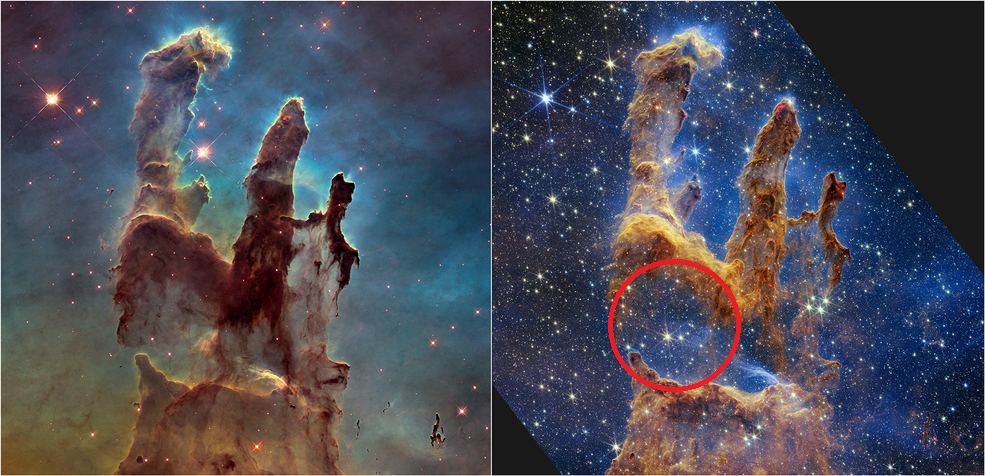
Another example involves one of Hubble’s most famous images: the Pillars of Creation, a star-forming region also known as the Eagle Nebula. Last week, NASA released JWST’s version of the same picture, sparking a fresh round of oohs and ahhs. Once again, Goodman answered the “Compared to What” question.

“If you look very carefully, you can see differences,” she said. “I actually find this visually striking, but as an astronomer, kind of annoying, OK? Because again, it doesn’t show you what’s important.”

Goodman pointed to an opening in the nebula’s clouds of dust that was much clearer in the JWST view.

Hubble’s view of the Pillars of Creation is at left, with the James Webb Space Telescope’s infrared view at right. A red circle has been added to the JWST image, indicating an opening in the Eagle Nebula’s clouds that is clearer in the infrared view and reveals the stars beyond. (Credit: NASA / ESA / CSA / STScI; Joseph DePasquale, Anton M. Koekemoer, Alyssa Pagan)

“The idea is that in the infrared … how important it is that you can see through the dust, the small solid particles and interstellar medium that are floating out there between the stars, that obscure our background view of so many things, including the early universe,” she said.

Visualizing in 3-D adds another dimension to our appreciation of astronomical imagery. A 3-D map of the region around our sun, based on data from the European Space Agency’s Gaia telescope, helped Goodman and her colleagues figure out that a wave of star formation is being driven by an expanding bubble of interstellar gas from supernova explosions.

“It was just us messing around with the data in three dimensions, and then later making a very detailed physical model of the motions of stars and the explosion of supernovae,” she said. “It looks like we had this all figured out, but the truth is, it was a lot of data exploration.”

Exploring computer-generated models in 3-D led not only to the “local bubble” discovery, but also to the discovery of the Radcliffe Wave, an undulating structure of dust and gas in our Milky Way galaxy.

Goodman said that computer simulations have become so useful that you could think of them as a third component of the discovery process, alongside theory and observations. She pointed to a research paper titled “AI-Assisted Super-Resolution Cosmological Simulations” as an example.

“There are several papers like this,” she said. “This is probably the most expanding field of cosmology at the moment.”

And perhaps the most exciting aspect of astronomical simulations is that they can be shared with the public. “It’s gotten to the point where if you’re careful about it, the same software that’s used to discover things can be made available to the public and can be published along with the results,” Goodman said.

Harvard astronomer holds up a Merge Cube that can be used to display 3-D data visualizations in augmented reality. (Photo by Alan Boyle)

To facilitate that sharing, Goodman is part of a team working on an open-source data visualization package called “glue.” Glue is being optimized for analysis of JWST data, and the team expects to make the Python-based package easier to use by incorporating it into a widely used interactive computing platform known as Jupyter (resulting in a hybrid nicknamed “glupyter”). Such tools could be used not only for visualizing astronomical data, but also for analyzing geospatial data, brain scans or genetic code.

Goodman demonstrated how a 3-D data visualization could be held in the palm of your hand, using a specially printed cube and an augmented-reality app. When you point your smartphone at the cube, you can see what appears to be a 3-D view of molecular clouds in our corner of the Milky Way. Twist around the cube, and the 3-D model twists around as well.

Will it someday be possible to juggle computer models of planetary systems, galaxies and the entire universe in augmented reality, fueled by JWST data? For astronomers, that “someday” is already here — and it’s coming soon for the rest of us.

Goodman’s Patrusky Lecture presentation, “The New Universe,” was part of this week’s ScienceWriters 2022 conference in Memphis, which was organized by the Council for the Advancement of Science Writing and the National Association of Science Writers and hosted by St. Jude Children’s Research Hospital. Alan Boyle is a volunteer member of CASW’s board. Check out this page on Harvard University’s website for additional resources, including presentation slides and links to Seamless Astronomy and Dimensions of Discovery.

The post How to See the Bigger Picture From NASA’s Webb Space Telescope appeared first on Universe Today.


Wednesday, October 26, 2022

Webb Can Detect Planets Orbiting White Dwarfs, And Maybe Even See Signs of Life

In a recent study accepted to the Monthly Notices of the Royal Astronomical Society, an international team of researchers led by Texas A&M University investigate how the James Webb Space Telescope (JWST) can detect a variety of exoplanets orbiting the nearest 15 white dwarfs to Earth using its Mid-Infrared Instrument (MIRI) Medium Resolution Spectrograph (MRS). This study holds the potential to expand our knowledge of exoplanets, their planetary compositions, and if they can support life.

A white dwarf is an incredibly dense star about the size of Earth that is the result of a Sun-like star exhausting all their nuclear fuel. Essentially, a white dwarf is what our Sun will become at the end of its lifetime billions of years from now. So, why are white dwarfs of particular interest for the search for life beyond Earth?

Mary Anne Limbach, who is a PhD Candidate in the Department of Physics & Astronomy at Texas A&M University and lead author of the study, explains how difficult it is to detect biosignatures on planets within the habitable zone (HZ) of Sun-like stars due to the Sun being 10 billion times brighter than the Earth. She says this means the JWST instruments would not be able to detect an Earth-analog exoplanet due to the starlight drowning out the light of the Earth-analog that is being imaged.

“On the other hand, white dwarfs, the remnants of dead stars, are much smaller than the Sun,” said Limbach. “In fact, the size (radius) of a white dwarf is about the same as Earth. In the infrared a white dwarf is only about 100 times brighter than an Earth analog. Also, most white dwarfs do not have star spots or flares, but rather remain at constant brightness over time. So, if we instead place a white dwarf and Earth-analog at 5 parsecs, we still cannot image Earth-analog, but we should detect the 1% of extra light we receive due to the presence of an Earth. This extra light is referred to as ‘infrared excess’ which is the method we propose in the paper to detect white dwarf exoplanets.” For context, one parsec is equivalent to 3.26 light-years.

Using this method, the researchers discovered JWST was capable of detecting the infrared excess of cold gas-giant exoplanets orbiting white dwarfs withing 15 parsecs from Earth, along with temperate or hot terrestrial exoplanets, which include both Earth- and Mercury-analogs, within 10 parsecs from Earth. The study also discusses how follow-up spectroscopy observations using MIRI can be utilized to search for biosignatures on terrestrial worlds within the habitable zones of white dwarfs. While these findings are extraordinary, can JWST be used to potentially observe biosignatures on planets around stars other than white dwarfs?

“Transit spectroscopy, which is a method for characterizing the atmospheres of exoplanets, is another method that has been proposed to search for biosignatures with JWST,” explains Limbach. “Other research papers have explored using this technique for white dwarfs and M-dwarf stars (which are less massive than the sun, but still fusing hydrogen). Using JWST transit spectroscopy, it would take hundreds of hours to detect biosignatures on the Trappist-1 planets, the most favorable M-dwarf for these observations. For comparison, to detect biosignatures on an earth-analog orbiting a white dwarf at 5 parsecs would take about 25 hours using our proposed infrared excess method. However, there’s one catch: we know about the Trappist-1 exoplanets, but we have not detected any terrestrial exoplanets around white dwarfs. Hence, our goal is to first identify these exoplanets using infrared excess so that they can be characterized.”

The Trappist-1 system is a star system located 12 parsecs (39 light-years) from Earth with at least seven Earth-sized planets in orbit around a star that is 12 times less massive than our own Sun, with a 2021 study indicating all seven planets share the same densities, indicating they might be rocky worlds. So, what does the future hold for trying to find life beyond Earth?

“NASA has plans to build a telescope capable of imaging habitable exoplanets around sun-like stars, but there are no planned upcoming infrared space observatories with sensitivities comparable to JWST,” said Limbach. “So, observations with the JWST/MIRI instrument may be our only chance to search for life around nearby white dwarfs.  If an abundance of life exists in this obscure location, we are likely to detect biosignatures on these worlds with JWST in the near future long before we have observatories capable of characterizing Earth-analogs orbiting sun-like stars.”

As always, keep doing science & keep looking up!

Featured Image: Artist’s rendition of a planet and comet orbiting a white dwarf. (Credit: NASA, ESA, and Z. Levy (STScI)

The post Webb Can Detect Planets Orbiting White Dwarfs, And Maybe Even See Signs of Life appeared first on Universe Today.


How Dangerous are Nearby Supernovae to Life on Earth?

Life and supernovae don’t mix.

From a distance, supernovae explosions are fascinating. A star more massive than our Sun runs out of hydrogen and becomes unstable. Eventually, it explodes and releases so much energy it can outshine its host galaxy for months.

But space is vast and largely empty, and supernovae are relatively rare. And most planets don’t support life, so most supernovae probably explode without affecting living things.

But a new study shows how one type of supernova has a more extended reach than thought. And it could have consequences for planets like ours.

Earth is no stranger to supernovae. One hasn’t been close enough to sterilize Earth, but there’s evidence showing supernovae have affected life on Earth.

A 2018 paper presented evidence of a supernova exploding near Earth about 2.6 million years ago. It was about 160 light-years away. The authors of that paper tied the supernova to the Pliocene marine megafauna extinction. In that event, up to a third of Earth’s large marine species were wiped out, but only in shallow coastal waters.

Another paper showed up to 20 supernovae in the last 11 million years in the Scorpius-Centaurus OB association. Some of these were as close as 130 light-years to Earth. The paper’s authors say that about 2 million years ago, one of the supernovae exploded close enough to our planet to damage the ozone layer.

But there are different types of supernovae. Some of them have a much longer reach and much greater duration. Scientists have long known about the powerful gamma rays that supernova release during the explosion. They also know about the cosmic rays that can arrive hundreds or thousands of years later. If this happens close enough to a planet like Earth, the cosmic rays can deplete the ozone layer and increase muon radiation at the surface.

An type IIn x-ray luminous supernova is different from other supernovae. When a supernova explodes, it emits gamma rays and other photons immediately. In an x-ray luminous supernova, gamma rays and photons are emitted, but some of the radiation from the explosion interacts with a dense circumstellar medium surrounding the progenitor star. This creates x-rays that can be lethal up to 160 light-years away.

In a scenario where an SN exploded close to Earth, it can take months or years following the initial explosion for the x-rays to arrive. Interactions with the circumstellar debris cause a delay. The x-rays can deplete Earth’s ozone layer, allowing harmful UV radiation from the Sun to reach the planet’s surface.

After the x-rays arrive, the cosmic rays arrive, similar to other SN. This is a double whammy for Earth’s ozone layer.

This figure from the study shows a timeline of radiation exposure for a planet close to a luminous x-ray supernova. Image Credit: Brunton et. al 2022.
This figure from the study shows a timeline of radiation exposure for a planet close to a luminous x-ray supernova. Image Credit: Brunton et al. 2022.

Researchers aren’t sure about the lethal distances of supernovae. There are many variables, both in the progenitor star and its environment. The progenitor star’s mass loss is especially important. But by characterizing the lethal x-ray dose for Earth’s stratosphere and the energy output of some of the brightest SN, the authors calculated the lethal distance for some well-known supernovae.

SN 1987A exploded in the Large Magellanic Cloud, and the light reached Earth in 1987. Scientists observed the explosion and confirmed the source of energy for the SN’s visible light for the first time. It proved that the long-duration glow after an SN explosion is radioactive.

SN1987A wasn’t very lethal, according to the authors. They say the SN was only deadly to a distance of less than one light-year. It was the least dangerous SN out of the 31 the team characterized.

The most lethal of the 31 was SN2006jd. It exploded in the galaxy NGC 4179, about 57 million light-years away, and the light reached Earth in 2006. According to the researchers, SN2006jd was lethal to almost 100 light-years.

The five most lethal SNs in this study are all Type IIn supernovae, as are seven of the top ten.

This figure shows the ten most lethal SN in the study. The top five are all Type IIn x-ray luminous supernovae, and so are seven of the top ten. Image Credit: Brunton et. al 2022.
This figure shows the ten most lethal SN in the study. The top five are all Type IIn x-ray luminous supernovae, and so are seven of the top ten. Image Credit: Brunton et al. 2022.

Type IIn supernovae also have the greatest range of influence. This shows that these SN could significantly influence Earth’s biosphere from greater distances.

This figure from the study shows the most powerful of the17 SN in the sample of 31 and their range of influence. The authors say their calculations are conservative, yet SN 2006jd still has a range of influence that spans from 30 parsecs to 60 parsecs (100 light-years to 200 light-years.) Image Credit: Brunton et. al 2022.
This figure from the study shows the most powerful of the17 SN in the sample of 31 and their range of influence. The authors say their calculations are conservative, yet SN 2006jd still has a range of influence that spans from 30 parsecs to 60 parsecs (100 light-years to 200 light-years.) Image Credit: Brunton et al. 2022.

This research has some implications for Earth.

Our Solar System is inside what’s known as the Local Bubble. It’s a cavity carved out of the ISM in the Milky Way’s Orion Arm. Multiple supernovae explosions created the bubble in the last 10 to 20 million years. Did those SN affect Earth?

Advances in x-ray astronomy will shed more light on the consequences for terrestrial planets, and the authors think there’s lots more to uncover. But their observations show that “… the interacting X-ray phase of an SN’s evolution can entail significant consequences for terrestrial planets. We limit any further speculation until further developments in X-ray astronomy are made; however, the evidence presented here certainly points to this process as capable of imposing lethal consequences for life at formidable distances.”

Scientists know that supernovae have had some effect on Earth. The presence of the radioactive isotope 60Fe has a half-life of 2.6 million years, yet researchers found undecayed 60Fe in ocean samples dating from 2 to 3 Myr ago. It should’ve decayed into nickel long ago. Supernovae can create 60Fe through nucleosynthesis when they explode.

But other things can create 60Fe. Asymptomatic giant branch stars can make it, too, so by itself, it’s not a smoking gun for a nearby supernova.

Researchers also found 53Mn in the same samples of ferromanganese crust that hold the 60Fe. It’s also a radioactive isotope that should’ve decayed by now. Unlike 60Fe, only supernovae can create 53Mn. Its presence is definite proof of nearby supernovae in the recent geological past.

Artist view of a supernova explosion. Some radioactive isotopes, like 53Mn, can only be synthesized in supernova explosions. Credit: NASA

It’s not the presence of these radioactive isotopes that poses a threat to life. It’s the radiation that must’ve struck Earth, and if the supernova that created the isotopes was close enough to spread them to Earth, then the radiation must’ve struck Earth, too.

Ionizing radiation from supernovae can alter Earth’s atmospheric chemistry from substantial distances. The initial burst of energy from an SN poses one threat, and so do the cosmic rays that arrive hundreds or thousands of years later and linger. But this research adds another threat: x-rays that arrive months or years after the initial outburst. “Therefore, a corollary of the formidable threat found here is that this alters the timeline by which we know an SN can influence a nearby planet, adding an additional phase of adverse effects.”

Exactly what effect did it have?

“Combining these findings with our threat assessment here, it is possible that one or more of these SNe were interacting, and thus inflicted a high dosage of X-ray radiation on Earth’s atmosphere. This would imply that SN X-ray emission has had a notable impact on Earth and potentially played a role in the evolution of life itself,” they write.

SN outbursts have almost certainly struck our planet. The exact consequences are difficult for scientists to untangle. But if the radiation weakened the ozone layer, allowing more UV radiation to reach the Earth’s surface, it would’ve caused mutations. It’s called UV mutagenesis, which may have driven molecular evolution and been critical in the origin of sex. In fact, mutation is evolution’s primary driver.

The fact that supernovae can lead to mutations is the backdrop for the authors’ concluding remarks.

“We thus conclude with the comment that further research into SN X-ray emission has value not just for stellar astrophysics but also for astrobiology, paleontology, and the Earth and planetary sciences as a whole.”

This image shows the Milky Way's habitable zone. Our understanding of the Galactic Habitable Zone has a long way to go before it's definitive, and this research into supernova lethality will probably change it. Credit: NASA/Caltech.
This image shows the Milky Way’s habitable zone. Our understanding of the Galactic Habitable Zone has a long way to go before it’s definitive, and this research into supernova lethality will probably change it. Credit: NASA/Caltech.

This research has implications for habitability throughout the galaxy, too. The Galactic Habitable Zone (GHZ) is a region in a galaxy where habitability is most likely. Since supernovae can be fatal for life if close enough, regions with many stars that can potentially explode as supernovae are less habitable. If this research is correct, then supernovae can be lethal at greater distances than thought and can be fatal in the period of a few months or years after the initial outburst due to the x-rays. That alters the shape and location of a galaxy’s GHZ.

The researchers urge more long-term study of supernovae for months and years after an outburst and plea for more advancements in x-ray observation to aid the study. “These observations and innovations will shed light on the physical nature of SN X-ray emission and will clarify the danger that these events pose for life in our galaxy and other star-forming regions,” they write.

More:

The post How Dangerous are Nearby Supernovae to Life on Earth? appeared first on Universe Today.


Clearing the Air on a Trip to Mars: the NASA Particle Partition Challenge!

In the coming decade, NASA and the China National Space Agency (CNSA) will send the first astronaut crews to Mars. Unlike missions to the International Space Station (ISS) or the Moon, crewed missions to Mars present several unique challenges because of the distance and transit times involved. For instance, it is only practical to send missions to Mars when our two planets are closest to each other in their orbits (known as “Opposition“), which occurs every 26 months. Even then, it can take up to nine months for spacecraft to reach Mars, creating all kinds of logistics headaches.

On top of that, there’s the need for life support systems that will maintain a breathable atmosphere inside the spacecraft. Like the system that allows astronauts to live aboard the ISS for extended periods, methods are needed to scrub waste carbon from the air and safely sequester it. HeroX, the world’s leading platform for crowdsourced solutions, has launched the NASA Particle Partition Challenge. With a total prize purse of f $45,000, this competition is looking for innovative ideas on how to ensure that astronauts can breathe comfortably on the way to Mars!

NASA is looking for a next-generation life support system to keep crews healthy on their mission to Mars. Credit: NASA

Astronauts living aboard the ISS rely on a complex life support system that routinely scrubs the air for carbon dioxide waste produced by exhalation. From 2011 to 2017, this system included a Sabatier reactor that uses heat and hydrogen gas to convert carbon dioxide into methane (CH4) and water. The methane can be used for more chemical reactions or as a fuel source. The water, another crucial resource for space exploration, can be used on its own or electrolyzed to create oxygen gas and hydrogen (which can be processed with carbon to create more methane).

For years, NASA has been working on the next-generation life support system to support crewed missions to Mars and other locations beyond the Earth-Moon system. This system will rely on a Bosch reactor, which relies on electrolysis and hydrogen gas to convert carbon dioxide into oxygen gas, with solid carbon (graphite) and water created as byproducts. Once again, the resulting water is extremely valuable as a resource, but the graphite particulates create a problem. These must be removed regularly for the reactor to keep operating and are hazardous if not removed correctly.

This represents a major challenge since Bosch reactors produce large amounts of graphite on a daily basis. According to NASA’s estimates, a crew of four astronauts will produce roughly 1 kg (2.2 lbs) of carbon particulates a day. In addition, the particulates are very fine, rating in size from 1 to 500 microns (averaging 8.36 microns). Therefore, the removal methods must be very efficient and precise so that carbon particulates don’t escape back into the spacecraft’s internal atmosphere and slowly pollute the air supply.

To this end, the Challenge is looking for innovative ways to safely and efficiently remove fine particulate carbon from a continuously-running Bosch reactor without impacting its performance. The winning designs will have the chance to become part of the life support systems used by astronauts as they make the long journey to Mars. It will also aid in the development of future extraterrestrial habitats that will enable long-duration missions on the surface of the Moon and Mars. In short, the technology this Challenge inspires will become essential to future missions to deep space, where opportunities for resupply are few and far between, and sustainability and self-sufficiency are vital.

Artist’s concept of a bimodal nuclear rocket making the journey to the Moon, Mars, and other destinations in the Solar System. Credit: NASA

“This problem has been brought to the right people,” said HeroX CEO Kal K. Sahota. “The HeroX community is ready to help again, this time breathing life into the length of planetary missions.”

To encourage the next generation of innovators and potential astronauts, there will also be a Junior challenge running concurrently for competitors under 18 years of age. This Challenge will ask competitors to develop ideas for how habitats far from Earth can maintain a breathable atmosphere for their inhabitants. The Challenge kicked off at 09:00 AM EDT (06:00 AM PDT) today (Wednesday, October 26th) and will remain open to submissions until January 12th, 2023.

The judging panel will finish evaluating submissions in early March, followed by the announcement of the three winning entries on March 16th. The competition is open to anyone 18 years of age or older, participating as an individual or a team from anywhere in the world, as long as U.S. federal sanctions do not prohibit participation (some restrictions apply).

Winners of this single-phase competition will share a total prize purse of $45,000, while the top three participants in the Junior category will each receive public recognition and NASA swag. For more information on the Challenge and eligibility, head over to the HeroX competition page.

Further Reading: HeroX

The post Clearing the Air on a Trip to Mars: the NASA Particle Partition Challenge! appeared first on Universe Today.


The Smallest, Lightest Neutron Star Ever Seen Could be a “Strange Star”

The life of every star is a fight against gravity. Stars are so massive they risk collapsing under their own weight, but this is balanced by the heat and pressure a star generates through nuclear fusion. Eventually, that comes to an end. The outer layers of a star will be cast off, and the remaining core will become a stellar remnant. Which kind of remnant depends on the mass of the core.

If the core is less than 1.4 solar masses, then it will collapse until the pressure of electrons balances its weight, thus becoming a white dwarf. If the core is more massive than that, up to perhaps 3 solar masses, it collapses until neutron pressure resists, creating a neutron star. Beyond that, the core will collapse into a stellar-mass black hole.

At least that seems to be the case. The most massive white dwarf we’ve found is about 1.35 solar masses, and the smallest black hole we’ve observed is about 2.6 solar masses. The most massive confirmed neutron star is about 2.14 solar masses. Of course, the cut-off ranges aren’t absolute. A stellar core might be a bit under 1.4 solar masses but experiences an explosive collapse that pushes it to become a neutron star. Neutron stars of 1.2 or 1.3 solar masses would be unusual, but not impossible. But recent observations of the neutron star HESS J1731-347 seem to give it a mass of 0.77 solar masses, which shouldn’t be possible.

Neutron stars are notoriously difficult to mass. They are only about 20 kilometers in diameter and can be seen by the x-rays they give off. To calculate the mass you generally either need the neutron star to be a companion of a star, so that you can determine mass by orbital dynamics, or it needs to be a pulsar so that you can use radio observations to get a mass estimate. HESS J1731-347 is neither of these, but it does have a remnant nebula surrounding it. That remnant is illuminated by a nearby regular star, which we do know the distance of. The regular star was mapped by the Gaia spacecraft, so we know its distance really well. From that data, the team looked at the reflected light of the nebula to determine the distance of HESS J1731-347. It’s about 8,000 light-years away, which is closer than we thought.

Knowing the distance, the team then looked at x-ray observations of the neutron star. Given their luminosity, the calculated mass comes out to be 0.6 – 0.9 solar masses, which is far below the white dwarf mass limit. If this mass is accurate, our understanding of neutron stars is off. One possibility is that we don’t understand how neutron stars form. The authors propose another possibility, which is that it could be a type of quark star known as a strange star.

The difference between a neutron star and a quark star. Credit: CXC/M. Weiss

The standard view of neutron stars is that they are mostly neutrons. Some theorists argue that within the core the boundary of neutrons might break down, creating a soup of up and down quarks, thus a quark star. A strange star would be one where colliding quarks in the core create strange quarks, so that the neutron star has a core of up, down, and strange quarks. All of this is hypothetical, but since strange quarks are twenty times more massive than up and down quarks, a strange star would have a much greater density than a normal neutron star. Thus, it could hold itself together even with a mass much smaller than the Sun.

The third option is, of course, that the mass result is wrong. This is only one result, and several factors could make the neutron star appear dimmer than it actually is, thus skewing the mass result. It’s an interesting result, but not conclusive. Even the authors acknowledge that more observations are needed to confirm the result. It is indeed a strange sight, but it might not be a strange star.

Reference: Doroshenko, Victor, et al. “A strangely light neutron star within a supernova remnant.” Nature Astronomy (2022): 1-8.

The post The Smallest, Lightest Neutron Star Ever Seen Could be a “Strange Star” appeared first on Universe Today.