Friday, August 15, 2025

New Theory Points to the Universe's Greatest Fireworks Show

An artist's conception of a supermassive black hole surrounded by an accretion disk and emitting a relativistic jet (Credit : ESO)

What if the universe began with a fireworks show? A new theory suggests that supermassive black holes, the mysterious giants found at the heart of galaxies, were born from the universe's very first stars in a spectacular flash of light that ionised all of space before vanishing forever. This dramatic "Pop III.1" model could finally explain how these giant stellar remnants grew so impossibly large so quickly after the Big Bang, while potentially solving several major puzzles plaguing modern astronomy, from the Hubble Tension to the nature of Cosmic Dawn itself.

Thursday, August 14, 2025

Moonquakes Will Pose Risks To Long-term Lunar Base Structures

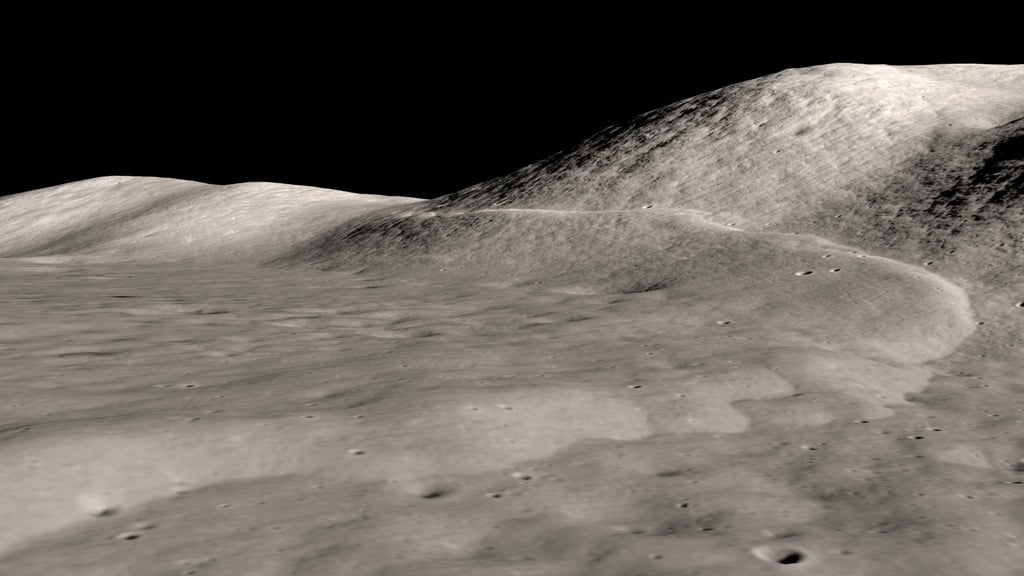
A scene from a visualization of the Lee-Lincoln scarp in Taurus-Littrow on the Moon. This scarp is evidence of moonquakes that sent rocks and landslides across the surface. Seismometers left on the Moon by Apollo astronauts recorded hundreds of events between 1969 and 1977, including 28 shallow moonquakes. The study narrowed the locations of these quakes and found that many of them occurred near scarps, implying that the forces creating the scarps also caused the quakes, and they continue to shape the lunar surface. The Lee-Lincoln scarp was only about 13 kilometers from one of the epicenters identified by the scientists. Credit: NASA's Scientific Visualization Studio

Our Moon is a seismically active world and its long history of quakes could affect the safety of permanent base structures there. That's one conclusion from a study of quakes along the Lee-Lincoln fault in the Taurus-Littrow valley where the Apollo 17 astronauts landed in 1972. “The global distribution of young thrust faults like the Lee-Lincoln fault, their potential to be still active and the potential to form new thrust faults from ongoing contraction should be considered when planning the location and assessing stability of permanent outposts on the Moon,” said Smithsonian senior scientist emeritus Thomas R. Watters, lead author of the paper.


Researchers Simulate What a Black Hole "Shadow" Look Like

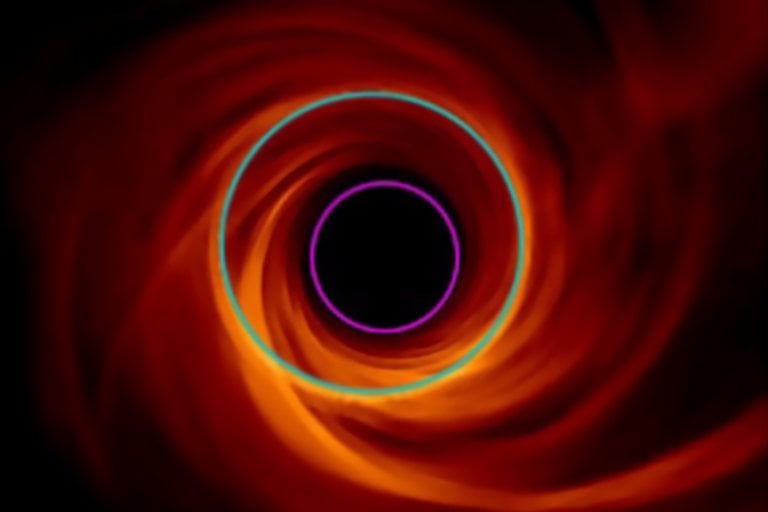
Snapshot image from radiative simulations of M87 black hole. Credit: DOI: 10.1093/mnras/staf200

Supercomputer simulations are helping scientists sharpen their understanding of the environment beyond a black hole’s "shadow," material just outside its event horizon.


The JWST Shows Us That TRAPPIST-1d Is Not As Earth-Like As We Hoped

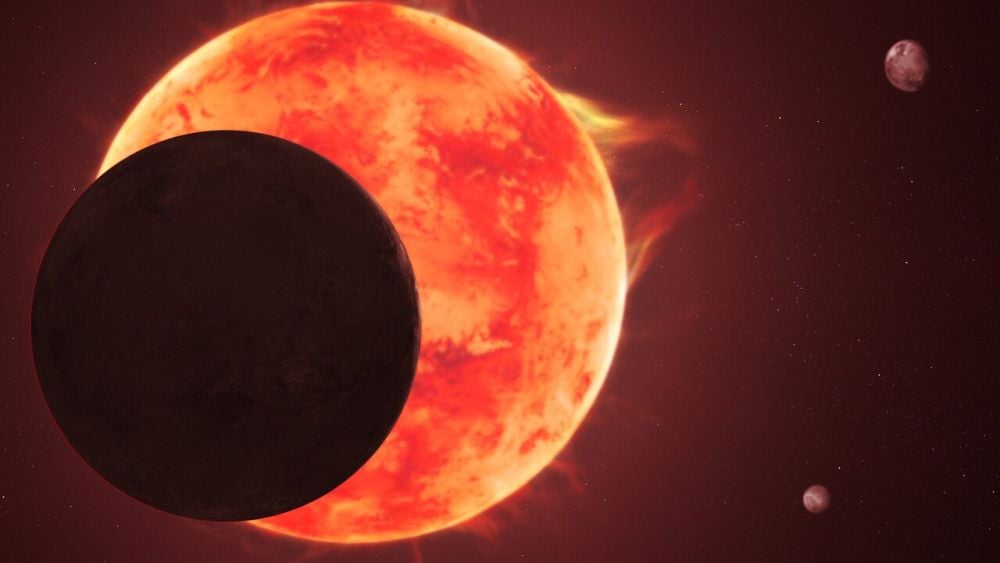
This artist’s concept depicts planet TRAPPIST-1 d passing in front of its turbulent star, with other members of the closely packed system shown in the background. Image Credit: NASA, ESA, CSA, J. Olmsted (STScI)

The exoplanet TRAPPIST-1 d intrigues astronomers looking for possibly habitable worlds beyond our Solar System because it is similar in size to Earth, rocky, and resides in an area around its star where liquid water on its surface is theoretically possible. But according to a new study using data from the NASA/ESA/CSA James Webb Space Telescope, it does not have an Earth-like atmosphere.


Mystery of the "Little Red Dots" May Finally Be Solved

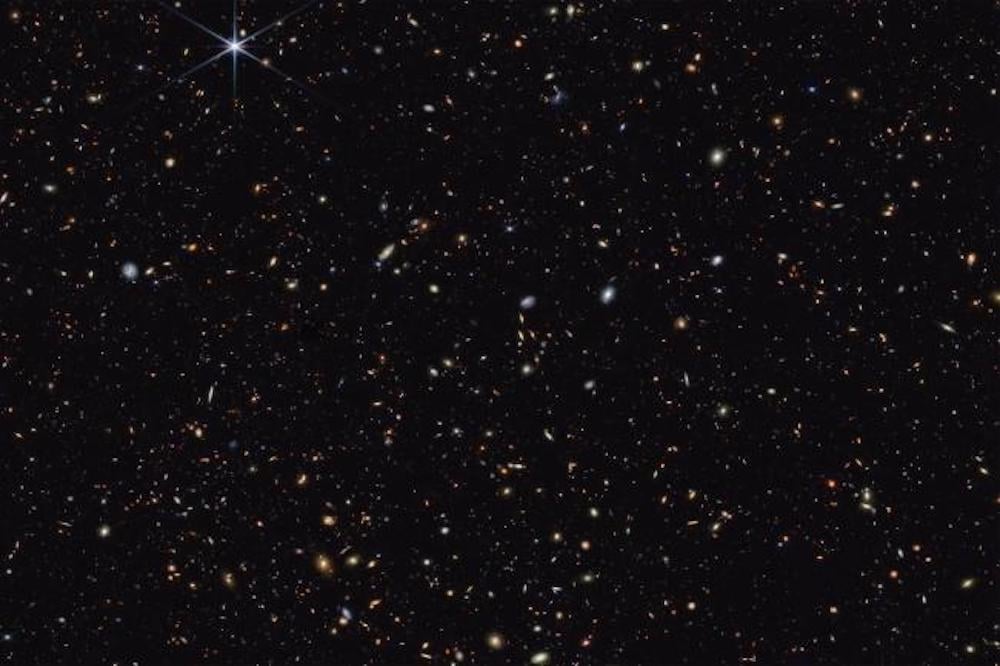
Distant galaxies appear scattered across the night sky in this deep field image from the James Webb Space Telescope. The most distant galaxies appear as small, reddish dots, or the mysterious Little Red Dots (Credit : NASA, ESA, CSA, STScI, Brant Robertson (UC Santa Cruz), Ben Johnson (CfA), Sandro Tacchella (Cambridge), Marcia Rieke (University of Arizona), Daniel Eisenstein (CfA))

Deep in the darkness, tiny red specks of light have been driving astronomers to distraction. These mysterious "little red dots" discovered by the James Webb Space Telescope shouldn't exist, they’re impossibly compact yet blazingly bright, defying our understanding of how galaxies form. Now, Harvard researchers believe they've solved this billion year old puzzle with a theory involving the universe's rarest structures; dark matter halos.


A Simple Instrument Could Find Martian DNA - If It Exists

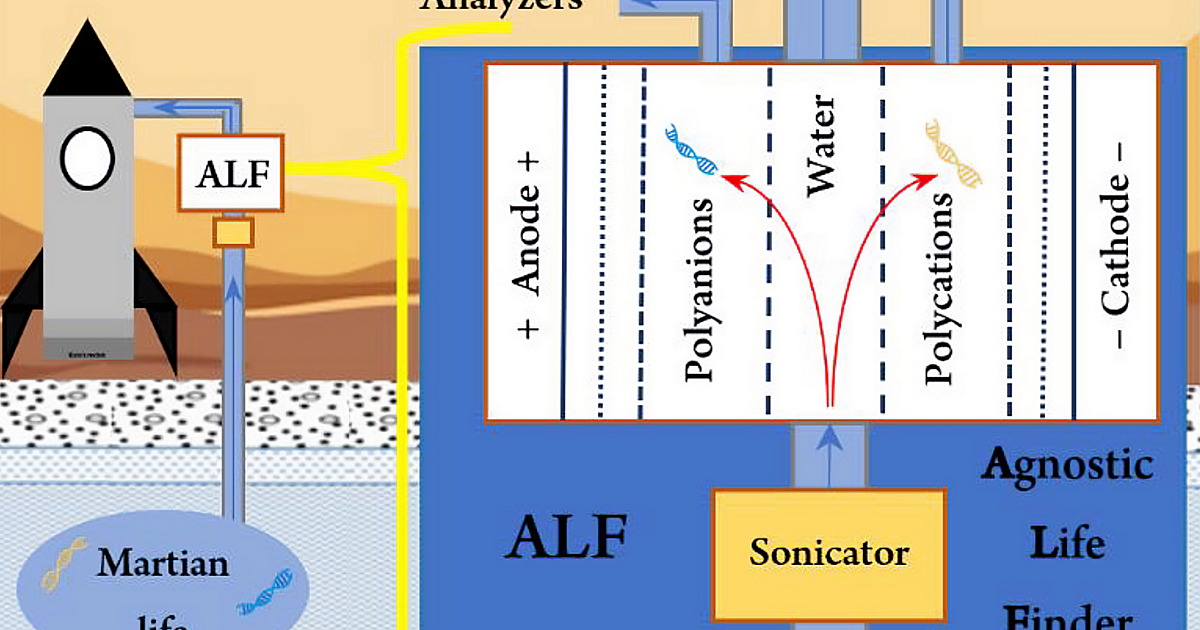
Graphic showing the functionality of the ALF. Credit - NASA / ALFA / Steven Benner

Mars still holds the promise of being one of the first places in the solar system humanity will colonize. However, if there was evolutionarily distinct, extant life on the planet, it might sway the heart of even the most ardent Mars colonization fans. So astrobiologists are in a race against time to try to determine whether or not such life exists, before the entire planet becomes an analogue of the Earth’s biosphere, if only unintentionally, and only a shadow of the ones that exists here. A new paper from the Christopher Temby and Jan Spacek of the Agnostic Life Finder (ALF) team discusses one of the most promising ways to prove definitively that life exists on the Red Planet - finding polyelectrolyte polymers - in other words, DNA.


Wednesday, August 13, 2025

The Vibrational Lives of Black Holes

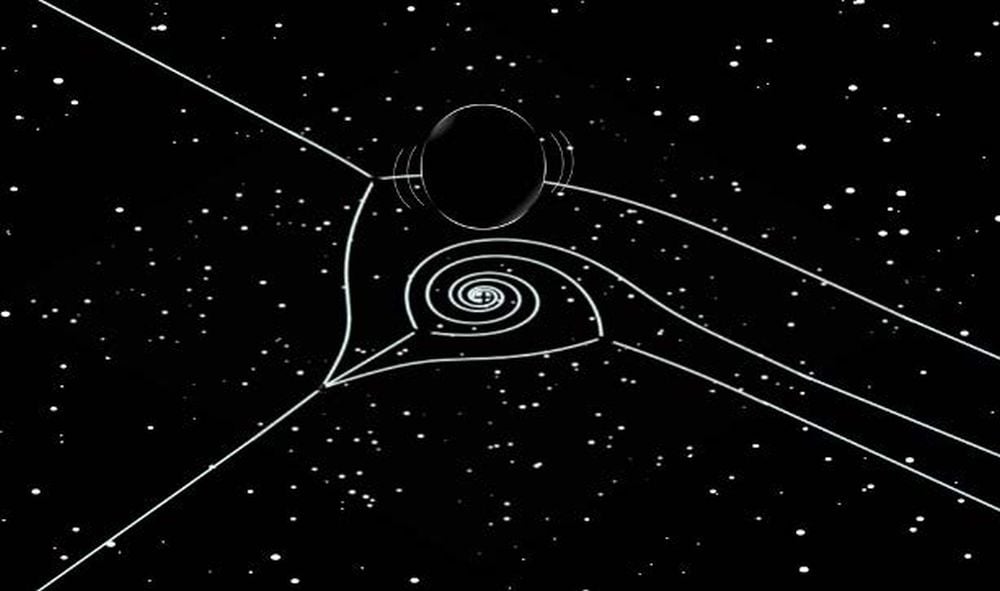
This image shows a black hole and Stokes curves, which are used to understand the complex vibes coming for perturbed black holes. Image Credit: Kyoto University / Taiga Miyachi

When black holes are disrupted by things like infalling matter or gravitational waves, they vibrate like a bell struck with a clapper. The vibrations decay over time as the black hole returns to an equilibrium state. Astrophysicists can measure these vibrations to learn more about the black hole.