Saturday, November 5, 2022

Worrying Solar Storm Data, Falcon Heavy is Back, Total Lunar Eclipse

Historical data about solar storms carved in trees, and it’s a bit worrying. Falcon Heavy’s back after 40 months of absence. There’s a meteor shower and a total lunar eclipse in the coming days. And JWST gave us yet another version of Pillars of Creation.

As always, if you prefer to have the latest space and astronomy news being videoed at you, enjoy this week’s episode of Space Bites.

More Pillars of Creation by Webb

Another phenomenal image from JWST. This time we’re looking at the Pillars of Creation (again), but with the Mid-Infrared Instrument (MIRI). MIRI is sensitive to the giant clouds of gas and dust surrounding the newly forming stars in the region. In this view, you can see the faint background clouds in red, which are invisible in other wavelengths. The blue-looking stars have already cleared their surroundings of gas and dust. The densest dust regions show up as the darkest shades of grey—anyway, time to swap out your phone’s background for this one.

More about MIRI’s Pillars of Creation.

Meteor Shower and Total Lunar Eclipse

Keep your eyes on the sky next week; you might see a few fireballs as part of the annual Taurid meteor shower. Typically this meteor shower is disappointing, giving us about five meteors/hour at the peak. This year will be even worse because the shower coincides with the November 8th full moon. However, the Earth will pass through a cloud of debris, and there could be a rise in meteor activity and especially fireballs. So head outside next week, look up, and you might see a fireball.

On Tuesday, November 8th, Eastern Asia and Western North America will be treated to a total lunar eclipse. This is when the Earth’s shadow falls onto the Moon, obscuring it and turning it into a deep shade of red. The entire eclipse will last for 5 hours and 54 minutes, with the Moon passing through the dark inner region of the shadow for 1 hour and 24 minutes. Unfortunately, this will be the last total lunar eclipse until March 14th, 2025. Read our complete guide.

More about Taurids and the Total Lunar Eclipse.

Star Storms in Tree Rings

If you look at tree rings, they can not only show the age of the tree, but also record astronomical events. Solar storms are one of them. This way scientists could see records of previous powerful solar storms that happened hundreds of years ago. But the worrying thing is that the Carrington Event is not among them. So, does it mean that solar storms of the past were much more devastating?

More about solar storm records.

Heavy Elements from Neutron Stars Merger

In 2017 astronomers detected the first kilonova collision of two neutron stars, and their impact was seen in both gravitational waves and electromagnetic radiation. Astronomers also witnessed a vast cloud of gold generated by the colliding neutron stars. Researchers simulated the merger on a supercomputer and predicted that other heavy elements, like strontium, lanthanum, and cerium, should be visible in the wreckage. Then they imaged the region with powerful telescopes and found the elements as predicted.

More about kilonova aftermath.

InSight Felt a Meteor Strike on Mars

In December 2021, NASA’s Mars InSight detected a magnitude 4 Marsquake. Unlike the hundreds of other tremblers felt so far, this one resulted from a house-sized meteorite crashing into Mars. The impact site was found using NASA’s Mars Reconnaissance Orbiter, which measured about 150-meters across and 21 meters deep. Martian regolith was scooped out of the crater and scattered 37 kilometers away. Because it’s freshly excavated, this could be a fascinating place to send a sample return mission.

More about InSight’s discovery.

Falcon Heavy Is Back

It’s been 40 months since SpaceX’s Falcon Heavy rocket last blasted off. On November 2, we watched the mighty rocket carry a classified payload for US Space Force. The twin side boosters returned to the launch site through the thick fog, but the central core wasn’t reused because it was helping to loft the cargo into a geostationary transfer orbit. This was SpaceX’s 50th launch in 2022, meeting a pace of one rocket launch every 6.1 days.

More about Falcon Heavy launch.

Don’t Miss Out On Space News

If you want to get a curated selection of the most important space and astronomy news every week, subscribe to our Weekly Email Newsletter and get magazine-size ad-free news directly from Fraser Cain.

If you prefer the news to be videoed at you, check out our Space Bites playlist on our YouTube channel.

The post Worrying Solar Storm Data, Falcon Heavy is Back, Total Lunar Eclipse appeared first on Universe Today.



It’s Tough to Find Evidence of Stars Eating Planets

Tragically sometimes stars engulf their own planets. While most stars are able to quickly cover up the evidence for their crime, a new study by astronomers has revealed that in some cases the evidence can linger for up to two billion years.

There are a variety of ways in which a planet can end up getting inside of a star. The most common cause happens during the early days of the formation of a solar system. When planets first start forming, they start out as planetesimals. A typical solar system like our own will have dozens of planetesimals. These will collide off of each other and gravitationally interact with each other. Sometimes these collisions lead to mergers, and sometimes the interactions lead to one or more objects getting ejected from the system altogether. But perhaps most tragically, sometimes these interactions lead to a planet or two wandering too close to its parent star.

When this happens the planet will get torn apart by the gravitational tidal forces of the star. But even if for some reason it is able to remain intact through this passage, then it won’t last long. A typical Earth-sized planet will last only a few hours in the extreme temperature and pressure conditions inside of a star.

With the planet gone the only evidence astronomers have is a slight elevation in the proportion of heavy elements on the star’s surface. But once those elements sink too far below the surface, which they do because planetary elements are typically heavier than the hydrogen and helium inside star, then we can no longer detect it.

Astronomers have long debated how long this process can take. To help answer the question a team of astronomers surveyed a series of binary star systems. They targeted binary star systems because it’s very difficult to tell if a solitary star engulfed its planets or simply was born with a higher proportion of heavier elements. But with binary stars, if one of the stars has a much higher abundance of heavy elements, then that’s a sign that planet engulfment has occurred.

While astronomers have identified several binary systems like this, this was the first survey to specifically target systems with known planets in orbit around them. With this constraint the team behind the study found only a single system that had one of a binary pair of stars with an enrichment of heavy metals. However, those stars orbited each other greater than 30,000 AU away, and so it’s possible that the metal enrichment of one of the stars was just due to random chance, and not evidence of engulfment.

Based on this, the astronomers estimate that most stars are able to bury the evidence of planet-killing in less than 90 million years. But for larger and longer-lived stars, specifically ones 10 to 20% more massive than the Sun, they can hang on to the evidence for up to 2 billion years. 

Either way, the evidence for planet engulfment does not last long. And we are unlikely to see the remnants of these kinds of crimes in systems older than one or two billion years. So it seems that when it comes to planet killing, there is a cosmic statute of limitations.

The post It’s Tough to Find Evidence of Stars Eating Planets appeared first on Universe Today.


A Black Hole's Jets are Coming From a Region 2,000 km Away From the Singularity Itself

In 1961 astronomers discovered a powerful x-ray source coming from the constellation Cygnus. Not knowing what it was, they named the source Cygnus X-1. It’s one of the strongest x-ray sources in the sky, and we now know it is powered by a stellar-mass black hole. Since it is only about 7,000 light-years away, it also gives astronomers an excellent view of how stellar-mass black holes behave. Even after six decades of study, it continues to teach us a few things, as a recent study in Science shows.

Cygnus X-1 is actually a binary system. The black hole itself is a 21 solar-mass stellar remnant, and it orbits a 41 solar-mass companion star. It’s a powerful x-ray source because material from the star is captured into an accretion disk of the black hole, which superheats the material and generates jets of plasma that flow away from the black hole. This is a common situation for black holes, but astronomers still don’t understand all the details of how this type of structure evolves.

For this study, the team used data from the Imaging X-Ray Polarimetry Explorer (IXPE), which can capture not just x-rays but also their polarization. When they combined this data with other observations of Cygnus X-1, they found the x-rays are emitted not from the regions along the jets, but from a 2,000 km region perpendicular to the jets. In other words, the accretion disk itself is the primary x-ray source. This supports the model where the innermost region of the accretion disk is what powers a black hole’s jets.

This X-ray image of Cygnus X-1 was taken by a balloon-borne telescope, the High Energy Replicated Optics (HERO) project. NASA image.

The team also found that the orientation of the accretion disk is tilted significantly relative to the orbital plane of the binary system. It would be unusual for members of a stellar binary system to have such differing rotational axes, so it is likely that the shift occurred during the cataclysmic explosion that formed the black hole.

Knowing that the x-ray source is relatively close to the black hole, astronomers can further study their dynamics to better understand how black holes affect the warping of space and time, which could lead to more stringent tests of general relativity.

Reference: Krawczynski, Henric, et al. “Polarized x-rays constrain the disk-jet geometry in the black hole x-ray binary Cygnus X-1” Science (2022): 5399.

The post A Black Hole's Jets are Coming From a Region 2,000 km Away From the Singularity Itself appeared first on Universe Today.


Friday, November 4, 2022

Can Plants be Adapted to Thrive in Space?

Humans in space have to eat. In the early days of space exploration, they got to eat paste and drink Tang (or so the legends tell us). That’s hardly a great long-term diet. Plants should be in there, too. And, astronauts aboard the ISS have been growing gardens in space for years.

So, what else do we need to know about farming in space? Well, as it turns out, quite a bit. That’s why NASA is sending up a plant habitat to the ISS. It’s part of a program called Epigenetic Adaptation to the Spaceflight Environment—Accumulated Genomic Change Induced by Generations in Space (Plant Habitat-03). The idea is to follow successive generations of plants as they germinate, grow, live, and die in a microgravity environment. This experiment will fly to the ISS on the Northrup Grumman Commercial Resupply Services Mission 18, tentatively set for November 6th, 2022.

Growing up Green in Low Gravity

While low gravity might seem like a pretty relaxing place to live and work, for plants, it’s actually stressful. Like humans, plants evolved in Earth’s gravity and in ground-based environments. Exposure to the stress of spaceflight shows that things like an arabidopsis plant (previously grown on the station) actually change their genetics. It’s not a mutation like we see in SF movies. It’s more like the plant adds a little extra something to its DNA to affect gene expression. That’s the process where a gene is stimulated or turned on in a cell to make RNA and other proteins. Living in space changes that a little bit, but figuring out that process and how extensive it is takes time and multiple experiments. That’s where Plant Habitat-03 comes in.

“Plant Habitat-03 will provide a better understanding of how the epigenome contributes to an organism’s ability to adapt to environmental stress, in both current and subsequent generations,” said Sharmila Bhattacharya, space biology program scientist in NASA’s Biological and Physical Sciences Division at NASA Headquarters in Washington. “This is an important insight into how astronauts could potentially grow repeated generations of crops in orbit as well as on the Moon or Mars to provide food and other services aboard future space missions. The results can also support the development of strategies for adapting crops for growth in extreme environments on Earth.”

Plants Adapting in Space

Plants evolve all the time. We see it on Earth, where farmers and researchers genetically modify them. In nature, the same processes take thousands of years. Plant Habitat-3 will put them in microgravity and then watch them adapt to life in space. What epigenetic changes (that is, changes in gene expression) will occur? Will they be transmitted to subsequent generations? Or, will each set have to “re-learn” all over again in new generations? Those are the questions the research team wants to answer. So, what’s the experimental process?

As part of the project, the experiment will grow seeds in a special unit aboard the ISS. Once the plants reach maturity, astronauts will pick them and return the harvested plants back to Earth. Their seeds will return to space, along with new seeds on their first “mission” to the ISS. Ultimately, the idea is to find out just how much the plant epigenetics change from spaceflight-affected specimens and compare them to new generations of plants flown in space.

plants in space
Arabidopsis plants imaged in white light (left) and Green Fluorescent Protein (GFP) excitation illumination, right. The arabidopsis are also part of the Plant Habitat-03 experiment. Image provided by Anna-Lisa Paul, Ph.D. and Robert Ferl, Ph.D., Department of Horticultural Sciences, University of Florida.

Plant Habitat-03 is one of many projects that study how living things respond to living in space. Previous ISS studies have looked at growing plants in space, for example, by studying how best to provide water and aeration to microgravity gardens. Human studies are, of course, well known. However, if we’re going to put people into space for long periods of time, understanding their space-borne food sources is important, too. Clearly, as NASA prepares for future human exploration, including the ambitious Artemis missions, having a good understanding of the food those people will need is a huge part of the effort.

Studies in Space Benefit Earth

In addition to the space-based applications of the Plant Habitat-03 flight, there are Earth-based benefits. For one thing, our planet has regions that are undergoing stresses from climate change. Finding out how stress affects genetic expression in food crops could help farmers on Earth to adapt crops as conditions change across the continents.

Surviving Space: Extreme Plant Adaptation
Epigenetic Adaptation to the Spaceflight Environment – Accumulated Genomic Change Induced by Generations in Space (Plant Habitat-03)

The post Can Plants be Adapted to Thrive in Space? appeared first on Universe Today.


IceCube Senses Neutrinos Streaming From an Active Galaxy 47 Million Light-Years Away

Researchers using the IceCube Neutrino Observatory have detected neutrinos emanating from the energetic core of an active galaxy millions of light-years away. Neutrinos are difficult to detect, and finding them originating from the galaxy is a significant development. What does the discovery mean?

Neutrinos are strange particles. For a long time, scientists thought these elementary particles had no mass. Now they know that neutrinos do have mass, but so little of it that the particles pass right through us and other matter. Neutrinos also have no electrical charge, a property that gives them their name and allows them to pass through electromagnetic fields.

“The unveiling of the obscured universe has just started, and neutrinos are set to lead a new era of discovery in astronomy.”

Elisa Resconi, professor of physics at Technical University of Munich.

Detecting something with almost no mass and no charge is difficult, so detectors are built in strange places, like deep in abandoned mines. Only in those isolated environments can scientists detect the rare neutrino that interacts with other matter as it passes through Earth.

The IceCube Neutrino Observatory (ICNO) is a unique facility buried deep in Antarctic ice. The ICNO is made up of strings of detectors sunk into the Antarctic ice. There are 86 strings of sensors, with each string having 60 modules. The strings are sunk between 1,450 and 2,450 meters into the ice in holes bored with hot water. The dense ice slows light below the speed of light <sort of> while the neutrino maintains its velocity. This only happens when the neutrinos are highly energetic. In those conditions, they emit Cherenkov radiation, which ICNO detects.

The IceCube Neutrino Observatory is an array of strings of detectors drilled deep into the Antarctic ice. Image Credit: University of Adelaide.

Scientists working with the ICNO have detected neutrinos emanating from the energetic core of an active galaxy millions of light-years away. Why is this important? Because almost all of the neutrinos ever detected come from the Sun.

The galaxy is M77, also known as NGC 1068. It’s a spiral galaxy about 47 million light-years away in the constellation Cetus. It’s sometimes called the Squid Galaxy.

A new paper published in the journal Science presented the findings. The paper is “Evidence for neutrino emission from the nearby active galaxy NGC 1068.” The IceCube Collaboration, an international group of more than 350 people from 14 countries, produced the paper.

Neutrinos are important for a host of reasons in particle physics. But their critical characteristic is that they rarely interact with other matter. So when we detect one on Earth, it’s largely unchanged by interactions with matter and electromagnetic fields, even when its source is hundreds of light-years away or further.

Detecting neutrinos from sources other than the Sun is challenging. But studying them can potentially answer some of our key questions about the Universe, especially if we detect multiple neutrinos from the same source.

One of the strings of detectors is being lowered into its hole at the IceCube Neutrino Observatory in Antarctica. Image Credit: WISC/IceCube Collaboration.
One of the strings of detectors being lowered into its hole at the IceCube Neutrino Observatory in Antarctica. Image Credit: WISC/IceCube Collaboration.

“One neutrino can single out a source. But only an observation with multiple neutrinos will reveal the obscured core of the most energetic cosmic objects,” says Francis Halzen, a professor of physics at the University of Wisconsin–Madison and principal investigator of IceCube. “IceCube has accumulated some 80 neutrinos of teraelectronvolt energy from NGC 1068, which are not yet enough to answer all our questions, but they definitely are the next big step towards the realization of neutrino astronomy.”

Neutrino astronomy is a different way of studying astronomical objects. Typically, we observe objects with electromagnetic radiation: everything from radio waves to gamma rays. Those are all photons of different energies, but photons interact with matter and energy on their way from distant sources to our telescopes. Those interactions can be helpful because they teach us a lot about the source of the photons and whatever lies between our detectors and the source.

When a neutrino interacts with molecules in the clear Antarctic ice, it produces secondary particles that leave a trace of blue light as they travel through the IceCube detector. Image Credit: Nicolle R. Fuller, IceCube/NSF

But neutrinos rarely interact, so they allow astrophysicists to observe things electromagnetic telescopes can’t observe, like the interior of the Sun. Or, in this case, an active galaxy.

NGC 1068 is similar to the Milky Way. It’s a barred spiral galaxy, and also like the Milky Way, it has a supermassive black hole (SMBH) at the center. When SMBHs actively take in gas and dust, they emit energy jets and are called Active Galactic Nuclei (AGN.) From our viewpoint, NGC 1068’s central region is obscured by a torus of dust.

The environment around an AGN is complex. Neutrino astronomy is one way to study this complex object.

“Recent models of the black hole environments in these objects suggest that gas, dust, and radiation should block the gamma rays that would otherwise accompany the neutrinos,” says Hans Niederhausen, a postdoctoral associate at Michigan State University and one of the main analyzers of the paper. “This neutrino detection from the core of NGC 1068 will improve our understanding of the environments around supermassive black holes.”

“As we observe neutrinos emitted by <NGC 1968>, we will be able to learn more about the extreme particle acceleration and production processes occurring inside the galaxy, which hasn’t been possible up to now as other high energy emissions can’t escape from it,” said Associate Professor Gary Hill, from the University of Adelaide’s Department of Physics, School of Physical Sciences and member of the international IceCube Collaboration.

Astrophysicists and astronomers are very familiar with NGC 1068. It’s one of our most well-studied galaxies and can be seen with backyard telescopes. (A search in Google Scholar produces over 14,000 results for NGC 1068.) This familiarity helps scientists understand new developments like this neutrino detection.

“It is already a very well-studied object for astronomers, and neutrinos will allow us to see this galaxy in a totally different way. A new view will certainly bring new insights,” said Theo Glauch, a postdoctoral associate at the Technical University of Munich and another of the paper’s main analyzers. According to Glauch, NGC 1068 could become a “standard candle” in neutrino astronomy. In astronomical terms, a standard candle is an object with a known luminosity, meaning its distance can be accurately determined.

Neutrino astronomy is poised to take a step forward in the near future. There are plans for an expanded IceCube Neutrino Observatory, dubbed IceCube-Gen2. It’s a next-generation extension of the original IceCube Observatory. The design will add optical and radio instruments to the original system, making it a multi-messenger observation facility. The new instrument will increase the neutrino detection rate by an order of magnitude while also being five times more sensitive to neutrino point sources.

“IceCube-Gen2 will build upon two discoveries by IceCube,” says Albrecht Karle, an IceCube-Gen2 coordinator based at the University of Wisconsin–Madison. “One is the presence of a large cosmic neutrino flux at high energies; the other is the exceptional clarity of the ice. By optimizing the design, we can scale the detector up by one order of magnitude with very similar instrumentation.”

“The unveiling of the obscured universe has just started, and neutrinos are set to lead a new era of discovery in astronomy,” says Elisa Resconi, a professor of physics at TUM and another of the paper’s main analyzers.

More:

The post IceCube Senses Neutrinos Streaming From an Active Galaxy 47 Million Light-Years Away appeared first on Universe Today.


What Happens to Hot Jupiters when their Star Becomes a Red Giant?

The study of extrasolar planets has led to some astounding discoveries, many of which have defied the expectations of astronomers and challenged our notions about the forms planetary systems can take. For example, the discovery of Jupiter-sized planets that orbit closely to their stars (“Hot Jupiters”) defied what astronomers suspected about gas giants. Previously, the general consensus was that gas giants form beyond the “Frost Line” – the boundary beyond which volatile elements (like water) freeze solid – and remain there for the rest of their lives.

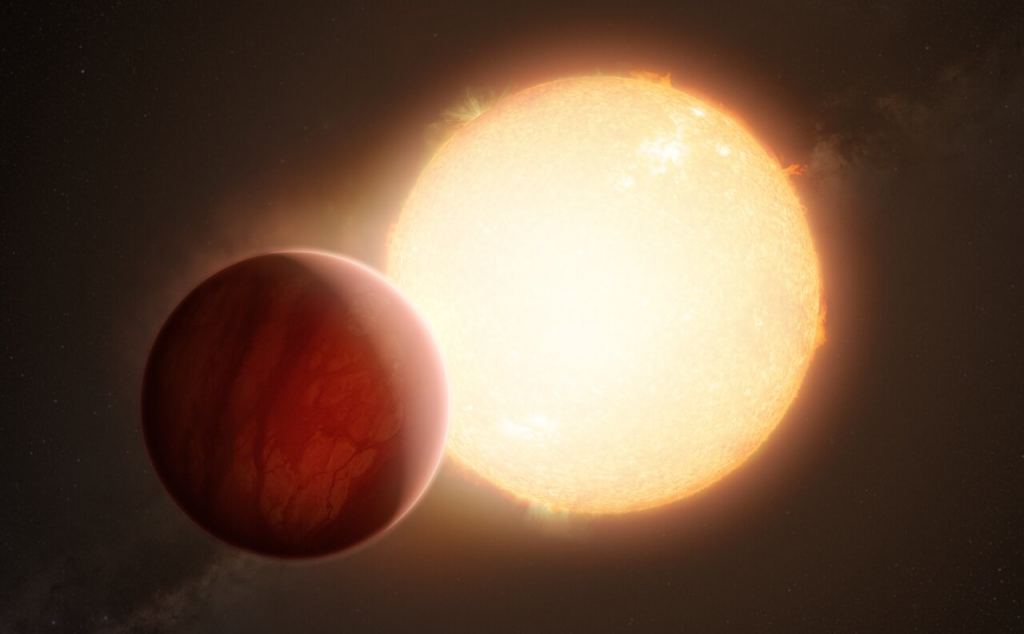
Interestingly, this will happen when our Sun leaves its main sequence phase and enters its Red Giant Branch (RGB) phase. This raises the question of what happens to Hot Jupiters when their parent stars expand to become Red Giants. Using advanced 3D simulations, a team of researchers led by the Compact Object Mergers: Population Astrophysics and Statistics (COMPAS) consortium simulated how red giants will expand to engulf Hot Jupiters. Their findings could answer another mystery confronting astronomers, which is why some binary systems have one rapidly-rotating star with strange chemical compositions.

The research was led by Mike Lau, a Ph.D. student at Monash University’s School of Physics & Astronomy, and other members of the COMPAS consortium, a collaborative effort to study the evolution of binary systems. They were joined by members of The ARC Centre of Excellence for Gravitational Wave Discovery (OzGrav), the Flatiron Institute’s Center for Computational Astrophysics, Princeton University, and the Harvard & Smithsonian Center for Astrophysics (CfA). Their paper, “Hot Jupiter engulfment by a red giant in 3D hydrodynamics,” recently appeared in the Monthly Notices of the Royal Astronomical Society.

This image tracks the life of a Sun-like star, from its birth on the left side of the frame to its evolution into a Red Giant star on the right. Credit: ESO/M. Kornmesser

As Lau explained to Universe Today via email, the topic of Hot Jupiter engulfment is of interest to astrophysicists because they believe it may explain some of the “odd” stars that have been observed in our galaxy – rapidly rotating and chemically enriched giant stars. The recent explosion in exoplanet discoveries has allowed for various theories to be tested, including the possibility that when stars expand to become Red Giants, planets that used to orbit at a safe distance will spiral toward the star’s center, stirring up stellar material in the process. Said Lau:

“This is, therefore, one way of explaining observed rapidly rotating giant stars. Also, any planetary material that comes off during the in-spiral could alter stars’ surface chemical makeup. This may help us understand why a small fraction of stars are observed to be abnormally rich in lithium. Finally, we may be able to directly detect this process by looking for stars that have swollen up and brightened from eating a planet, though we will have to be very lucky to catch them in the act.“

The ability to directly observe engulfments and the resulting effect on stars will be possible thanks to next-generation space telescopes like the James Webb and ground-based telescopes with 30-meter (~98 ft) primary mirrors. This includes the Extremely Large Telescope (ELT), the Giant Magellan Telescope (GMT) – both of which are under construction in the Atacama desert in Chile – and the Thirty Meter Telescope (TMT), currently being built on Mauna Kea, Hawaii. Using a combination of adaptive optics, coronographs, and spectrometers, these observatories will be able to directly detect exoplanets orbiting close to their stars.

This artist’s impression shows an ultra-hot exoplanet as it is about to transit in front of its host star. Credit: ESO

In the meantime, Lau and his colleagues conducted a series of 3D hydrodynamic simulations that recreated the engulfment process. As he described it:

“We used a method called smoothed particle hydrodynamics. This represents the giant star and hot Jupiter as collections of particles that follows the fluid’s motion, like a ball pit but with millions of balls. This technique has also been used to visualise fluids in video games and animations. A key result from our simulation is that the hot Jupiter may lose most of its material due to friction as it spirals into the star.”

In the future, Lau and his colleagues hope that further advances in computing will allow for higher-resolution simulations. If confirmed, their results could account for rapidly-rotating stars with abnormal chemical makeups in binary systems. They also offer a preview of what future surveys will show when they examine these systems and their exoplanets and can obtain spectra from them directly.

Further Reading: arXiv

The post What Happens to Hot Jupiters when their Star Becomes a Red Giant? appeared first on Universe Today.


Three New Potentially Hazardous Asteroids Discovered, Including a big one That Measures 1.5 km Across

An asteroid 1.5 km across is no joke. Even a much smaller one, about the size of a house, can explode with more power than the first nuclear weapons. When an asteroid is greater than 1 km in diameter, astronomers call them “planet-killers.” The impact energy released from a planet-killer striking Earth would be devastating, so knowing where these asteroids are and where they’re headed is critically important.

Our defensive capability against asteroid strikes is in its infancy, so advance notice of asteroids that could cross Earth’s orbit is critical. We’ll need time to prepare.

Imagine a time a couple of hundred years ago when the Solar System was largely mysterious to us compared to now. Earth has craters, so we know something slammed into it. But we didn’t know much more than that.

Earth’s most well-known impact crater is probably the Chicxulub crater, the physical evidence of the impact that led to the dinosaurs’ extinction. But it wasn’t easily visible.

Other craters are more visible, like the one in Arizona. It’s called the Barringer Crater, or, less imaginatively, Meteor Crater.

So we know that space rocks hit Earth. And we know they’ve also struck the Moon, Mercury, and Mars. We now know that no planets were safe from impacts in the Solar System’s long history.

Now we have an entire scientific enterprise aimed at finding and cataloguing the Solar System’s asteroid population. In 1994 the US Congress told NASA to get busy and find Near Earth Objects (NEOs) larger than 1 km in diameter. There are around 25,000 asteroids larger than 140 km in diameter near our planet’s orbit. The 140 km size was selected because one that big can destroy an entire city.

When the US Senate gave NASA its asteroid-finding mandate in 1994, the Senate wanted the agency to find 90% of the asteroids larger than 140 metres. But as of 2022, scientists think we’ve found only about 40% of them.

This study adds two more to the list and a third smaller one.

An international team of astronomers using the Dark Energy Camera at Cerro Tololo Inter-American Observatory in Chile have spotted three asteroids that lurk in the region interior to the orbits of Earth and Venus. They presented their findings in a paper in The Astronomical Journal. It’s “A Deep and Wide Twilight Survey for Asteroids Interior to Earth and Venus,” and the lead author is Scott Sheppard, an astronomer at the Earth and Planets Laboratory of the Carnegie Institution for Science.

The inner Solar System is a very challenging environment to search for asteroids. There are only two ten-minute windows each night when astronomers can search the region. The Sun’s glare creates a bright background glow that confounds observations. The Earth’s atmosphere adds another layer of difficulty by distorting and blurring observations.

“Our twilight survey is scouring the area within the orbits of Earth and Venus for asteroids,” said Sheppard. “So far, we have found two large near-Earth asteroids that are about 1 kilometre across, a size that we call planet killers.”

This figure from the study shows the population of NEOs. The asteroid marked with the blue dot could potentially intersect Earth's orbit someday. The blue dot furthest left is the closest asteroid to the Sun ever found. Image Credit: Sheppard et. al, 2022.
This figure from the study shows the population of NEOs. The asteroid marked with the blue dot could potentially intersect Earth’s orbit someday. The blue dot furthest left is the closest asteroid to the Sun ever found. Image Credit: Sheppard et al., 2022.

The asteroid of concern is the 1.5 km one named 2022 AP7. Its orbit intersects with Earth’s, so it’s a potential threat. The other two are named 2021 LJ4 and 2021 PH27, but their orbits are completely inside Earth’s orbit, so they pose no danger. The researchers behind this paper think there are more asteroids in this region, though scientists have only discovered about 25.

“There are likely only a few NEAs with similar sizes left to find, and these large undiscovered asteroids likely have orbits that keep them interior to the orbits of Earth and Venus most of the time,” said Sheppard. “Only about 25 asteroids with orbits completely within Earth’s orbit have been discovered to date because of the difficulty of observing near the glare of the Sun.”

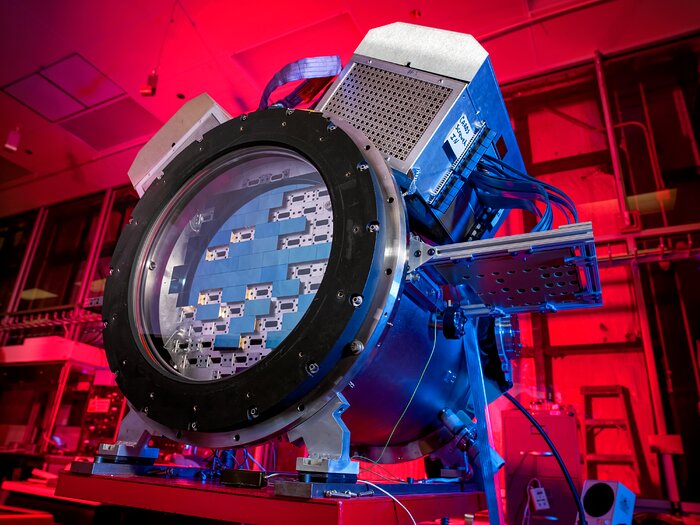
Spotting tiny objects like these asteroids in the Sun’s glare, when there are only two 10-minute observation periods each evening, is beyond the capabilities of most telescopes. It takes a unique instrument to operate effectively in these conditions. The tool of choice was the Dark Energy Camera (DEC) at Cerro Tololo Inter-American Observatory in Chile.

The Dark Energy Survey camera (DECam) at the SiDet clean room. The Dark Energy Camera was designed specifically for the Dark Energy Survey. It was funded by the Department of Energy (DOE) and was built and tested at DOE's Fermilab. The camera's ability to observe deep and wide make it well-suited to hunting asteroids in the inner Solar System. Image Credit: DOE/FNAL/DECam/R. Hahn/CTIO/NOIRLab/NSF/AURA
The Dark Energy Survey camera (DECam) at the SiDet clean room. The Dark Energy Camera was designed specifically for the Dark Energy Survey. It was funded by the Department of Energy (DOE) and was built and tested at DOE’s Fermilab. The camera’s ability to observe deep and wide make it well-suited to hunting asteroids in the inner Solar System. Image Credit: DOE/FNAL/DECam/R. Hahn/CTIO/NOIRLab/NSF/AURA

The DEC wasn’t developed to hunt asteroids. Researchers created it to hunt for a different elusive target: Dark Energy, the mysterious force that drives the Universe’s expansion. DEC needs to observe hundreds of millions of galaxies to fulfill its mission. To do that, the DEC is both deep and wide: it can peer deep into the Universe while also capturing a wide field of view. That’s the only way it can record the galaxies’ motions and conditions in the Universe’s early age.

That ability to observe deep and wide simultaneously means the DEC is suited to finding asteroids near the Sun.

“Large areas of sky are required because the inner asteroids are rare, and deep images are needed because asteroids are faint, and you are fighting the bright twilight sky near the Sun as well as the distorting effect of Earth’s atmosphere,” said Sheppard. “DECam can cover large areas of sky to depths not achievable on smaller telescopes, allowing us to go deeper, cover more sky, and probe the inner Solar System in ways never done before.”

One way astronomers classify asteroids like 2022 AP 7 is with a measurement called Earth MOID, meaning Earth Minimum Orbit Intersection Distance. It’s a way to assess the collision potential between astronomical objects. In this case, the two objects are Earth and the asteroid. 2022 AP 7’s MOID is only 0.0475 au. That’s only about 4.4 million km or 2.7 million miles. Not much in astronomical terms.

With an MOID that small, 2022 AP 7 is definitely a Potentially Hazardous Asteroid (PHA.) Its MOID and its size mean it meets the definition. It’s likely the largest PHA found in about eight years.

This research is about more than just finding dangerous asteroids so that we can prepare to defend Earth from future impacts. It goes to the heart of understanding our Solar System. Since asteroids in the inner Solar System are so challenging to spot, our theoretical models of object populations are based on what’s easiest to see. This creates a bias in our models, and the DEC is helping to mitigate that bias.

This table from the study shows the three new asteroids. Atira asteroids have orbits entirely inside Earth's orbit and are the least populous asteroid group. Apollo asteroids cross Earth's orbit and are the largest population of NEOs. Image Credit: Sheppard et. al, 2022.
This table from the study shows the three new asteroids. Atira asteroids have orbits entirely inside Earth’s orbit and are the least populous asteroid group. Apollo asteroids cross Earth’s orbit and are the largest population of NEOs. Image Credit: Sheppard et al., 2022.

The Dark Energy Camera was built to perform the Dark Energy Survey, which ended in 2019. Now astronomers are directing the camera’s power toward other things. As this study shows, that effort is producing meaningful results.

“Our DECam survey is one of the largest and most sensitive searches ever performed for objects within Earth’s orbit and near Venus’s orbit,” said Sheppard. “This is a unique chance to understand what types of objects are lurking in the inner Solar System.”

2022 AP 7 doesn’t pose a direct threat to Earth yet. As a Potentially Hazardous Asteroid, its orbit will cross Earth’s orbit sometime in the future. But we don’t know when.

More:

The post Three New Potentially Hazardous Asteroids Discovered, Including a big one That Measures 1.5 km Across appeared first on Universe Today.