At the heart of our galaxy, there is a monster black hole. Known as Sagittarius A*, it has a mass of 4.2 million Suns, and it’s only about 27,000 light-years from Earth. Sag A* is the closest supermassive black hole, and one of only two that we’ve observed directly. It is so close that we can even see stars closely orbiting it. Some of those stars we’ve been observing for more than 20 years, which means we have a very good handle on their orbits. We’ve used those orbits to determine the mass of Sag A*, but a new study looks at a different question: does our galaxy’s black hole have a companion?
Most galaxies contain a supermassive black hole, and some galaxies contain two. This is caused by galactic mergers, where the black hole of one galaxy is captured by another. We know from observations that our galaxy doesn’t have two supermassive black holes. There could be stellar mass black holes orbiting Sag A*, but current observations wouldn’t be sensitive enough to detect them. Another possibility is that there is an intermediate black hole orbiting Sag A*, which is the focus of this work.
An Intermediate Mass Black Hole (IMBH) is one with a mass between hundreds and thousands of Suns. They aren’t formed by the collapse of a massive star, nor are they the gravitational seeds of galaxies. They’ve only recently been discovered through the gravitational waves of black hole mergers, so they aren’t well understood. We don’t even know how common they might be. But if an IMBH orbits Sag A*, its gravitational pull would affect the orbits of nearby stars also orbiting our supermassive black hole.
SO-2 orbits very close to Sag A*. Credit: ESO/M. Kornmesser
In this study, the team looked at the orbit of a star known as S0-2, or S2. It has one of the closest orbits to Sag A*, with an orbital period of just 16 years. It orbits the black hole so closely that you need to take general relativity into account when calculating its orbit, and we have more than two decades of observational data on it. If there is an IMBH orbiting nearby, S0-2 should be affected by it.
The team found that to the limits of observation, there was no evidence of gravitational perturbations on the orbit of S0-2. This doesn’t mean there isn’t an intermediate-mass black hole in the area, but it does put some upper bounds on the mass if it does exist. Based on the data, if a hypothetical IMBH orbits outside the orbit of S0-2, say with an orbital radius between 1,000 AU and 4,000 AU, then it could have a mass no greater than 1,000 to 10,000 Suns. If there is an IMBH orbiting Sag A* closer than S0-2, then it can have a mass no greater than 400 Suns.
Those aren’t tight constraints, but they do confirm that there isn’t a large intermediate black hole orbiting Sagittarius A*. If it has a smaller IMBH companion, it’s currently beyond our ability to detect.
The European Space Agency’s Gaia Observatory has been operating steadily at the Earth-Sun L2 Lagrange Point for almost a decade. As an astrometry mission, Gaia aims to gather data on the positions, proper motion, and velocity of stars, exoplanets, and objects in the Milky Way and tens of thousands of neighboring galaxies. By the end of its primary mission (scheduled to end in 2025), Gaia will have observed an estimated 1 billion astronomical objects, leading to the creation of the most precise 3D space catalog ever made.
To date, the ESA has conducted three data releases from the Gaia mission, the latest (DR3) released in June 2022. In addition to the breakthroughs these releases have allowed, scientists are finding additional applications for this astrometric data. In a recent study, a team of astronomers suggested that the variable star catalog from the Gaia Data Release 3 could be used to assist in the Search for Extraterrestrial Intelligence (SETI). By synchronizing the search for transmissions with conspicuous events (like a supernova!), scientists could narrow the search for extraterrestrial transmissions.
Data from the more than 1.8 billion stars observed by Gaia have led to this map of the entire sky. Credit: ESA/Gaia/A. Moitinho
This study, which recently appeared in The Astronomical Journal (“Signal Synchronization Strategies and Time Domain SETI with Gaia DR3“), was Nilipour’s first academic study. As he explained in an interview with Yale News, “My two mentors, Steve Croft, and James Davenport, chose this for me, the idea of developing a geometric technique for constraining [technosignature] searches. It’s probably the biggest challenge in SETI right now because there are so many possibilities for the location of a transmission and the nature of the signal.”
Put simply, technosignatures are evidence of activity that unambiguously demonstrates the presence of an advanced technological civilization. To date, the vast majority of SETI experiments have searched for radio signals since the technology is known to be viable and radiowaves propagate well through space – the most advanced and comprehensive being Breakthrough Listen. These experiments also consisted of listening to various stars for a set period in the hopes of discerning radio signals coming from orbiting planets. But in recent years, scientists have expanded the range of potential technosignatures and ]considered other methods as well. Said Nilipour:
“There are lots of thoughts about what technosignatures might look like. The most common form that we look for is narrowband radio emission, because, based on our sample size of human technology, this seems to be something that a technological civilization should be producing. Other forms might be laser emission, close encounters of stars at high velocities, and emission from a star suddenly and dramatically decreasing.”
For their study, Nilipour and his team theorized that an intelligent civilization would understand how difficult it is to monitor all the space surrounding their planet in every possible mode – radio, optical, infrared, ultraviolet, x-ray, gamma-ray, etc. As such, they might opt to time their signals of greeting (fingers crossed!) with a conspicuous astrophysical event that would draw the attention of observers – i.e., supernovae. Nilipour began working on this theory as part of a summer undergraduate program offered by the National Science Foundation (NSF) and the Breakthrough Listen Initiative at the Berkeley SETI Research Center.
The “SETI ellipsoid” is an egg-shaped zone of space where alien civilizations would have had enough time to observe an astronomical event and then send out a signal that could be observed from Earth. Credit: Davenport et al. (2022).
As a first step, Nilipour and his colleagues chose four historical supernovae from the past 1,000 years and examined how long it took light from their explosions to reach Earth. As Nilipour explained:
“We merged two searching frameworks – the ellipsoid method, which synchronizes signals to a conspicuous astronomical event, and the Seto method, which is tied to geometric angles and not distance – and applied them to four events. We chose four historically documented supernovae from the years 1054, 1572, 1604, and 1987, respectively. In this case, a supernova would act like a lighthouse, a common focal point for the sender of the signal and the receiver of the signal – us.”
They determined that the light caused by these four events took 6,300 years, 8,970 years, 16,600 years, and 168,000 years to reach Earth (respectively). They then compared these results to light signals from over 10 million stars recorded by the Gaia observatory that were included in the DR3 catalog. This revealed 465 stars whose light took the same amount of time to reach Earth and 403 stars whose light signals traveled to Earth from an advantageous angle in relation to these supernovae. While none of the 868 systems yielded evidence of technosignatures, their results have provided important constraints for future searches.
As Nilipour indicated, their method can also be used to search through other archival data to tease out possible signs of technosignatures:
“Finding a technosignature would have been incredible, but this really was more about showing a methodology that we can use in the future. What we’ve done here can be applied to additional Gaia data, to data from TESS [the Transiting Exoplanet Survey Satellite], and to other data as it becomes available. We’re currently running the same type of analysis using a new supernova in the galaxy M101 that became visible in May of this year, which is the closest supernova in over a decade.”
Artist’s impression of Green Bank Telescope connected to a machine learning network. Credit: Breakthrough Listen/Danielle Futselaar.
Given the number of stars in our galaxy alone, the amount of background noise, the time-sensitive nature of transmissions, and (as if that wasn’t enough) the likelihood of obtaining false positives, searching for potential technosignatures is an extremely daunting task. Were it possible to monitor every sector of the sky – indefinitely and in multiple wavelengths simultaneously – it would just be a matter of time before transmissions could be heard (assuming anyone out there was transmitting). Unfortunately, we don’t have the time or the resources for such thorough all-sky coverage.
Herein lies the value of research like this, which effectively narrows the search by exploring different types of technosignatures, frequency ranges, and locations in the night sky. Little by little, SETI researchers are improving the odds of an unambiguous detection that can be confirmed by follow-up studies. If there is a needle to be found in the cosmic haystack, we will find it sooner or later. Despite the limits imposed on us by such a large Universe and so many possibilities, it is still just a matter of time.
So much in science is based on constraints. If scientists don’t understand something, they try to constrain it as much as possible so that more precise experiments can finally detect whatever the theorized phenomenon is. Dark matter is notoriously difficult in this regard, as it has evaded detection for over a century at this point, despite even more precise instruments trying to capture a glimpse of it. One of those instruments is the Super Cryogenic Dark Matter Search (SuperCDMS), run by the SLAC National Laboratory and located in northern Minnesota. To help further the cause, researchers looked at the data from the experiment while considering a few new possibilities, and while they didn’t find any evidence of dark matter, they helped tighten the constraints even more.
SuperCDMS, like most dark matter detection experiments, relies on the theory of dark matter that believes it interacts with ordinary matter in some way, shape, or form. Most likely, this interaction will take the form of some sort of interaction with the nuclear of an atom it runs into.
When dark matter collides with an atom, there are two possibilities for what happens. First is an “elastic collision” – simply thought of as when billiard balls bounce into one another, as Noah Kurinsky, a staff member at SLAC and corresponding author on a new paper describing this research, points out. Data from SuperCDMS has already been thoroughly scouted for evidence of those types of interactions. However, there is another option – an “inelastic” collision.
UT video speculating on the nature of dark matter.
In such a collision, the energy isn’t transferred to the atom’s nucleus but its electrons, or even photons, if they happen to be present. And there are two main ways they could potentially have such a collision.
One is called Bremsstrahlung radiation, meaning “braking radiation” in German. In this case, while the dark matter particle would still hit a nucleus, some energy would be transferred directly into a photon. Detectors at the SuperCDMS would then be able to pick up the increased energy of that photon and deduce that an inelastic dark matter collision could have caused it.
Bremsstrahlung radiation has been experimentally observed before, but the other potential inelastic collision method, known as the Migdal effect, has not yet. In this case, the dark matter particle again hits the nucleus, but the nucleus itself shifts ever so slightly, and the cloud of electrons surrounding it must shift as well. This shift should theoretically be detectable by experiments such as SuperCDMS, and indeed other theorists have calculated what that shift might look like in an experiment.
UT video on the existence of dark matter.
Unfortunately, after reanalyzing data previously collected by SuperCDMS, Dr. Kurinsky and his colleagues found no evidence of dark matter. However, they added some additional constraints by showing that a dark matter particle’s total “mass” (equivalent to the energy in high-end physics) is less than one-fifth the mass of a proton.
But they didn’t stop there. Another way the detector might not see the results they expect based on these new interaction theories is if the dark matter particles don’t make it all the way to the detector in the first place and get swallowed up by Earth’s ground or even the atmosphere beforehand. That would help to put an upper bound on the minimum level of mass dark matter to reach the detector.
To do this calculation, the physicists collaborated with another group of scientists not well-known for their interest in particle physics – geologists. That collaboration allows the physicists to calculate how much energy a dark matter particle would lose depending on which direction through the Earth it was passing. Calculations show a dramatic difference in lost energy as it passed the entire way through the Earth and its core to reach the mine in Minnesota where SuperCDMS is located finally, and another dark matter particles that might come from straight overhead and meet the path of least resistance into the detector.
Discussion of why constraints are so important in dark matter research.
Again, these calculations didn’t turn up any smoking gun of dark matter, so the search continued. However, they were able to say that dark matter must be below the energy limit that would allow the particles (if that is indeed what they are) to pass through to the detector, even via the most direct route. They can also confidently say that if it has enough energy to make it to the detector, it must have a mass of less than 1/5th of a proton.
Now the search continues, with more and more scientists joining it every year. And with more and more detectors coming online every year, maybe there is some hint of dark matter’s existence hiding in the data sets of other detectors just waiting to be analyzed using this new framework. But until then, details of this most mysterious of materials will continue to elude us.
The Mars Sample Return (MSR) has been going through a rough patch lately. We recently reported on reports coming out about Congress restricting its budget and potential cost overruns. However, like any good government program, progress continues toward the goal of bringing samples until there is a clear order to stop or the money drives up. That wasn’t the case back in March and April when NASA successfully tested two engines that will be used in the Mars Ascent Vehicle (MAV).
Designed to get the samples back off Mars and into Martian orbit, the MAV will be a two-stage system like many of its Earth-based predecessors. Known as SRM1 and SRM2 for the two different stages, each will take responsibility for a different phase of the MAV’s ascent flight.
SRM1 is the bigger of the two. Its goal is to get the samples off the ground and into the air, so it has to pack more of a punch than the SRM2. It also contains a novel feature called a supersonic splitline nozzle, or SSSL.
Testing of the SSSL and the rest of the SRM1 engine was performed at Edwards Air Force Base on April 7th. Part of a spectacular video NASA released provides details about the experiment, including that the SRM1 testing took place in a vacuum chamber, so there’s no sound to pick up on. Also, the corrective movements of the SSSL during the video seem particularly precise. The test was completed successfully, and the engineer is moving on to the next testing phase.
SRM2, on the other hand, is responsible for boosting the MAV into orbit, where it will rendezvous with the spacecraft that will take it back to Earth. Another challenge represented in its test video is that it will have to deal with spin.
On the test bench, which was not in a vacuum chamber and could be heard warming up, the rocket engine spun at 200 rotations per minute (RPM). Its performance appeared remarkably steady in the video, with little evidence that spinning like this is uncommon in rocket engines.
Fraser discusses the details of MSR, some of which are still in flux.
Both the SRM1 and SRM2 had another requirement for their test chambers – they had to be right around -20 degrees C. While the SRM2 test was performed outside at a Northrupp Grumman test facility in Maryland in March, it wasn’t cold enough in the exposed outside, so they had to cool the test chamber to the appropriate temperature.
Overall, both engines seemed to pass all the metrics required by their test plans, allowing them to move on to the next stage of development & testing. However, the project’s financial and administrative future remains up in the air, so it is unclear if either rocket will make it much further in development. But NASA is also particularly good at recycling technologies developed for other projects, so it can likely find a use for these functional rocket engines, whether they go on the MAV or not.
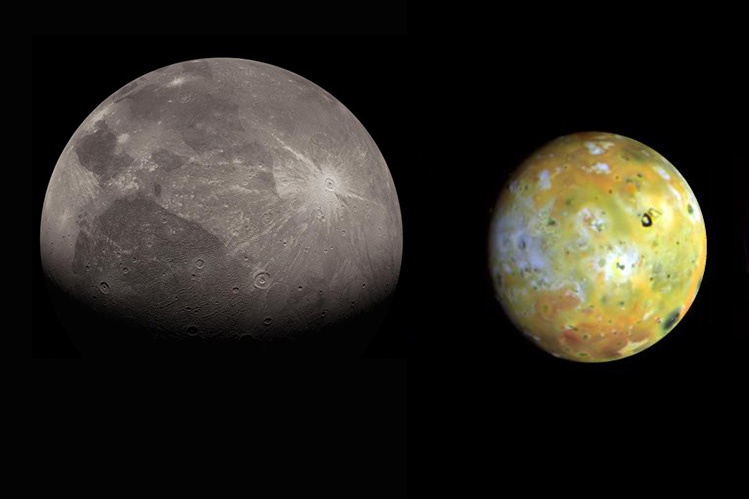
A pair of studies published in JGR: Planets and Science Advances discuss new findings from NASA’s James Webb Space Telescope (JWST) regarding Jupiter’s first and third Galilean Moons, Io and Ganymede, and more specifically, how the massive Jupiter is influencing activity on these two small worlds. For Io, whose mass is about 21 percent larger than Earth’s Moon, the researchers made the first discovery of sulfur monoxide (SO) gas on the volcanically active moon. For Ganymede, which is the largest moon in the solar system and boasts twice the mass of the Earth’s Moon, the researchers made the first discovery of hydrogen peroxide, which exists in Ganymede’s polar regions.
Image of Ganymede (left) taken by NASA’s Juno spacecraft in June 2021 and Io (right) taken by NASA’s Galileo spacecraft in June 1996. (Credit: Io: NASA/JPL-Caltech/SwRI/MSSS/Kalleheikki Kannisto; Io: NASA/JPL/USGS)
“This shows that we can do incredible science with the James Webb Space Telescope on solar system objects, even if the object is really very bright, like Jupiter, but also when you look at very faint things next to Jupiter,” said Dr. Imke de Pater, who is a Professor Emeritus in the Department of Astronomy at the University of California, Berkeley, along with being lead author of the JGR: Planets paper discussing Io and a co-author on the Sciences Advances paper discussing Ganymede.
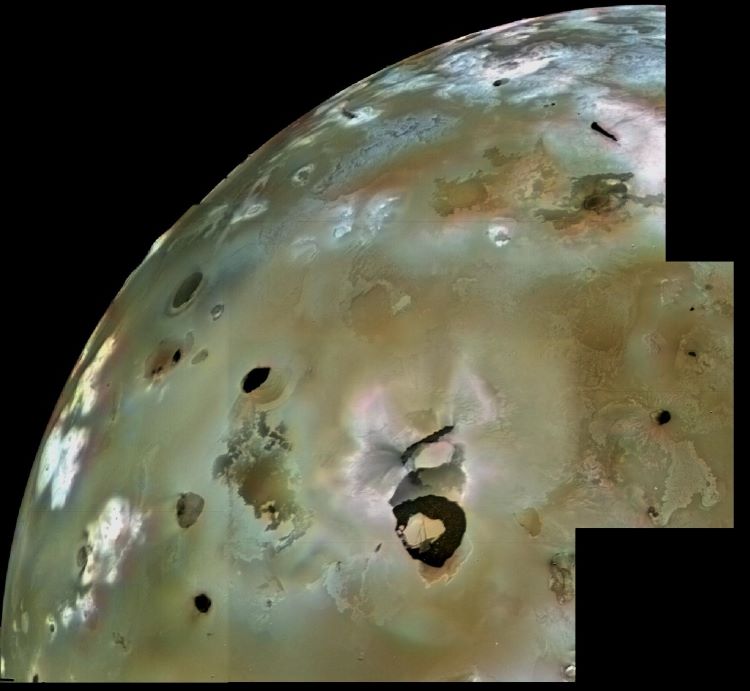
For Io, the researchers analyzed spectral data obtained with JWST’s Near-Infrared Spectrograph (NIRSpec) instrument when Io was orbiting in Jupiter’s shadow, which allowed the researchers to observe the glow from the active volcanoes that are across its surface. Through this, they successfully detected two known volcanoes on Io’s surface: Kanehekili Fluctus and Loki Patera, both of which exhibited active lava flows with minimum temperatures of 1200 Kelvin (926.85 degrees Celsius/1700 degrees Fahrenheit) with source vent sizes of about 0.25 km2 (0.09 mi2) and less than 0.1 km2 (0.03 mi2), respectively.
Image of Loki Patera (large black feature, lower center) on Io taken by NASA’s Voyager spacecraft in March 1979. (Credit: NASA/JPL/USGS)
The greatest find was a first-time detection of SO gas connected to a volcanic eruption on Io, with this occurring at Kanehekili Fluctus. The team refers to this detection as a “forbidden SO emission line” due to SO’s difficulty to detect compared to sulfur dioxide (SO2), which is the dominant atmospheric component on Io. This emission line is very faint due to its low amounts combined with brief lifespan after having energy applied to it, also known as excitation. Additionally, SO can only be detected when Io is in Jupiter’s shadow, since this is when SO2 gas freezes onto Io’s surface, with only SO and recently erupted SO2 gas remaining in the atmosphere.
“These observations with Webb show for the first time that this excited SO actually did come from a volcano,” Dr. de Pater said.
Io is the most volcanically active planetary body in the solar system, exhibiting hundreds of volcanoes and many of which erupt lava dozens of kilometers (or miles) into space. This volcanic activity is caused by what’s known as tidal heating, which is when a large body exerts an enormous gravitational influence on a much smaller body, causing the smaller body to stretch and compress. Over time, this activity causes the smaller body’s interior to produce friction, which leads to interior heat.
In the case of Io, its mass is dwarfed by Jupiter, the latter of which is just over 300 times as massive as the Earth, which means Jupiter exerts an enormous gravitational influence on its tiny moon. Additionally, Io has a slightly eccentric orbit, meaning its orbit is just shy of being circular like the Earth’s. This means Io is closer to Jupiter at some points (known as perijove) in its orbit and farther away at other points (known as apojove) and is estimated to experience a distance difference of approximately 3,400 kilometers (2,113 miles) during one complete orbit.
This results in Jupiter’s massive gravity exhibiting a greater gravitational tug on Io at periapsis and a smaller tug at apoapsis, and this resulting interior heat on Io is why it’s the most volcanically active planetary body in the entire solar system. While the majority of the tidal heating occurring on Io comes from Jupiter’s gravity, Io is also constantly being tugged by Jupiter’s second Galilean Moon, Europa.
For Ganymede, the researchers also used JWST’s NIRSpec instrument to detect hydrogen peroxide (H2O2) at the polar regions of the large moon, which, like the SO detection on Io, is a first-of-its-kind discovery.
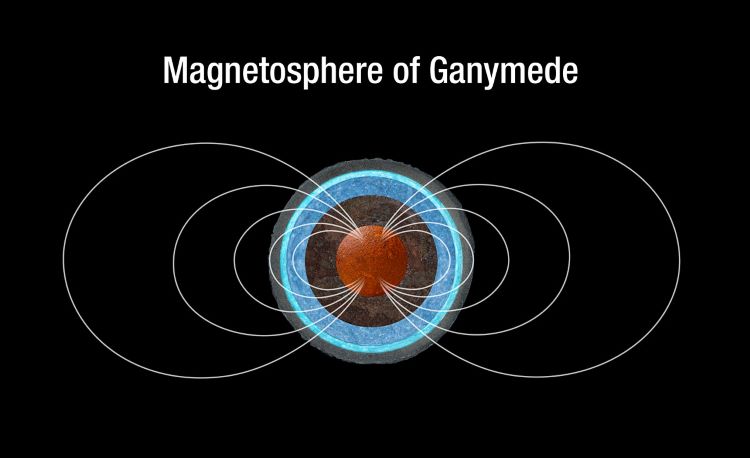
The researchers attribute the presence of hydrogen peroxide to a chemistry-based process known as radiolysis, which occurs when charged particles (also called ionizing radiation), strike water (or water ice), causing the water molecules to break apart. In the case of Ganymede, charged particles break apart the water ice in the moon’s polar regions and reconnect to form hydrogen peroxide. The reason why this occurs in the polar regions is due to Ganymede’s magnetic field, which interacts with Jupiter’s own massive magnetic field, and is currently the only known moon in our solar system to possess one.
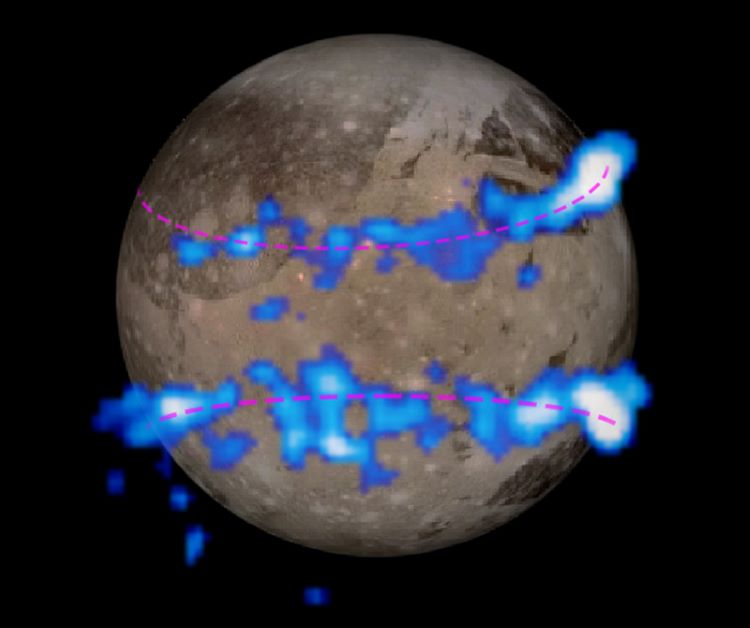
Illustration of Ganymede’s magnetic field lines. Like Earth, they are generated within the moon’s iron core. Measurements from NASA’s Hubble Space Telescope indicate Ganymede’s aurorae, which follow magnetic field lines, suggests that a subsurface saltwater ocean also influences the behavior of the Ganymede’s magnetosphere. (Credit: NASA, ESA, and A. Feild (STScI))
“Just like how Earth’s magnetic field directs charged particles from the sun to the highest latitudes, causing the aurora, Ganymede’s magnetic field does the same thing to charged particles from Jupiter’s magnetosphere,” said Dr. Samantha Trumbo, who is a 51 Pegasi b Postdoctoral Fellow at Cornell University, along with being lead author of the Sciences Advances paper discussing Ganymede and a co-author on the JGR: Planets paper discussing Io. “Not only do these particles result in aurorae at Ganymede, as well, but they also impact the icy surface.”
Image of Ganymede’s auroral belts (colored blue for illustration) taken by NASA’s Hubble Space Telescope overlaid on an image of the moon taken by NASA’s Galileo spacecraft. The high concentrations of rocking of Ganymede’s magnetic field suggests the moon possesses a subsurface saltwater ocean. (Credit: NASA/ESA)
When Dr. Trumbo was a PhD student at Caltech, she studied hydrogen peroxide on Europa with Caltech professor of planetary astronomy, Dr. Michael Brown. Unlike Ganymede, where hydrogen peroxide is found to be limited to the polar regions, Europa was found to possess hydrogen peroxide throughout its surface, likely due to the lack of a magnetic field shielding the surface from the charged particles emanating from Jupiter.
“This is likely a really important and widespread process,” said Dr. Trumbo. “These observations of Ganymede provide a key window to understand how such water radiolysis might drive chemistry on icy bodies throughout the outer solar system, including on neighboring Europa and Callisto (the fourth Galilean moon).”
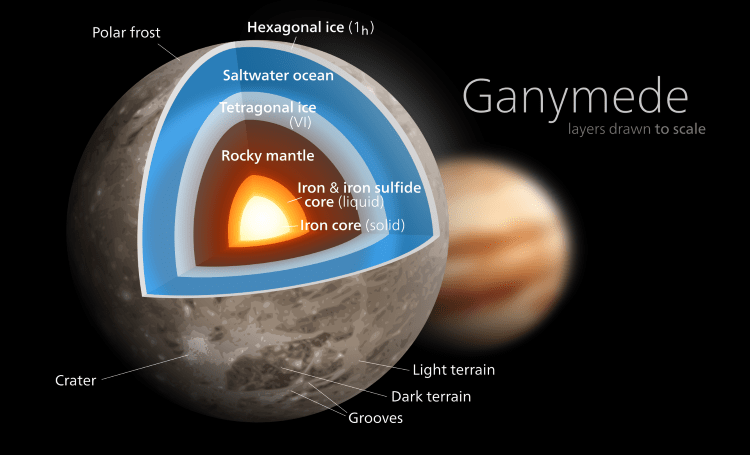
Like Io, Ganymede has been found to also experience tidal heating from Europa orbiting inward and Callisto orbiting outward, making it a strong candidate for containing a liquid ocean beneath its icy crust. But, how does Ganymede have a magnetic field? This is due to planetary differentiation, meaning its interior contains separated layers of chemical elements, with the heavier elements sinking deeper into the moon. This also means it contains a metallic core like the Earth, and it is this metallic core that produces the moon’s magnetic field.
Artist’s diagram depicting the potential internal structure of Ganymede. (Credit: Kelvinsong/Creative Commons Attribution-Share Alike 3.0 Unported license)
What new discoveries will researchers make about Io’s sulfur gas and Ganymede’s hydrogen peroxide poles in the coming years and decades? Only time will tell, and this is why we science!
It probably comes as no surprise to people suffering through drastic weather this year that our planet is heating up. Climate change is the culprit and researchers continue to look for ways to mitigate its effects. A scientist at the University of Hawai’i suggests a novel approach: create a giant solar shade in space to block enough sunlight to counter climate change.
Sure, it sounds like science fiction, but there’s some solid science behind the idea. The concept first appeared in the early 1920s as a method of climate engineering. In recent years, engineers have proposed sunshades and solar sails as multipurpose technology to shade one part of Earth while also providing a way to capture sunlight for solar power.
According to astronomer István Szapudi, tethering a sunshade to an asteroid is a workable design suitable for development within the decade. It’s based on everyday experience. “In Hawai’i, many use an umbrella to block the sunlight as they walk about during the day,” said Szapudi. “I was thinking, could we do the same for Earth and thereby mitigate the impending catastrophe of climate change?”
The Theory Behind the Sunshade
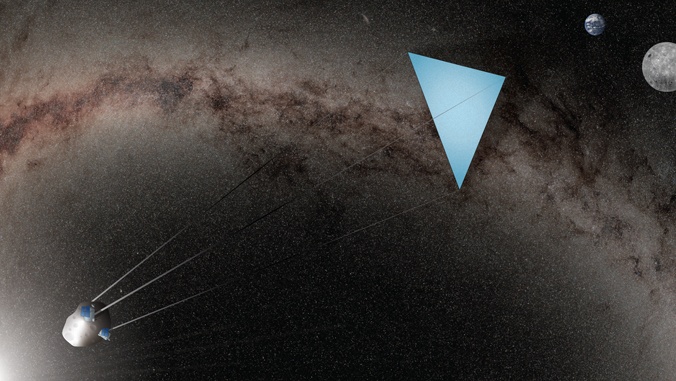
Making a sunshade big enough to do an effective job requires a fairly massive installation. It has to balance gravitational forces at the same time it has to resist solar radiation pressure. Essentially, Szapudi sees a shield made of lightweight materials tethered to a massive counterweight (i.e. an asteroid).
An artist’s concept for a proposed sunshade tethered to an asteroid. Credit: Brooks Bays/UH Institute for Astronomy
In the system Szapudi describes, the counterbalance would “ride along” the sunward side of the shield. The mass of the asteroid would help reduce the weight and mass of the shield itself. The system would then operate to reduce solar radiation by 1.7%. Theoretically this is about what you’d need to avoid a catastrophic rise in global temperatures.
In Szapudi’s paper, the system is called a Solar Radiation Management (SRM) system. It’s “home base” would be at an L1 Lagrange point. The author also suggests that for reasons of stability, an alternatue approach could use several smaller shields rather than a single large one. A substructure would connect the individual shields and the asteroid counterweight. The paper also describes maintaining stability of the whole structure as well as fuel-free orbital maintenance.
Practical Challenges to the Theory
While this sounds like an interesting approach to reducing solar radiation, there are some problems with the system. Even using lightweight materials for the sunshade is great. But, it will still weigh about 3.5 million tons. That’s an issue because current launch capabilities only allow about 35,000 tons. So, it’s likely that any future designs will require even lighter materials to make such a system launch-viable.
Luckily, the counterweight doesn’t have to be launched, since it’s an asteroid. The challenge there is to locate and move a target asteroid to a stable orbit so that work crews can attach the sunshade. There are a couple of ways to do this. One is to rely on a ballistically captured one snared into orbit around Earth naturally. That relies on finding one in the right orbit. The other way is to use some kind of artifically applied force to move the asteroid where it’s needed.
Could near-Earth asteroids provide an anchor for a sunshade? Map courtesy NASA.
Another main challenge is the existence of sufficiently strong tether materials. Think of the “space elevator” idea but with long-enough tethers to attach sunshades and counterweights. Luckily, the technologies needed for both the tethers and sunshield aren’t all that far in the future. For example, graphene for the shield is steadily becoming more affordable. These days, it’s about $100 a square meter, but in ten years could be had for as little as $1/square meter. Similarly, launch costs will continue to become more affordable, perhaps to a few tens of dollars per kilogram.
When Do We Get a Sunshade?
The author suggests in the paper that a tethered shield could be readily available soon. Szapudi writes, “Depending on the parallel and intertwined development of graphene, tether, and orbital technologies, a tethered shield might initially be faster and cheaper to realize than a heavier structure satisfying the McInnes bound. Nevertheless, the latter might eventually serve as a solar energy source for Earth or solar system exploration.”
The actual building and deployment of a system like Szapudi’s really requires that people start the R&D now. Of course, it’s not a complete panacea for the all effects of climate change. But, as the author points out, it could serve as more of an “insurance policy” that can be deployed if other methods of mitigating climate change fail.
Aliens are big in the news recently, fueled by congressional hearings about Unidentified Anomalous Phenomena (UAPs), formally known as UFOs. But while the idea of aliens visiting Earth may be exciting, the better bet is still the idea that aliens might exist on distant worlds. We already know potentially habitable planets are common and intelligent life has arisen on at least one world, so why not many? But after 60 years of searching for evidence of extraterrestrials “out there,” we’ve found nothing. So what does that tell us?
Although it seems odd at first blush, an absence of evidence can tell us things about the universe. Given the fact that we have found no definitive technological radio signals from an alien civilization, we can’t simply conclude that they don’t exist. But a prolonged silence after decades of study does tell us something about the likelihood of aliens, or at least the chances of us finding them. That’s the focus of a new study in *Acta Astronautica*, which looks at the statistics of the search for alien civilizations thus far.
The study uses Bayesian statistics to look at the odds of finding an alien technosignal. One of the main aspects of Bayesian statistics is that it assumes focuses on the likelihood of an outcome, not the certainty of an outcome. It’s the betting person’s view of the universe. In this case, there are two main assumptions. The first is that we know intelligent life can evolve in the universe (at least if you consider humans intelligent), and the second is that we’ve found no signals in 60 years.
To this, the author adds a couple more assumptions. The first is that intelligent civilizations arise at random times and in random locations. In other words, Earth has no special place in the universe and is just as likely to detect aliens as anywhere else. The second is that if an alien civilization sends signals into space, they are directed either in all directions, like the expanding sphere of our radio signals, or are randomly directed. If, for example, most civilizations tended to direct their signals toward the center of the galaxy, we would be unlikely to detect them being 30,000 light-years away from the galactic center.
These assumptions are pretty reasonable given what we know. Or at least they are no more unreasonable than other assumptions. Given all this, the author found an upper bound on alien technosignatures. At best, there is a 95% chance of no more than five galaxy-wide alien signals emitted per century. This means there is only a 50/50 chance of Earth detecting a signal within the next 1,800 years. So unless some alien civilization intentionally directs a signal our way, our odds of detecting something anytime soon aren’t great.
That doesn’t mean we shouldn’t keep looking. But if you want evidence for aliens in the near future, maybe it’s worth watching the congressional hearings on UAPs after all.