In 1997, George Lucas released the special edition remaster of his Star Wars trilogy, making changes to the special effects that both delighted and divided fans worldwide (did Han shoot first?). Among the myriad additions was a visually spectacular ring-shaped shockwave emanating from the exploding Death Star, and Alderaan too. Star Trek fans will delightedly point out that this particular special effect had previously been used in the 1991 film Star Trek VI: The Undiscovered Country, in which the Klingon moon Praxis explodes, giving the effect its name: the Praxis ring. Hollywood lore suggests Lucas was so impressed with the effect in that film that he added it to Star Wars too.
Praxis rings look cool on the silver screen, but we all know explosions in space are supposed to be spherical. With no preference for up, down, left, or right, the material blown off an exploding star should push outward in all directions.
Except when it doesn’t. A paper published at the end of March described the flattest explosion ever observed, with a disc of material ejecting out from the core along one plane, just like the Praxis effect.
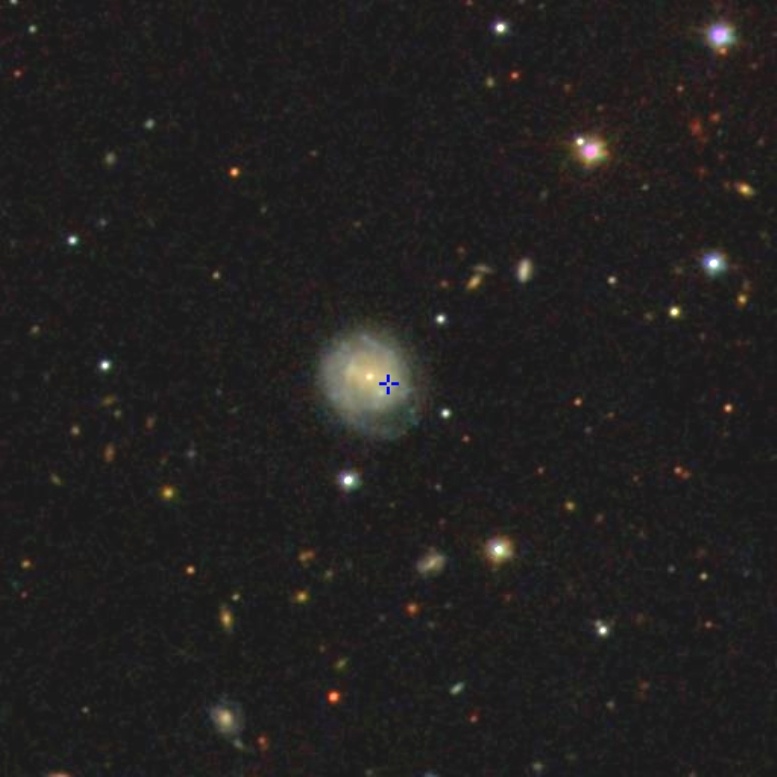
The explosion is AT2018cow, nicknamed ‘The Cow’ because of the letters in its procedurally generated designation. The Cow is a Fast Blue Optical Transient (FBOT), a rare class of explosion of which only five have ever been seen. FBOTs tend to be in the blue end of the spectra range, and they happen quickly on astronomical time scales: The Cow exhausted most of its energy in 16 days. But FBOTs are also incredibly bright – brighter than most supernovas.
The Location of AT2018cow within its galaxy in the constellation Hercules, as seen by the Sloan Digital Sky Survey. Credit: SDSS
Justyn Maund, the lead author of the paper, said in a press release that “very little is known about FBOT explosions – they just don’t behave like exploding stars should, they are too bright and they evolve too quickly. Put simply, they are weird, and this new observation makes them even weirder.”
At 180 million light years away, The Cow, which was observed in 2018, is the nearest FBOT ever seen. Maund’s team has been pouring over the observation data, and by studying the polarization of the light received from the explosion, they were able to discern details about its shape.
Polarization is the property of light waves that describes the orientation of the waves. Sunglasses use this principle to filter out sunlight by blocking waves in one orientation while allowing waves in other orientations to pass through.
In a stellar explosion, a uniform, spherical debris cloud will produce light that is not polarized in any particular direction, effectively being canceled out across the sphere. But if there are irregularities in the shape of the debris cloud, the light will be partially polarized.
Observations of The Cow show a bright peak in polarization 5.7 days after the start of the explosion, which declined rapidly within a day, followed by a second peak on day 12. “Such a high polarization requires an extremely aspherical geometry,” the paper suggests, “such as shock breakout through an optically thick disk.”
Artist Rendering of AT2018cow, showing a flat disc-shaped explosion. Image credit: Philip Drury, University of Sheffield.
In other words, The Cow seems to have exploded like Praxis.
What causes FBOTs like The Cow? It’s going to take more work to find out for sure. New sky survey instruments like the Vera Rubin Observatory (slated for first light later this year) will be able to capture a bigger sample size of FBOTs and make the task of characterizing them easier.
For now, Maund and his team think that the most likely explanation is that there is an accreting object like a neutron star or black hole at the center of these objects driving the explosion, but the exact mechanism is unclear. It does not appear to be a typical supernova – the collapse of a star into a black hole or neutron star – because there is a lack of radioactive nickel, which supernovas usually produce in great quantities.
The Cow isn’t the only explosion to produce ring shapes. Supernova 1987a is seen here in x-ray and visible light. A similar mechanism may be at work. Image Credit: X-ray: NASA/CXC/U.Colorado/S.Zhekov et al.; Optical: NASA/STScI/CfA/P.Challis.
But there are clues that suggest that the explanation for the disc shape lies in what happened before the explosion. Astronomers have seen similar, though not identical, ring structures in some supernovae. During the last stages of a star’s life, it can grow into a blue supergiant, and the speed of its solar wind picks up dramatically. The fast wind collides with the slower wind, piling up material and grouping it around the poles and equator due to the star’s magnetic field. Later, when the star explodes, the explosion impacts the concentrated material, lighting it up in visible rings.
Whether the disc shape of The Cow is the result of a similar mechanism remains to be seen. Maund thinks it might also be a failed supernova, or the result of disruptions as a star passes a black hole.
Either way, its shape is highly unusual, but not impossible. So the next time you watch Star Wars, you’ll have to resist the urge to tell your friends that the Death Star should have a spherical explosion. If The Cow tells us anything, it’s that sometimes space explosions are just weird like that.
The four astronauts chosen for NASA’s Artemis II mission will check off a string of firsts during their flight around the moon, scheduled for next year. It’ll mark the first trip beyond Earth orbit for a woman, for a person of color and for a Canadian. Artemis II will represent yet another first for Canadian astronaut Jeremy Hansen: Based on the current crew schedule, it’ll be his first-ever space mission.
Commander Reid Wiseman, pilot Victor Glover and mission specialist Christina Koch round out the first crew for NASA’s Artemis moon program, which picks up on the legacy of the Apollo moon program. If all goes according to plan, they’ll be the first humans to go into lunar orbit since Apollo 17 in 1972.
As NASA Administrator Bill Nelson geared up to introduce the crew, he echoed the moonshot vision that President John F. Kennedy laid out in 1962 in his famous “We Choose to Go to the Moon” speech.
“We choose to go to back to the moon, and on to Mars,” Nelson said. “And we’re going to do it together, because in the 21st century, NASA explores the cosmos with international partners. We will unlock new knowledge and understanding. We’ve always dreamed about what more is ahead. Why? Because it’s in our DNA. It’s part of us. It’s who we are, as adventurers, as explorers, as frontierspeople.”
Dozens of astronauts and scores of VIPs attended today’s big reveal at NASA’s Johnson Space Center in Texas. Joe Acaba — the chief of the Astronaut Office — joked onstage about the secrecy that surrounded the selection of the four Artemis II crew members. “I’ll give you one hint: I am not one of them,” he told the crowd. “Don’t be so happy about that.”
Metaphorically speaking, the stage was set for Artemis II last fall when NASA’s Space Launch System sent an uncrewed Orion deep-space capsule on a weeks-long Artemis I mission around the moon and back. That flight was designed to test NASA’s hardware and procedures for Artemis II — and for the even more ambitious Artemis III mission, which currently aims to put astronauts on the lunar surface in late 2025.
The flight plan is for the 10-day Artemis II mission is analogous to the Apollo 8 round-the-moon mission in 1968. As was the case for Artemis I, the trip would begin with an SLS launch — but this time with people instead of test dummies inside the Orion capsule. After an initial systems checkout in high Earth orbit, the crew would fly past the moon and then make a gravity-assisted turnaround 6,400 miles beyond lunar orbit. The return to Earth would feature a 25,000 mph re-entry and an Apollo-style splashdown.
This NASA infographic lays out the flight plan for Artemis II. Click on the image for a larger version.
“Am I excited? Absolutely,” Christina Koch, who would become the first woman to see the moon’s far side with her own eyes, told today’s audience. “But my real question is, are you excited? I see you and I ask that, because the one thing I’m most excited about is that we are going to carry your excitement, your aspirations, your dreams with us on this mission.”
Jeremy Hansen, the only space rookie on the Artemis II crew, gave a shout-out to America’s leadership in space and Canada’s “can-do attitude.” His role on the mission recognizes Canadian contributions to NASA’s space effort, including the robotic arms for the space shuttle and the International Space Station as well as a lunar utility vehicle that Canadian companies are building for moon missions.
“For decades now, literally thousands upon thousands of Canadians have risen to that challenge to bring real value to the international partnership with respect to space exploration, to bring real solutions,” Hansen said.
“Human spaceflight is like a relay race,” Glover said. “And that baton has been passed from generation to generation, and from crew member to crew member, from Mercury, Gemini, Apollo, Apollo-Soyuz, Skylab, Mir, the shuttle, International Space Station, commercial crew and now the Artemis missions. We understand our role in that. And when we have the privilege of having that baton, we’re going to do our best to run a good race, to make you proud.”
Artemis II commander Reid Wiseman closed out the ceremony with a round of thanks to NASA’s workforce, its international partners — and particularly to his fellow astronauts, including the International Space Station’s current crew.
“If any of you over there are looking for heroes, go Google these folks, because they’re our heroes,” Wiseman said.
Commander Reid Wiseman Hometown: Baltimore, Md. Born: 1975 Background: Naval aviator, test pilot, selected to become astronaut in 2009. Spaceflight experience: Expedition 40/41 on International Space Station, 2014.
Pilot Victor Glover Hometown: Pomona, Calif. Born: 1976 Background: Naval aviator, test pilot, selected as NASA astronaut in 2013. Spaceflight experience: SpaceX Crew-1 and Expedition 64 on International Space Station, 2020-2021.
Mission specialist Christina Hammock Koch Hometown: Grand Rapids, Mich. Born: 1979 Background: Engineer at NASA Goddard Space Flight Center, research associate in U.S. Antarctic Program, electrical engineer at Johns Hopkins University Applied Physics Laboratory, researcher at National Oceanic and Atmospheric Administration, selected as NASA astronaut in 2013. Spaceflight experience: Expedition 59/60/61 on International Space Station, 2019-2020.
Mission specialist Jeremy Hansen (Canada) Hometown: London, Ontario Born: 1976 Background: Fighter pilot, selected as Canadian Space Agency astronaut in 2009. Training experience: Cave test subject with European Space Agency’s CAVES program in 2013, aquanaut with NEEMO 19 underwater test program in 2014.
And here are a few reactions from notables on Twitter:
The @NASA Artemis II crewed mission around the Moon will inspire the next generation of explorers, and show every child – in America, in Canada, and across the world – that if they can dream it, they can be it. pic.twitter.com/X8q3GLTBiQ
Congratulations to Victor Glover, Christina Koch and Reid Wiseman of NASA, and Jeremy Hansen, as the #NASA Artemis 2 crew in ‘24! This is a great honor, a proud moment for you and for the nation. Your role in carrying out America’s effort in space will be one of high inspiration! pic.twitter.com/oTYpWgB6JY
In 1931, Indian-American physicist Subrahmanyan Chandrasekhar proposed a resolution to Einstein’s Theory of General Relativity that postulated the existence of black holes. By 1972, astronomers obtained the first conclusive evidence that these objects existed in our Universe. Observations of quasars and the center of the Milky Way also revealed that most massive galaxies have supermassive black holes (SMBHs) at their cores. Since then, the study of black holes has revealed that these objects vary in size and mass, ranging from micro black holes (MBHs) and intermediate black holes (IMBHs) to SMBHs.
Using astronomical simulations and a technique known as Gravitational Lensing, an international team of astrophysicists detected what could be the largest black hole ever observed. This ultramassive black hole (UMBH) has a mass roughly 30 billion times that of our Sun and is located near the center of the Abell 1201 galaxy cluster, roughly 2.7 billion light-years from Earth. This is the first time a black hole has been found using Gravitational Lensing, and it could enable studies that look farther into space to find black holes and deepen our understanding of their size and scale.
This illustration shows how gravitational lensing works. The gravity of a large galaxy cluster is so strong it bends, brightens, and distorts the light of distant galaxies behind it. Credit: NASA, ESA, L. Calcada
Gravitational Lensing (GL) refers to a phenomenon predicted by General Relativity, which describes how spacetime curvature is warped by the presence of massive objects. This technique involves astronomers using massive objects in the foreground (like galaxies or galaxy clusters) to amplify light from more distant objects. This enables astronomers to study objects that would otherwise be inaccessible to them, either because of distance or the presence of other objects along the same line of sight. This technique also allows astronomers to study distant objects in greater detail, such as the Abell 1201 cluster.
Dr. Nightingale and his associates began studying this cluster in 2004 when Prof. Alastair Edge, a fellow Durham University astronomer and a co-author of this paper, reviewed images of a galactic survey and noticed a giant lens in its vicinity. For this study, Dr. Nightingale, Prof. Edge, and their colleagues consulted data from the Hubble Space Telescope (HST) in multiple bands – including visible light, X-rays, and other wavelengths. Following up on what Hubble saw years ago, the team compared the data to simulations on the new DiRAC COSmology MAchine 8 (COSMA8) supercomputer facilities at Durham University.
Using open-source software (PyAutoLens) that astronomers rely on to model strong lenses, the team simulated light traveling between Abell 2021 and Earth thousands of times. Each simulation included a black hole with a different mass and how this would influence the way the light traveled over 2.7 billion years to reach Earth. Their results showed that a UMBH located in the foreground galaxy, over 30 billion times as massive as our Sun, would account for what Hubble saw. Astronomers rarely see black holes this massive, and this find (if confirmed) would constitute the largest black hole ever detected.
On top of that, it was the first time astronomers used the GL technique to detect such a massive black hole. What’s more, it could help astronomers learn more about UMBHs and dormant black holes in the future. Ordinarily, astronomers are largely restricted to studying active black holes because of how bright they are in multiple wavelengths. This is caused by gas and dust being pulled in toward black holes and forming tightly-bound disks that are accelerated to velocities approaching the speed of light (aka. relativistic speed).
This causes the material in the disk to become highly energetic, emitting radiation in visible light, infrared, X-rays, radio waves, and other wavelengths. The same occurs when the material infalls and is accreted onto the face of the black hole, being torn apart at the subatomic level. This is characteristic of Active Galactic Nuclei (AGN), where a galaxy’s center shines brighter than all the stars in the galactic disks. This study has shown how dormant black holes, which are significantly less luminous, can be inferred by the presence of a powerful GL.
The team hopes that this study will lead to deeper explorations of black holes, which will benefit from the new class of 30-meter telescopes that will become operational in the near future. These include the Extremely Large Telescope (ELT), the Giant Magellan Telescope (GMT), and the Thirty Meter Telescope (TMT), which will combine greater sensitivity with adaptive optics and interferometers. Along with improved data analysis and new methods, astronomers will likely be able to study even more distant black holes and gain additional insights into these behemoths.
Roscosmos has had quite the run of bad luck lately. In addition to sanctions putting pressure on their space program and the cancellation of agreements (all due to the war in Ukraine), the Russian space agency has experienced several problems in space. On December 14th, 2022, and February 11th, 2023, two space capsules reportedly suffered radiator coolant leaks (Soyuz MS-22 and Progress 82). In addition to delivering fresh supplies to the International Space Station (ISS), one of the spacecraft (M-22) was slated to bring three members of Expedition 68 back to Earth.
Luckily, on February 25th, Russia announced it was sending another Soyuz capsule to replace the M-22 (Soyuz M-23) and retrieve the three crew members, cosmonauts Sergey Prokopyev and Dmitri Petelin, and astronaut Frank Rubio (who will return to Earth now on September 27th). In addition, Tuesday, March 28th, Russia undocked the M-22 from the ISS and successfully brought it home without crew. NASA provided live coverage of the undocking and departure of the uncrewed spacecraft via NASA TV, the agency website, and the NASA app.
The Soyuz MS-22 begins to depart the station following its undocking from the Rassvet module. Credit: NASA TV
After undocking with the ISS at 5:57 AM EDT (2:57 AM PDT), the spacecraft made an automated, parachute-assisted landing in Kazakhstan less than two hours later at 5:46 PM Kazakhstan time (7:46 AM EDT; 4:46 AM PDT). This successful retrieval of this spacecraft and the safe return of the three Expedition 68 crewmembers will put this incident and the delays it imposed to rest. However, the incident raises questions about the state of Roscosmos, given that this is the latest in a recent string of technical failures and malfunctions.
Due to the rescheduled departure date, astronaut Frank Rubio is destined to set a new record for the longest time a U.S. astronaut spent in space. Whereas the record for longest stay goes to the late Russian cosmonaut Valeri Polyakov, who spent 437 continuous days in space aboard the Mir Space Station, Rubio’s 371-day stay will be edging out Scott Kelly and Christina Koch, who spent a total of 340 (March 2015 to March 2016) and 328 days (February to December 2019) aboard the ISS (respectively).
Meanwhile, Expedition 69 has started aboard the ISS, with cosmonaut Sergey Prokopyev acting as Station Commander. Other crewmembers include NASA astronauts Stephen Bowen, Woody Hoburg, and Frank Rubio, United Arab Emirates (UAE) astronaut Sultan Alneyadi, and Roscosmos cosmonauts Andrey Fedyaev and Dmitri Petelin. This Expedition will feature research into how cardiac cells behave in microgravity, pharmaceuticals that may protect astronaut health, tests involving the European Robotic Arm, and the Foam and Emulsions physics study.
We finally got JWST data about TRAPPIST-1. An Earth-sized rogue planet was found. More information about China’s plans for the Moon.
JWST Reveals Trappist-1 Data
Finally! The data we’ve been hoping to see is rolling in JWST’s observations of the famous TRAPPIST-1 system, where seven Earth-sized worlds are orbiting a red dwarf star, several of which are in the habitable zone. Today we learned about the innermost planet in the system, TRAPPIST-1 b, which orbits so close to the star that its dayside temperatures reach 500 kelvin, midway between Earth’s average temperature and Mercury. JWST also failed to detect any atmosphere at 1b. Stay tuned for the next world in the system; it looks like we’re going to get them one at a time.
Kazakhstan has seized control of the Biaterek launch complex at the Baikonur Cosmodrome. It’s not the main site where the Soyuz rockets are launched from. The Biaterek is mainly used for the development of the Soyuz 5 rocket, which Russia was working on with Kazakhstan. Roscomos has lost almost all their business connections since the full-scale invasion of Ukraine. So, it looks like there are even more tensions with the partners they have left.
Scientists have found what appear to be rogue planets hidden in old survey data. A terrestrial mass planet and a Neptune mass planet have been discovered free-floating in the Milky Way. They were found by analyzing micro-lensing events when a rogue planet passes in front of a background star and distorts its light.
China proposed research goals for their future Moon base. They plan to establish a basic version of a station by 2028, and subsequently expand it into an international facility. There were also some new details about upcoming Chang’e landers and rovers. China’s traditionally not very public about their plans, but the Moon program is definitely looking serious.
When China’s Chang’e-5 mission returned samples of the Moon’s south pole to Earth, scientists were excited to discover tiny glass beads mixed in with the rock and regolith. These are evidence of ancient asteroid impacts on the Moon, turning the regolith into glass with extreme heat and pressure. They were surprised to discover water was trapped inside the glass spheres, created by hydrogen from the solar wind striking the Moon, mixing with local oxygen atoms. They estimate trillions of tonnes of water bound up in lunar regolith that could be available to future lunar explorers.
Going to the Moon to stay means that we will need to bring a lot of heavy things there. One of the ways to minimize the required effort and cost is to make things from the stuff that’s already available on the Moon. One of the heaviest, yet very necessary things for future lunar exploration, will be batteries. So, there are several promising technologies that should be able to 3D-print batteries from lunar regolith. If this works, this can be a game changer.
One of the most surprising discoveries made by NASA’s Voyager missions was the possibility of a vast ocean of liquid water on Jupiter’s moon Europa. This is surrounded by a thick sheet of ice that could descend for tens of kilometers. With further research, planetary scientists have discovered that the ice shell is detached from the solid core of the moon and pushed along by ocean currents under the ice. This could also explain why Europa’s surface is covered in enormous cracks.
Two setbacks were revealed this week. Boeing Starliner’s first manned flight will be delayed at least until summer, which was announced by NASA. Also, the maiden flight of Vulcan will be delayed. According to ULA’s Tory Bruno, there was an anomaly when testing the Centaur second stage. It’s unclear now what exactly was the problem and how serious it is. But, as Tory Bruno said, Vulcan will fly when it’s ready.
Don’t Miss Out On Space News
If you want to get a curated selection of the most important space and astronomy news every week, subscribe to our Weekly Email Newsletter and get magazine-size ad-free news directly from Fraser Cain.
If you prefer the news to be videoed at you, check out our Space Bites playlist on our YouTube channel
A while back, we reported on a research group that was using an interesting mix of materials to create concrete on Mars. The University of Manchester researchers used blood and urine to create concrete bricks using Martian regolith stronger than concrete used on Earth. However, there was an obvious downside of literally requiring blood to make them, let alone the side effects of having astronauts potentially live in a building built partially out of their own bodily fluids. So the researchers thought up a different material whose usefulness in space will be familiar to anyone who has read Andy Weir’s most famous novel – potatoes.
Potatoes bring a lot of benefits to space exploration. Most importantly, they’re an extremely efficient and stable source of calories. But their starch can also be used as a binder when making concrete. Specifically, it can bind together materials, such as Martian or Lunar regolith, to create something akin to what we would typically consider concrete.
The resultant material, known as “StarCrete,” is twice as strong as typical concrete used here on Earth, at least from a compressive strength perspective. When the potato starch is mixed with lunar regolith, the resultant material is even stronger, clocking in at almost three times the compressive strength of concrete typically used on Earth.
UT video examining the extend of ISRU on Mars.
Another disadvantage of typical concrete is its environmental record – concrete production is responsible for 8% of all CO2 emissions, as it requires extremely high temperatures, typically up to 1300 C, to create. Starcrete can be made at temperatures closer to a typical home oven of around 190 C. So there is an environmentally friendly use case for using Starcrete to replace typically made Earth concrete back here on the ground.
To this end, the researchers at the University of Manchester have created a start-up company called DeakinBio which is seeking out potential use cases for StarCrete on Earth. They’re certainly not the only start-up seeking ways to decrease the CO2 emissions of the concrete industry. And it certainly won’t be as easy to get the raw ingredients of their material on Earth as it would be on Mars or the Moon. But it’s certainly worth a shot.
If the start-up route happens to fail, though, there could be a silver lining. It seems difficult for the researchers to move away from utilizing bodily fluids to construct their materials. To be honest, there’s a good reason for that – people can be viewed simply as bioreactors that can create blood, urine, and in some cases, tears, so there will always be a steady supply of those on any long-term space mission.
Another UT video looks at the technology discussed in this article.
Ironically, despite moving away from the first two bodily fluids, the University of Manchester researchers found a use case for the third. Magnesium chloride, which admittedly is also commonly found on the Martian surface (but not on the Moon), can dramatically improve the strength of their StarCrete. Chalk another point up for material scientists’ ingenuity (and strong stomachs).
In the coming decade, NASA and China plan to send the first crewed missions (astronauts and taikonauts) to Mars. Both agencies hope to begin sending missions by 2033, coinciding with a Mars Opposition, followed by additional missions in 2035, 2037, and after. These missions will culminate with the creation of a Mars surface habitat that will enable future missions and research. Launch opportunities for these missions are limited because the distances between Earth and Mars vary considerably over time, ranging from about 56 million km (~35 million mi) to more than 400 million km (250 million mi).
The times when Earth and Mars are at their closest (known as a Mars Opposition) only occur once every 26 months. Moreover, using conventional propulsion methods, it takes missions six to nine months to travel between Earth and Mars. As a result, round-trip missions to Mars could take up to three years, dramatically increasing radiation exposure for the crew and the time they spend in microgravity. According to a recent study from NASA’s Jet Propulsion Laboratory (JPL), 2033 will be a unique opportunity to send a crewed orbital mission to Mars that lasts just 1.6 years.
The study, which appeared in the Journal of Spacecraft and Rockets, was led by Humphrey “Hoppy” Price, the chief engineer of NASA’s Mars Exploration Program and the architect of the JPL plan for a minimal-architecture crewed mission to Mars. He was joined by Robert Shishko, a principal system engineer and economist at JPL’s Mission and System Architecture Section, JPL senior systems engineer Joseph Mrozinski, and JPL systems engineer Ryan Woolley.
This included long-duration life support systems (LSS), 500-kWe-class Solar Electric Propulsion (SEP), zero boiloff (ZBO) cryogenic propellants, and liquid oxygen (LOX) produced on Mars. Refueling and reusability were also identified as “medium-risk” requirements. Other issues identified by STPI included timelines, funding, the Deep Space Transport (DST), and the difficulties imposed by parallel developments between the Artemis Program and the “Journey to Mars.” As the STPI team concluded in their report:
“STPI found that a 2033 departure date for a Mars orbital mission is infeasible under all budget scenarios and technology development and testing schedules, given NASA’s current and notional plans. 2035 may be possible under budgets that match 1.9 percent real growth, but carries high risks of schedule delays due to complex technology development, testing, and fabrication schedules for the DST; may require reducing the scope of lunar missions; and reduces NASA’s ability to mitigate risks to human health.”
The DST is an especially tricky point, according to the STPI report. As per NASA’s “Journey to Mars” architecture, this spacecraft would be integrated with the Lunar Gateway by the late 2020s. It would rely on solar-electric propulsion and either include a habitable volume or use the Orion spacecraft in lieu of. Assuming there is a small boost in funding and budget consistency during the 2030s, the STPI anticipates that the DST will not be ready to depart until 2037. Assuming that delays and budget shortfalls are a factor, they anticipate 2039 is a more realistic date.
Price and his colleagues also addressed the potential for nuclear propulsion and in-situ resource utilization (ISRU), which comes up often in the context of future missions to Mars. According to various proposals, nuclear-thermal and nuclear-electric propulsion (NTP/NEP) could reduce transit times (45 to 90 days), radiation exposure, and the amount of time astronauts spend in microgravity. Also, ISRU offers the potential for lower payloads and less propellant, since materials and fuel could be manufactured on Mars. However, they also state that these technologies pose “development challenges and risks” and probably won’t be ready by 2033.
This echoes the findings of the Ninth Community Workshop for Achievability and Sustainability of Human Exploration of Mars (AM IX) workshop. Here too, NTP/NEP was raised as a possible means of reducing transit times and the associated health risks, which was naturally met with enthusiasm by many members. However, according to AM IX Report, critics of this idea “cited studies that suggested neither NTP nor NEP would be available in the human exploration time horizon of interest.”
Launch Opportunity
What is needed, therefore, is a mission architecture that avoids the higher-risk technologies identified by the STPI’s analysis and minimizes the number of new vehicles and developments required. Accordingly, Price and his colleagues propose a round-trip mission launching in 2033 that would take advantage of a unique planetary alignment (Venus-Earth-Mars) that occurs about once every 15 years. The mission would perform a gravity assist maneuver via a Venus flyby, accelerating the spacecraft and reducing the necessary propulsion and the total mission time.
The mission would begin with the spacecraft flying to Mars, spending about 30 days in high orbit, and then returning to Earth via the Venus gravity assist. The mission would last about 570 days (1.6 years), dramatically reducing the radiation the crew is exposed to and the time spent in microgravity. Another major advantage is that this mission architecture would rely on existing technologies and vehicles that are currently in production – like the Space Launch System (SLS) and Orion spacecraft – or in the study contract phase for the Artemis Program.
They also emphasize that this mission would likely be on-orbit only, meaning there would be no landing involved, but could still serve as a precursor for future missions to the surface. As the team stated in their study:
“This would be an orbit-only mission as a precursor to landing missions that would follow, similar to how the Apollo 8 lunar orbit mission was a precursor to the Apollo 11 landing mission. Having a crewed Mars lander available for a 2033 mission, although potentially feasible, is unlikely due to the funding commitments that would be needed for such an effort. However, if private commercial efforts would be able to produce a crew qualified lander by 2033, then a landing mission could be considered.”
A Mars Mission Vehicle
Price and his team include a proposal for a Mars Mission Vehicle (MMV) consisting of an Orion spacecraft and three propulsion stages that would rely on conventional engines (like the RS-72 or XLR-132) and non-cryogenic bipropellants – like nitrous oxide (N2O4) and monomethylhydrazine (MMH). The MMV would be launched by the SLS and commercial rockets and assembled in High Earth Orbit (HEO) or around the Moon using the Lunar Gateway. The crew would launch aboard an SLS and rendezvous with the MMV as the final element in the assembly.
An Orion spacecraft to transport crew to the MMV in HEO and provide direct-entry Earth return
A Mars Transit Habitat (MTH) to provide accommodations and life support for the crew
An Earth Departure Stage (EDS) to perform the trans-Mars injection (TMI) burn in HEO
A Mars Orbit Insertion (MOI) stage
In addition, two Trans-Earth injection (TEI) stages would be sent ahead of the MMV to provide transportation back to Earth by way of a Venus flyby. A sunshade would be deployed for thermal control during this phase since the spacecraft will be within 1 Astronomical Unit (1 AU) of the Sun. As mentioned before, the mission architecture and MMV design incorporate technology that is already in production or within reach.
While only the SLS and Orion are currently in production, the authors stress that the other elements are on the drawing board for NASA and its industry partners. In particular, there’s the Mars Transfer Habitat (MTB), which NASA has been developing since it announced at the 2017 IEEE Aerospace Conference that contracts were being awarded for Deep Space Habitation (DSH) studies. Price and his teammates further estimate that an MTH could be tested at the Lunar Gateway by the late 2020s and be ready by 2033. As they write:
“The MTH is currently in NASA’s planning process to be developed and to have the first delivery version tested at the Lunar Gateway. The EDS, MOI, and trans-Earth injection (TEI) stages would be of a common design with identical components, except for the tank lengths and capacities, which would be of three different variants. The stages would be manufactured from a common assembly line using conventional space-storable hypergolic propellants with systems that are currently at a high technology readiness level (TRL).”
Mission Profile
According to the timelines established in this study, the mission would begin by mid-2028 with the launching of the MMV elements to Earth and Mars orbit. Four SLS and 13 commercial launches would be used in total, with a combined payload mass of about 1020.5 metric tons (1125 tons). First, two SLS Block 2 Cargo and ten commercial launch vehicles would send the two TEI stages toward Mars, where they would position themselves and dock together once in HMO. Second, one SLS Block 2 Cargo and three commercial launches would deliver the mission vehicle to HEO.
These would be fully assembled and ready for final inspection and validation by late 2032. Last, a single SLS would deliver the crew and their Orion spacecraft to HEO to dock with the mission vehicle. The mission would then depart for Mars in 2033 based on the following timeline:
“The crew would launch in SLS/Orion in late March or early April 2033 to dock with the mission vehicle in the departure orbit in HEO. Again, the launch date for the crew would not be critical, and so there would be flexibility to accommodate some delays. In April 2033, with a departure period of a few weeks, the TMI burn would be performed, and the mission vehicle would depart for Mars. After about a 200-day transit, the mission vehicle would arrive at Mars in November 2033 and perform the Mars orbit insertion burn into HMO.”
The mission would spend about 30 days in orbit, at which point the MOI stage would be jettisoned, and the mission vehicle would rendezvous with the two TEI stages to return home. The return phase of the mission would last about 340 days and include the Venus flyby that would put the MMV on course to loop around the Sun and return to Earth. A few days before the spacecraft reaches Earth orbit, the Orion would separate from the MTH, leaving it on a course to fly past Earth. The Orion would then perform a final burn to reenter Earth’s atmosphere and achieve splashdown.
In addition to their 570-day mission profile, Price and his colleagues also offer an alternative conjunction-class long-stay mission. This mission would still launch by April 2033 and last about 950 days (2.6 years), with a 550-day stay in Mars orbit. This profile would require fewer launches from Earth and only one TEI stage to accomplish the return portion of the mission. It would also require far less acceleration to break free of Earth’s gravity and achieve an MOI, but would also need a much larger acceleration to depart from Mars orbit and a significantly greater burn from the TEI modules.
This mission comes with some additional risks, mainly from the extended period spent in microgravity and the increased exposure to radiation. So while the 950-day mission is simpler, would cost less, and involves fewer technical challenges, these come at the cost of increased risks to human health and safety. The long-duration stay in Mars orbit also leads to the same logistical difficulties identified in NASA’s current mission proposals, not the least of which are the need for long-duration life support systems, supplies, and waste management.
Follow-up Missions
Another selling point of this study is the recommendations for follow-up missions that would commence by 2037. This (they state) would require the development and qualification of a four-person Crewed Lander and Ascent Vehicle (CLAV) that could also be built using current technologies. Price and colleagues from NASA JPL and the Georgia Institute of Technology (GIT) outlined this vehicle concept in a previous study released in 2016. In this latest study, Price and his team explain how this vehicle could allow for missions every four years and could be delivered to HMO with two SLS Block 2 launches:
“The crew could travel to HMO using the same mission profile previously described and rendezvous with the prepositioned lander. After transferring to the lander, the crew would descend to the surface, perform a science exploration mission, and return to the mission vehicle in HMO using the lander’s ascent vehicle plus a prepositioned boost stage to get from low Mars orbit to HMO. This would require the Mars ascent vehicle to rendezvous and dock with the boost stage in LMO in order to return to the mission vehicle.”
The landing mission could also be adapted to their short and long-duration mission proposals, with the stays taking place on the Martian surface rather than in orbit. Over time, these landings could lead to the build-up of infrastructure on Mars and the utilization of local resources (ISRU) for refueling, construction, science operations, and other necessities. They also anticipate an eventual transition to reusable and more advanced propulsion systems allowing for shorter transits and longer stays.
This plan stands in contrast to previous proposals by NASA, which called for the possible deployment of a space station around Mars in 2028. Proposed concepts include Lockheed Martin’s Mars Base Camp (MBC), which would be paired with a reusable Mars Lander to enable trips to and from the surface and serve as a fallback point in the event of major solar flares or other hazards. While cost assessments for the MBC are unavailable, it is a foregone conclusion that it would cost far more to construct, deploy, and assemble than the proposed CLAV.
Upsides/Downsides
One of the most obvious selling points of this mission architecture is its simplicity and cost-effectiveness compared to existing plans. In addition to the mass and performance estimates, the study provides a cost breakdown by year. In a 2015 op-ed, Dr. Olin G. Smith and Paul D. Spudis* estimated that the cost of NASA’s Journey to Mars could be as much as $1.5 trillion. Moroever, their assessment was based on a significantly larger annual budget of about $54 billion per year instead of the then-current $18 billion ($68.54 and $20.5 billion today).
In comparison, Price and his associates predict that a program lasting from 2023 to 2035 will cost $17.728 billion and would require a modest increase in funding (consistent with the STPI analysis). Their plan would also require fewer launches and less propellant, offers a Mars transfer vehicle that would be ready in time, and does away with the need for the Mars Base Camp. These advantages echo what Robert Zubrin proposed with his “Mars Direct” mission architecture, which similarly calls for direct flights to Mars, the necessary elements to be sent on ahead, and ISRU to reduce payload and mass requirements.
But perhaps the greatest selling point is that this mission would be ready to go by 2033 using technology that already exists (or will soon). No additional systems need to be invented, tested, and validated, the most notable of which would be NTP/NEP systems. Basically, the proposal offers a plan that is feasible, on budget, and on time, at least when compared to NASA’s existing mission architecture. But of course, there are some obvious drawbacks, the most obvious being that it does not allow for surface operations.
As noted in a previous article, the AM IX Report was rather ambivalent about the feasibility and value of an orbital mission to Mars, despite the fact that it would easier to prepare and ready to go sooner. As the Report’s authors wrote: “It was agreed that the opportunities offered by the 2033 launch window are not to be dismissed lightly (assuming crew readiness), but no consensus was reached as to the value of an initial orbital mission, and no consensus was reached on an initial conjunction vs. opposition mission.”
Given the cost and timelines involved, any missions to Mars are likely to seem less appealing if no surface operations are involved, regardless of the potential for follow-up missions. After all, one of the main objectives of crewed missions to Mars is to build upon the astrobiological research performed by robotic explorers going all the back to the Viking 1 and 2 missions in 1976. So while this proposed architecture would allow for missions by 2033, one has to consider if a delay might not be the preferable option.
Of course, the matter is complicated somewhat by the fact that missions to Mars are not so easily delayed, unlike missions to the Moon. Given the orbital mechanics involved, opportunities are largely confined to Opposition launch windows (once every 26 months). And even when Earth and Mars are at their closest, the distances involved always presents logistical, technological, and health and safety challenges. As such, any delays could push the first launch as far back as 2039 (as noted in the STPI analysis).
But it is this very insistence that NASA send the first crews to Mars by 2033, with-follow up missions every 26 months, that is creating these challenges. Consider the Artemis Program, which evolved from Phase I and II of NASA’s Journey to Mars. Prior to 2019, the plan was to use the SLS to launch the elements of the Lunar Gateway to the Moon, which would then be assembled in a halo orbit and paired with a reusable lunar lander. Crewed missions to the lunar surface would follow by 2028, at which point NASA would shift its focus to developing the DST and sending crews to Mars by 2033.
Given all that, it might be preferable to postpone the first crewed mission to Mars to give various technologies and proposed solutions time to mature. Otherwise, NASA will have to adjust its plans and be ready to go with a lower-cost orbital mission by 2033. The fact that the Chinese also plan to send their first crews to Mars in 2033 might seem like an incentive to “get their first.” But it is important to note that China is facing the exact same challenges and their technological readiness is no greater than NASA’s.
This is especially true where “parallel developments” with lunar exploration programs arise. According to the official guide released by the China National Space Agency (CNSA) in 2021, the creation of the International Lunar Research Station (ILRS) will be a three-phase process that will last until 2035. Phase II and III of the program (2030-2035) are reliant on the Long March9 (CZ-9) super-heavy launch vehicle being ready on time. Roscosmos was to contribute to these phases with their Angara-5, but development of this super-heavy launch vehicle has stalled (largely due to sanctions resulting from the war in Ukraine).
Alas, any major decisions regarding future missions to Mars will depend on what happens as 2033 draws nearer. That includes how the Artemis Program unfolds, what the budget environment looks like, and the development, testing, and validating of new technologies. In the meantime, it’s good to know there are options. Whichever path NASA takes, the end result is sure to be both exciting and inspiring!
*Smith was a former manager of shuttle systems engineering at NASA’s Johnson Space Center, while Spudis was a staff scientist at the Lunar and Planetary Institute (LPI). They passed away in 2020 and 2018, respectively.