Thursday, July 30, 2026

Radio Array Detects Polarized Light From a GRB

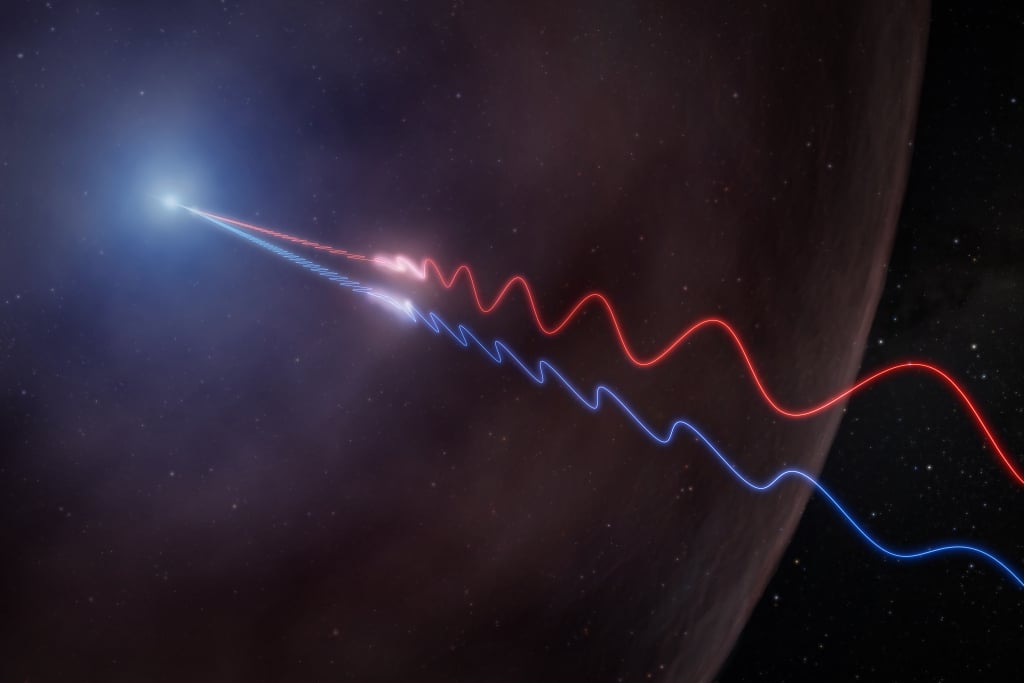
This illustration depicts Faraday rotation in the afterglow of a gamma-ray burst. A powerful jet (upper left) sends polarized radio waves outward through the thin wall of a surrounding bubble of magnetized gas called an HII region. As the light passes through this material, its polarization angle is twisted by the magnetic field. Because the effect is stronger at longer wavelengths, the red and blue waves, which represent different radio wavelengths, exit the bubble oscillating in different directions. By measuring this difference, astronomers were able to map the magnetic environment surrounding GRB 260310A for the first time. Credit: NSF/AUI/NSF NRAO/M.Weiss

On March 10, 2026, the Fermi telescope gamma-ray burst team reported the detection of a long-duration gamma ray burst that occurred when a star exploded inside a dense, highly magnetized cloud of hydrogen gas. That HII region is a bubble of ionized hydrogen created by winds from a massive young star. Astronomers immediately turned as many telescopes as possible to view the burst and its afterglow, including the NSF's Karl Jansky Very Large Array.


No comments:

Post a Comment