Power beaming is one of those technologies that can completely change the world. Almost unlimited power wherever it is needed, whenever it’s needed, is literally a technology straight out of science fiction. Researchers have been working on the technology for decades at this point, but there has been little commercial headway so far, so what is holding this revolutionary technology up? A “killer app” would certainly help move it along – and that is what a team from Space Power, a private company, and the University of Surrey think they have found in the form of powering other microsatellites.
All current CubeSats and other microsatellites have to have their own power system. Sometimes they are powered by solar panels, other times by batteries, and even more rarely by radioisotope thermoelectric generators (RTGs). These solutions have limitations, including limited lifetimes (batteries) or limited size (RTGs, solar panels). Any improvement in the way microsatellites can be powered would be welcomed by the burgeoning satellite industry.
Concept of a space-based power beaming satellite.
Credit – ESA
That improvement is the focus of a SPRINT (SPace Research and Innovation Network for Technology) grant that provided £7.4 million to a public-private partnership involving the University of Surrey’s Department of Physics and Space Power, a private company supported by the OI Space Incubator. The grant comes on the heels of a feasibility study the two entities produced that proved the concept of using a laser to send power from one satellite to another.
The current goal of the grant is to increase “small satellite operating efficiencies by a factor of between 2x-5x,” according to a press release from the University. The team will build a practica prototype that could eventually fly as part of a launch and demonstrate the power beaming technology in situ. If successful, private money should surely follow to support a commercial end goal. And with the increasing need for commercial satellites will come increased commercial opportunities for novel ways to power them. With a goal of creating commercially available products by 2025, the team at Space Power and the University of Surrey have a lot of work ahead of them.
Earth has a new companion. Asteroid 2020 XL5, a newly discovered kilometer-wide carbonaceous space rock, has been discovered at Earth’s L4 Lagrange point – a place where the gravitational forces of Earth and the Sun balance out, creating a stable point in which objects can become trapped. A new paper published this week in Nature Communications confirms that 2020 XL5 will be stuck at L4 for at least another 4000 years, shepherded silently through the Solar System by the gravitational tug of our home planet.
This is only the second Earth Trojan ever discovered – the first was found in 2010 – but other planets have plenty of them. Jupiter, which has been throwing its weight around in the Solar System for eons, has thousands of trojans, so many that the asteroid swarms at Jupiter’s L4 and L5 points rival the number of objects in the main asteroid belt itself. A mission to study Jupiter’s Trojans, named Lucy, launched in October and will arrive at Jupiter’s L4 point in 2027. Understanding what these captured asteroids are made of will help researchers build a clearer picture of the early Solar System.
Earth’s Lagrange points, where objects (known as Trojans) are able to remain in stable or semi-stable orbits. The newly discovered Earth Trojan 2020 XL5 was found at Earth’s L4 point. Credit: NASA/WMAP Science Team.
While its hoard is impressive, Jupiter does not have a monopoly on trojan asteroids. Neptune has 29 known trojans, and even Mars, at three-fifths of Earth’s size, has over a dozen of them in its Lagrange points.
So why does Earth have so few? Well, first of all, there are probably more out there, we just haven’t found them yet. Earth Trojans are notoriously hard to see because, from our perspective, we have to stare nearly directly towards the Sun to find them, making them near impossible to pick out in the glare. It doesn’t help that c-type asteroids like 2020 XL5 tend to have low albedo’s, reflecting very little light. This combination makes spotting Earth Trojans a difficult challenge.
So how was 2020 XL5 discovered? The trick is to time the observations carefully. There is a short period just before sunrise and just after sunset when the Sun is blocked by the horizon, but the Lagranges points are still visible in the sky. This isn’t an ideal observing situation, and the window of opportunity doesn’t last long, but it’s enough to take a quick look.
Using this method, astronomers used the Pan-STARRS1 survey, based in Hawaii, to find the object back in December of 2020. At the time, it was clear that 202 XL5 might possibly be an Earth Trojan, but it took until this recent study to confirm it. The data shows that this is a ‘transient trojan,’ meaning it did not begin in Earth’s L4 point, but was rather captured, and it won’t remain there forever either, eventually being bumped out to roam free once again. This isn’t likely to happen for a while, though, and it will remain in the L4 neighborhood for at least the next four millennia.
The attempt to find Earth Trojans doesn’t only rely on Earth-based telescopes. Space probes have visited Earth’s L4 and L5 points in search of previously unseen objects in-situ. For example, NASA’s OSIRIS-REx spacecraft carried out a survey in the L4 region, while the Hayabusa2 spacecraft visited L5 on its way to asteroid Ryugu. Neither mission detected new Earth Trojans, but they helped create population constraints regarding the number and size of the asteroids that might be there.
The search for more Earth Trojans continues. As the paper’s lead author Toni Santana-Ros explains, “asteroids are time capsules from the earliest days of our Solar System and can teach us lots about the era of planetary formation. Earth Trojans are particularly interesting, as they could be leftover material from the formation of Earth. Even if they come from far away instead, their relatively stable orbits at Earth’s Lagrange points could still make them ideal destinations for a spacecraft mission.”
When asked what’s next for the team, Santana-Ros replied, “This discovery strongly encourages us to keep searching for new Earth Trojans. Finding an Earth Trojan made of material leftover from Earth’s formation would be incredibly helpful for unraveling many secrets of the early Solar System.”
A Chinese satellite pulled a defunct navigation satellite out of the way of other satellites on January 22nd. The satellite, called SJ-21, appeared to operate as a space tug when it grappled onto the navigation satellite from the Chinese CompassG2 network. The operation details didn’t come from Chinese authorities but a report by ExoAnalytic Solutions, a commercial space monitoring company.
Chinese authorities are tight-lipped about the operation, but what can observations tell us about Chinese capabilities?
Earth’s geosynchronous orbit is crowded, so on the face of it, having one less piece of space debris is a good thing for all satellite operators. But people can get suspicious when China does something like this. Is suspicion warranted?
The details of the operation are in a report from ExoAnalytic Solutions. They presented them in a webinar hosted by the Center for Strategic and International Studies (CSIS) and the Secure World Foundation (SWF.) Brian Flewelling from ExoAnalytic presented the report.
ExoAnalytic Solutions owns and operates over 30 observatories and over 300 telescopes worldwide. The company says they monitor the full 360 degrees of the GEO belt and the graveyard region. Their Global Telescope Network is the world’s largest network of optical telescopes. According to the company’s website, they provide “…ubiquitous, automated, real-time space domain awareness for space superiority.”
This is one of the ExoAnalytic Solutions observing facilities. The company has over 30 observatories and more than 300 telescopes worldwide. Image Credit: ExoAnalytic Solutions.
Here’s what happened, according to ExoAnalytic Solutions.
On January 22nd, SJ21 went absent from its orbital slot for several hours. Before that, it performed close proximity operations with the defunct CompassG2 satellite, moving closer and closer. SJ21 docked with the dead satellite, but ExoAnalytics didn’t observe the actual docking. The docking took place in daylight when the company’s telescopes couldn’t image the satellite. ExoAnalytics reacquired SJ21 after it pulled the inoperative satellite out of geosynchronous orbit.
This video from ExoAnalytic Solutions explains their observations.
The China Aerospace Science and Technology Corporation (CASC) operates JS-21 (Shijian-21), but they haven’t been very open about the satellite’s operations and capabilities. They launched the satellite on October 24th, and China’s Xinhua news agency said, “The satellite will be mainly used to test and verify space debris mitigation technologies.”
Space debris is a growing problem, so any efforts to mitigate it are welcome. But China is tight-lipped about it. Compare their lack of details with other countries’ space debris mitigation efforts.
The ESA has a comprehensive web presence detailing its ongoing efforts to deal with space debris. Individual articles describe using drag sails to deorbit dead satellites, graphics explain the problem, and interviews with experts flesh out the whole issue. NASA is similar. The Canadian Space Agency also practices openness, especially when their a piece of space debris struck the Canadarm2 robotic arm in April 2021.
The Canadarm2, the Canadian-made robotic arm used on the International Space Station, suffered “limited” damage after it was hit by space debris in 2021. (NASA/Canadian Space Agency)
The United Nations’ Space Debris Mitigation Guidelines apply to all UN member states, including China. It can be challenging for citizens of western democracies to understand why China would be so secretive about something as innocuous as space debris mitigation. But China practices secrecy and obfuscation as a matter of course.
What do SJ-21’s operations mean?
First of all, this isn’t the first time SJ-21 has been in the news. In November, it attracted attention when the US Space Force’s 18th Space Control Squadron watched as the satellite orbited alongside another object. The 18th SCS said the object was probably a spent apogee kick motor. Typically, a rocket puts a satellite into a transfer orbit, and an apogee kick motor on the satellite itself provides the final thrust to bring the satellite into geostationary orbit.
China never confirmed it.
Other space agencies are concerned that China could use SJ-21 to interfere with operational satellites from other countries. Whether or not that’s China’s intent, the suspicion won’t go away.
The US Air Force’s China Aerospace Institute is a think tank that examines China’s activities in space. The Institute released a report in December 2021 focusing on SJ-21. “… one can reasonably argue that SJ-21 is probably going to be China’s second On-Orbit Servicing, Assembly, and Manufacturing (OSAM) practice-series satellite (Shijian) in GEO,” the report says.”
“One could also reasonably expect SJ-21 to advance work China has already done in lower orbits to practice rendezvous and proximity operations (RPOs) and the use of a robotic arm,” the report says. “This time, China might practice using multiple arms, a different type of debris mitigation technology such as that needed for refuelling or
deorbiting, or a combination of those, based on Chinese academic publications…”
But the report also says that “China’s activities in OSAM have not been examined in-depth to date.”
China is framing SJ-21 as part of their On-Orbit Servicing, Assembly, and Manufacturing (OSAM) operations. But is there something more to it?
In an article at Breaking Defense, Jonathan McDowell, an astrophysicist at the Harvard-Smithsonian Center for Astrophysics, pointed out something unusual in SJ-21’s activities. McDowell said that the satellite’s orbit “…is highly elliptical, ranging from 36,076 km in altitude to 38,886 km.“
Satellites are moved into the graveyard orbit when it’s easier to boost them into that orbit than to deorbit them. Satellites can stay in the graveyard orbit for millions of years. The graveyard orbit is about 300 km above the geostationary orbit, about 36,000 km. But JS-21 moved its dead passenger into an elliptical orbit that takes it well beyond that.
In order to eliminate collision risk, GEO satellites should be moved out of the geostationary ring at the end of their mission. Their orbit should be raised by about 300 km, according to the ESA, which is considered a safe distance to avoid future interference with active GEO spacecraft. Image Credit: ESA
“Usually, GEO graveyard raising is done more symmetrically,” McDowell explained in the Breaking Defense article.
ExoAnalytic Solutions reported that SJ-21 is now back in a geosynchronous orbit. So was this a harmless debris mitigation maneuver? If it was, why hasn’t China said so? Do they like keeping other countries in the dark, just in case? Is something potentially sinister going on? Asking these questions isn’t to invite conspiracy theories. This is global politics.
China isn’t the only one to develop and employ satellites like this. The Northrop-Grumman company developed their MEV-1 (Mission Extension Vehicle 1) satellite to help mitigate space debris. But the MEV-1 is designed to dock with customers’ satellites and re-fuel them to extend their lives. They can’t use that capability offensively. Could SJ-21 be a precursor to offensive satellite operations? People are reluctant to say that publicly, but must be wondering behind closed doors.
Northrop-Grumman made a promotional video of their MEV-1 satellite.
This could all be much ado about nothing. Many space agencies are putting more resources into space debris mitigation. It’s sensible operationally, scientifically, and economically. Maybe SJ-21 is purely a business venture, and China is keeping their cards close to their chest to protect any hoped-for economic advantage. But NASA, the ESA, and others are far more open about their activities.
Why so tight-lipped, China?
Maybe they’re just following Sun-Tzu’s advice when he said, “Let your plans be dark and impenetrable as night …”
We’re never able to see the far side of the moon from the Earth, but that doesn’t mean it’s that different. Recently rovers and satellites have started exploring the lesser-known side of the moon. They found a slightly different geology than that discovered on the near side, which might have implications for navigating the far side in the future.
China’s Chang’E-4 mission landed on the far side of the moon over three years ago in humanity’s first successful attempt at doing so. Since then, it has been trundling around the surface, making discoveries such as a strange-looking rock and some of the moon’s mantle on its surface.
A map of the path the rover has taken, as well as the wheel slippage rates on each day of travel.
Credit – Ding et al.
Now a new paper discusses a topic that is an unusual data source – how the Yutu-2 rover that is part of the Chang’E-4 mission has been moving. Published in Science Robotics, the paper discusses the various trials and tribulations that the rover has experienced while navigating a side of the moon that radio signals from Earth cannot directly reach.
The signal bouncing required to communicate Yutu-2 hasn’t slowed the rover down, though. What has slowed it down is its wheels slipping and sliding in some spots and getting clogged with dirt in others. Yutu-2 appears to be navigating a series of gentle slopes that regularly cause slight slippage of its wheels, which is caused by material similar in texture to sandy loam on Earth.
An example of some of the cohesive regolith that stuck to the rover’s wheels.
Credit – Ding et al.
Even with all the slipping and sliding, there have been noticeably more dirt clumps attaching themselves to the rover’s wheels than there have been at other lunar landing sites. This would imply a slightly higher cohesion to the regolith than the near side. There could be several different explanations for this, including the far side getting blasted by more solar radiation or something local to the geology of the far side region.`
Other exciting finds include small impact craters along the route Yutu-2 took, some of which had markings that indicated “secondary impact events.” Those happen when a meteorite or other small object impacts in a larger crater that was previously formed. In addition, some of the material at the bottoms of those craters were a “high reflectance,” making them attractive to any future explorers.
Open Space forum about China’s plans for the moon.
Ultimately, the differences between what Yutu-2 has found on the far side and what Apollo and other missions located on the near side were relatively minor. The moon appears to be the moon, no matter what side you’re on. That makes it slightly easier for any future human explorers, but there might still be some other mysteries on the far side to unlock – if only humanity sends some more explorers there.
Astronomers will go to great lengths for science. Recently, dozens of astronomers had the misfortune of traveling to one of the most tempting locales in the southwestern US – Las Vegas. But they weren’t there for the city’s bright lights – they were there to observe a very dim light of a star thousands of light-years away. And what they specifically wanted to see was the light from that star blink out for a few seconds. That lack of light provided the exact kind of data they needed to help them determine the size of Eurybates, one of the Trojan asteroids that will be the focal point of NASA’s Lucy mission.
What the scientists were looking for was an occultation. Most people know the most common form of this phenomenon – an eclipse. But occultations can happen with any background star and can be caused by any foreground object. Calculating where these minor occultations of stars by asteroids will occur takes a significant amount of orbital mechanics and processing power. The Earth itself has to be aligned correctly, and the asteroids and stars have to line up just right and be big enough.
NASA Goddard video describing the occultation data collection program.
Credit – NASA Goddard YouTube Channel
If an asteroid is big enough, it will cause the equivalent of a shadow in the star’s light, which can be used as a proxy measurement for its size. The shadow Eurybates caused was approximately 64 km (40 mi) wide, but scientists didn’t know its precise dimensions. So they set up observational sites around the perimeter of the shadow as it crossed over the Nevadan desert and measured the amount of time the star was obscured.
On October 20th, dozens of scientists spread out in a pattern to catch as much of the occultation as possible and to use their observational data to calculate the true size of Eurybates, which is one of the targets of the Lucy mission to the Trojan asteroids. As with all science, it’s never as easy as it sounds.
Another NASA Goddard video describing the target of the Lucy mission – the Trojan asteroids.
Credit – NASA Goddard
Despite taking place in a desert, clouds almost obscured the entire occultation, making it impossible to collect the data needed to find the true scope of the asteroid. Just to make the calculations even more complicated, Hubble found a moon orbiting Eurybates that could confuse the data if it were not ideally positioned out of the way during the occultation.
Luckily the stars (and asteroids, and clouds) aligned, and the scientists were able to collect the data necessary to constrain the size of Eurybates better. That updated estimate should also allow astronomers better to estimate the size of Lucy’s other targets. This also won’t be the only occultation the Lucy team will observe – they’ll be traveling, most likely to much less hospitable places than Las Vegas, until Lucy’s last flyby of Patroclus, another Trojan asteroid, in 2033.
Solar flares are complex phenomena. They involve plasma, electromagnetic radiation across all wavelengths, activity in the Sun’s atmosphere layers, and particles travelling at near light speed. Spacecraft like NASA’s Solar and Heliophysics Observatory (SOHO) and the Parker Solar Probe shed new light on the Sun’s solar flares.
But it was a Japanese-led mission called Yohkoh that spotted an unusual solar flare in 1999. This flare displayed a downward flowing motion toward the Sun along with the normal outward flow. What caused it?
A team of researchers think they’ve figured it out.
When the 1999 Yuhkoh flare was spotted, astrophysicists wondered what caused the downward motion. They called these dark finger-like phenomena “downward-moving dark voids.” Astrophysicists have a more accurate term for them now: supra-arcade downflows (SADs.)
A solar arcade is an active area with multiple coronal loops. Coronal loops are magnetic structures that extend from the Sun’s photosphere out into the corona, looping back down to reconnect with the photosphere again. Coronal loops trap plasma magnetically, and that makes them visible.
This image is an example of solar coronal loops observed by the Transition Region And Coronal Explorer (TRACE). These loops have a temperature of approximately 106 K. These loops contrast significantly with the cool chromosphere below. Image Credit: By NASA Public Domain
A supra-arcade is a solar arcade with added features. Along with the loops, there are downflows above the arcade. Scientists thought supra-arcades are somehow connected with the magnetic reconnection behind solar flares, but the specifics were unknown.
“We wanted to know how these structures occur,” says lead author and CfA astronomer Chengcai Shen. “What’s driving them, and are they truly tied to magnetic reconnection?”
The Sun has complex magnetic fields that can become compressed and disfigured. They can break, releasing fast-moving and powerful radiation along magnetic lines, then reconnect to form loops.
“On the Sun, what happens is you have a lot of magnetic fields that are pointing in all different directions. Eventually, the magnetic fields are pushed together to the point where they reconfigure and release a lot of energy in the form of a solar flare,” says study co-author and CfA astronomer Kathy Reeves.
“It’s like stretching out a rubber band and snipping it in the middle. It’s stressed and stretched thin, so it’s going to snap back,” Reeves added.
That knowledge is firmly established, so it’s reasonable to conclude that the same mechanism guided SADs. “A characteristic feature of magnetic reconnection is the production of fast reconnection outflow jets near the plasma Alfven speeds,” the authors write in their paper. “In eruptive solar flares, dark, finger-shaped plasma
downflows moving toward the flare arcade have been commonly regarded as the principal
observational evidence for such reconnection-driven outflows.”
But observations didn’t entirely back that explanation. It comes down to speed.
“However, they often show a speed much slower than that expected in reconnection theories, challenging the reconnection-driven energy release scenario in standard flare models,” they write.
In the elastic band analogy, the snap-back is rapid. But when scientists watched these SADs, most of them didn’t snap back. Instead, they reconnected more slowly with the Sun. If the same thing happened with an elastic band, we’d think somebody spiked our drink.
“This is not predicted by classic reconnection models, which show the downflows should be much quicker. It’s a conflict that requires some other explanation,” lead author Shen said.
Here’s where NASA’s Solar Dynamics Observatory (SDO) comes in. NASA launched the SDO in 2010 to study the nature of the Sun-Earth system and how it affects life on Earth. One of the SDO’s instruments is the Atmospheric Imaging Assembly (AIA.) The AIA gives us continuous full-disk coverage of the Sun’s chromosphere and corona.
This image from the SDO’s AIA is an excellent example of the instrument’s power. It’s an extreme UV light image of the magnetic fields and the loops they create, which are invisible to our eyes. These features dwarf the Earth. Image Credit: Solar Dynamics Observatory/NASA.
Shen and the other authors created 3D simulations of solar flares and compared them to solar flares the SDO observed. They found that magnetic reconnection isn’t the source of SADs.
Instead, fluid dynamics are at the heart of SADs. Two fluids of different densities create the SADs when they interact in the turbulent environment above the arcade.
This image shows some of the simulations created by the team of researchers. It shows how the density of the plasmas changes over time, leading to the development of SADs. Image Credit: Shen et al. 2022.
The authors say that the turbulent environment in this “interface region” where downward reconnection outflows impinge on closed flare arcades hasn’t received much attention in previous research. “This interface region hosts a myriad of turbulent flows, electron currents, and shocks, crucial for flare energy release and particle acceleration,” the authors explain in their paper. They liken it to another astrophysical phenomenon, “… the highly turbulent region sandwiched between the forward and reverse shock in supernova remnants,” they write. Plasma in that region of a supernova also forms finger-like structures.
This is the Crab Nebula, a well-studied supernova remnant. It illustrates the turbulent flows and shock waves that create the same structures seen in SADs. The fingers in remnants like these are Rayleigh-Taylor fingers. The unstable interface between fluids of different densities creates the fingers, similar to how SADs are formed on the Sun. Image Credit: By NASA, ESA, J. Hester and A. Loll (Arizona State University) Public Domain
In this case, the two fluids are both plasmas. But they have different densities, leading to the unexplained behaviour of SADs.
“Those dark, finger-like voids are actually an absence of plasma. The density is much lower there than the surrounding plasma,” co-author Reeves explained.
The authors intend to keep studying SADs and other solar features using observations and simulations. They think their work might lead to better tools for predicting space weather.
The year 2021 was a big one as far as stories from space are concerned! From start to finish, 2021 witnessed innumerable milestones and groundbreaking missions mounted by space agencies and the commercial space industry. Among them, the long-awaited launch of the James Webb Space Telescope, the arrival of the Perseverance mission, the launch of Double-Asteroid Redirect Test (DART), multiple test flights with the Starship, and the inauguration of space tourism. There was something for everyone!
However, looking at what’s planned for the year ahead, one might get the impression that 2021 was the appetizer and 2022 is the main course! That may sound like an idle boast, but not when you consider all of the ambitious missions, programs, and developments that are scheduled and anticipated for the next twelve months! So exactly what’s in store for space in 2022? We’ve provided a helpful list below:
Ariane 6
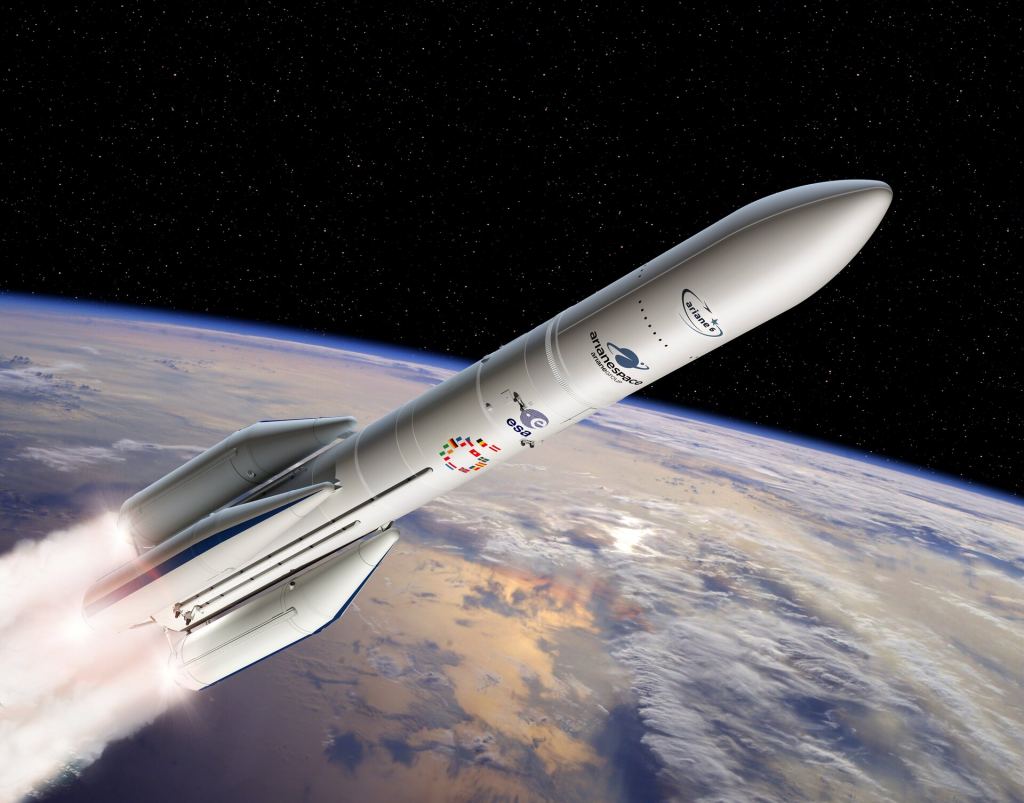
Building on their success with the Ariane 5 heavy launch vehicle, the European Space Agency and their primary contractor (Arianespace) plan to unveil its successor in 2022. The Ariane 6, which has been in development since 2010, is a two-stage heavy launch vehicle that measures over 60 meters (197 ft) tall and will weigh up to 900 metric tons (992 US tons) with a full payload.
Artist’s view of the configuration of Ariane 6 using four boosters (A64). Credit: ESA
Depending on the payload, the rocket will come in two variants: the Ariane 62, with two strap-on boosters, and the Ariane, 64 with four. The Ariane 62 will be capable of launching payloads of approx. 4500 kg (9920 lbs) into a geostationary transfer orbit (GTO) or 10,300 kg (22,700 lbs) into a Low Earth orbit. (LEO). The Ariane 64 will be able to launch payloads of approx. 11,500 kg (25,350 lbs) to GTO and 20,600 kg (45,415 lbs) into low Earth orbit.
Led by ArianeGroup, 600 companies in 13 European countries have been involved in the development of the Ariane 6. Meanwhile, France’s space agency (CNES) is busy preparing the Ariane 6 launch facilities at Europe’s Spaceport at Kourou, French Guiana. The ESA hopes to conduct the first flight of the Ariane 6 during the second quarter (between April and June) of 2022.
DART
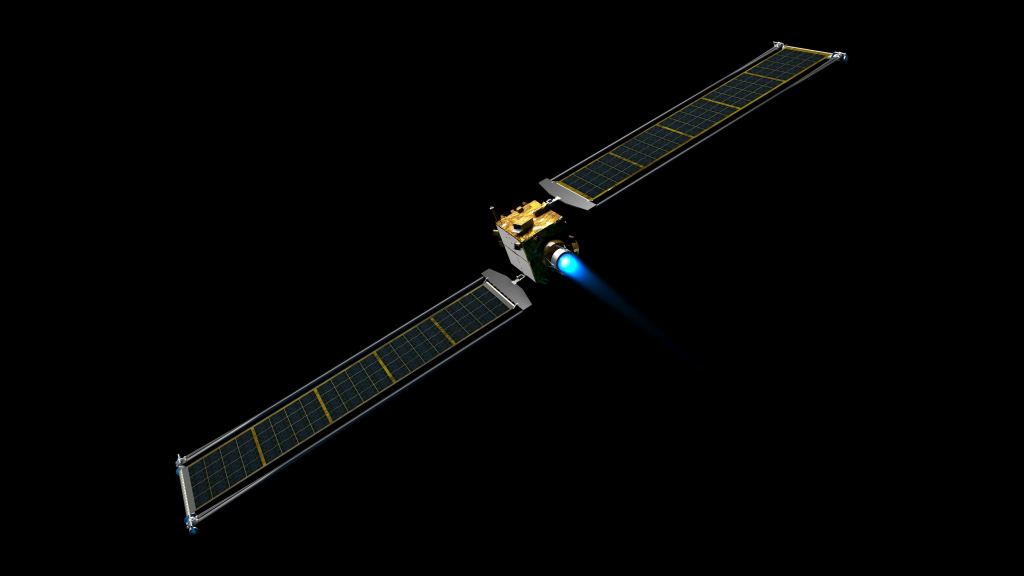
The NASA Double Asteroid Redirection Test (DART) mission is a demonstrator that will evaluate planetary-defense technologies. DART will test the kinetic impact technique, where a spacecraft intentionally collides with a potentially-hazardous asteroid to change its course and divert it from hitting Earth. The target for this mission is the binary near-Earth asteroid (65804) Didymos, which consists of a primary measuring 780-meter (2,560 ft) and a small “moonlet” 160-meters (525 ft) in size.
While this asteroid does not pose a threat to Earth, it is an ideal testing ground to evaluate the technology and technique involved. Once the DART spacecraft reaches Didymos, it will rely on an onboard camera (named DRACO) and sophisticated autonomous navigation software to collide with the moonlet at a speed of approximately 6.6 km/s (4 mi/s). The collision will cause a change in the speed of the moonlet’s orbit, which telescopes on Earth will then measure.
Illustration of the DART spacecraft with the Roll-Out Solar Arrays (ROSA) extended. Credit: NASA
On December 25th, 2021, fans of astronomy and cosmology received what was arguably the best Christmas present possible! After years of delays, cost overruns, and additional testing, the James Webb Space Telescope finally launched to space. In the early weeks of January, NASA provided a regular stream of updates, keeping the world appraised of the telescope’s successful pre-mission deployments. This included the extension of its heat shield, secondary mirror, primary mirror, and other crucial mission hardware.
Once operational, Webb will address some of the most fundamental questions about astronomy, physics, and the origins and evolution of the Universe. This will include observing the first stars that formed 200 – 400 million years after the Big Bang, followed by the first galaxies and how they evolved. These observations will allow astronomers to measure the influence of Dark Matter and Dark Energy in cosmic evolution.
Webb’s advanced infrared imaging will allow it to observe star systems that are still in the process of forming, which will answer unresolved questions about how stars seed the Universe with building materials to make planets and how planets can give rise to life. It will also greatly expand the census of extrasolar planets and help to characterize their atmospheres, allowing astronomers to determine which planets are truly “habitable.”
At present, the JWST is busy testing the individual segments of its primary mirror, a process that is expected to last for another week (January 22nd). On the following day, the James Webb will conduct its L2-Insertion Burn, a course correction that will place it into the L2 Lagrange Point, where it will stay for the duration of its ten-year mission. By this summer, six months after launch, Webb will be collecting its first light and should have some stunning first images for the public!
Juno
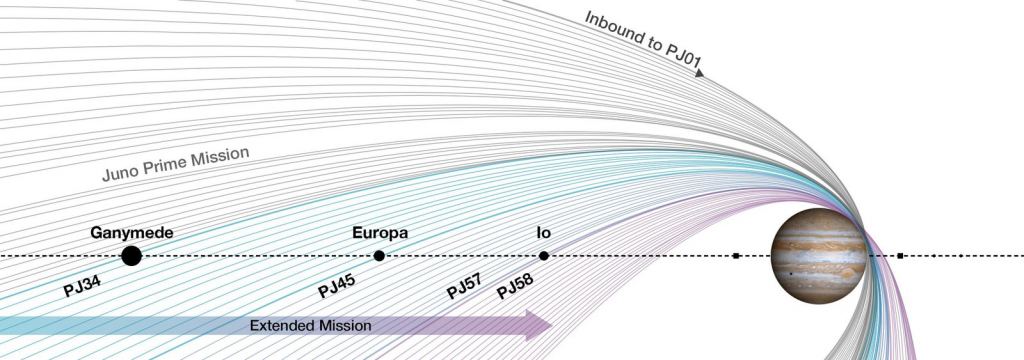
In August 2011, NASA’s Juno probe launched from Cape Canaveral Air Force Station (since renamed Cape Canaveral Space Force Station.) By July 2016, it established orbit around Jupiter and became the second mission dedicated to studying Jupiter’s atmosphere, composition, magnetic field, and gravitational field. Starting in September 2022, during its 45th polar orbit of Jupiter (perijove 45), it will shorten its orbit from 43 to 38 days. This will allow it to conduct multiple flybys of Europa.
The data Juno obtains about Jupiter’s largest moons (Callisto, Ganymede, Europa, and Io) will help inform future missions to study these satellites. For example, the ESA’s JUpiter ICy moons Explorer (JUICE) will launch in 2023 and arrive at Jupiter by 2031. By 2032, it will assume orbit around Ganymede to conduct surveys of the surface, followed by a series of flybys of Europa. There’s also NASA’s Europa Clipper Mission, which is scheduled to launch in 2024 and arrive at Jupiter by 2030.
These two missions will examine Jupiter’s moons to learn more about the composition of their surface ice, investigate water plume activity, learn more about their interior oceans, and scan for potential biosignatures. The data they obtain will also inform future missions to Jupiter’s icy moons, like the Europa Lander.
NASA has extended the mission of its Juno spacecraft exploring Jupiter. The extended mission involves 42 additional orbits. Credit: NASA/JPL-Caltech/SwRI
New Glenn
Blue Origin made some significant strides in 2021 with their New Shepard reusable launch vehicle. After a series of uncrewed test flights, including one loaded with science experiments and a “crew rehearsal,” the company conducted three high-profile flights to the edge of space with at least one celebrity aboard. On the inaugural flight, the crew included Jeff Bezos, his brother Mark, commercial astronaut Wally Funk, and 18-year old physics student Oliver Daemen, the oldest and youngest people to go to space (respectively).
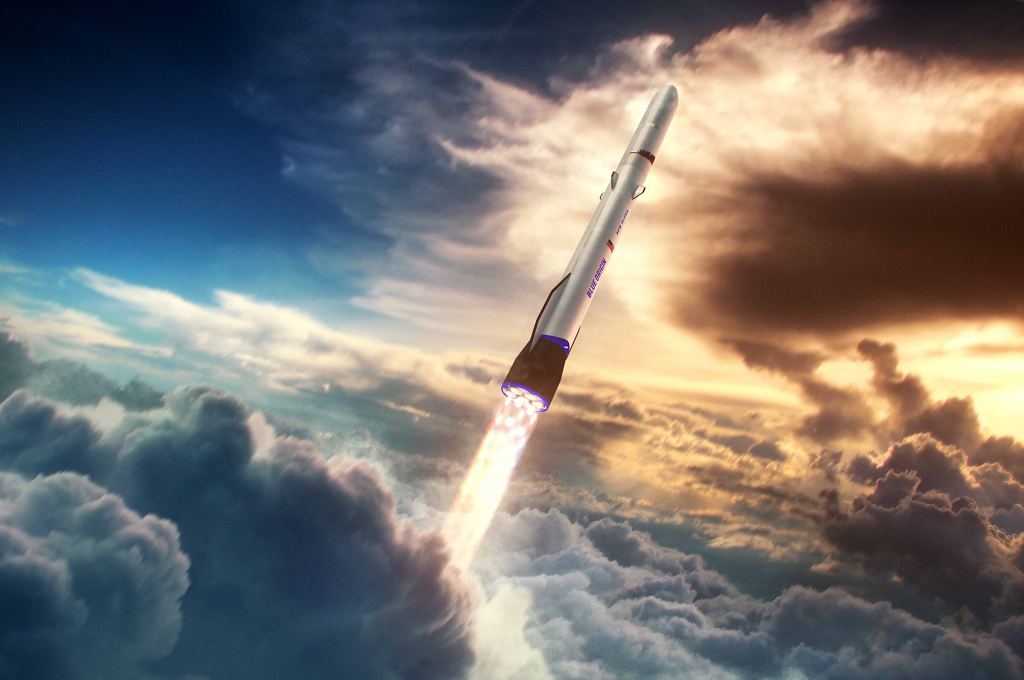
On the second flight, famed actor William Shatner was the headliner, with Laura Shepard Churchley (Alan Shepard’s daughter) and two-time Superbowl Champion and Good Morning America co-anchor Michael Strahan headlining the third. In 2022, Blue Origin is expected to press on with developing their New Glenn launch vehicle, a two-stage reusable launch vehicle named in honor of astronaut John Glenn. If all goes well, they may attempt the first launch sometime between October and December 2022.
Work on the rocket’s design began in 2012, and the first detailed specifications were unveiled in September 2016. While Bezos’ hoped that the rocket would be ready in time for a 2020 launch, by February 2021, the company announced that the target launch date would be “no earlier than the fourth quarter of 2022.” Once complete, the New Glenn will measure over 98 m (322 ft) tall, slightly less than the 110.6 m (363 ft) Saturn V launch vehicle that flew the Apollo astronauts to the Moon.
With its massive 7 meter-wide (22 ft) fairing, seven BE-4 primary engines, and three BE-3U secondary engines, the rocket will be able to lift 45 metric tons (49.6 U.S. tons) to Low Earth Orbit (LEO) and the 13 metric tons (14.33 U.S. tons) to a Geostationary Transfer Orbit (GTO). The ability to conduct orbital launches with these types of payloads means that Blue Origin will finally be competitive with other launch providers, like SpaceX and United Launch Alliance (ULA).
Artist’s impression of the New Glenn rocket. Credit: Blue Origin
Psyche
This will be the first mission to explore a metallic (M-type) asteroid, but the significance of this mission goes far beyond this. Psyche II is believed to be the core remnant of a protoplanet that formed in the early Solar System and experienced a massive impact that removed its outer layers. As a result, only the protoplanet’s iron-nickel core was behind as the largest known M-type asteroid in the Solar System. In addition to these metals, the mission team also anticipates that there will be large quantities of gold, platinum, and other precious metals.
Some estimates place the value of this metallic body at $10 quintillion (10 x 1018), which is significantly more than the entire global economy – over $80 trillion annually. (World Bank, 2017). However, the true value in this asteroid (for the time being) lies in the scientific returns it promises. By studying this planetoid remnant, astronomers expect to learn a great deal about the early Solar System, its formation, and evolution.
The Psyche mission will launch on August 1st, 2022, and will arrive around Psyche by January 31st, 2026.
Rosalind Franklin Rover (ExoMars 2022)
This year, the ESA will send the second installment in their ExoMars program to Mars. This will consist of the Roscosmos-designed Kazachok Lander and the ESA-designed Rosalind Franklin Rover. Building on the work of its predecessors, the ExoMars 2016 mission (which consisted of the Trace Gas Orbiter and Schiaparelli Lander), Kazachok and Rosalind Franklin will study the Martian surface to determine if life ever existed on Mars (and could today).
This mission is scheduled to launch between August and October of 2022 from the Baikonur Cosmodrome in Kazakhstan and land on Mars roughly nine months later. Once there, the rover will join its peers, like the Curiosity and Perseverance rovers, in the ongoing search for potential biosignatures. These could indicate the existence of life on Mars billions of years ago when the planet had a thicker atmosphere and still had flowing water on its surface.
Space Launch System (SLS)
As NASA’s next-generation super-heavy launch vehicle, the Space Launch System (SLS) is the successor to the Saturn V rocket that transported the Apollo astronauts to the Moon. Development began on the rocket in 2011 and has endured multiple delays and cost overruns since. However, NASA made significant strides towards getting the SLS ready in 2020 and 2021. This included the completion of the Green Run with the Core Stage of the rocket, an 8-step evaluation that culminated with the “Hot Fire Test” in March of 2021.
Since then, the Core Stage has been moved to NASA’s Launch Control Center (LCC) at the Kennedy Space Center in Florida, where it was integrated with its solid rocket boosters and stacked with the Orion Spacecraft. While NASA was hoping to conduct the inaugural launch of the SLS with an Orion spacecraft (Artemis I) by November 2021, that flight is now scheduled to launch by March 20th, 2022.
As part of the Artemis Program, this flight will see an uncrewed Orion sent on a circumlunar flight that will last 25 days. This mission will gauge the performance of both systems and allow mission scientists to develop vital experience in preparation for crewed flights. This will include Artemis II, a crewed mission that will launch in May 2024 that will see four astronauts conduct a lunar flyby before returning to Earth.
The fully-stacked SLS at the Vehicle Assembly Building at NASA’s Kennedy Space Center in Florida. Credit: NASA
If all goes well, Artemis III, the first crewed mission to the lunar surface since the Apollo Era, will occur sometime in 2025. This mission will consist of a crew of four flying to the Moon, and two astronauts (“The first woman and first person of color“) will land on the surface using a Human Landing System (SLS). This will be followed by several more crewed missions that will establish permanent infrastructure on the surface and in orbit – including the Artemis Base Camp and the Lunar Gateway.
In addition to the Artemis Program, the SLS is also an essential component for NASA’s long-term vision of crewed missions to Mars (their previous “Moon to Mars” mission architecture). These missions are still expected to occur early in the next decade, coinciding with launch windows of 2033, 2035, 2037 – i.e., every twenty-six months when Earth and Mars are at the closest point in their orbits to each other (aka. a “Mars Opposition“).
Starship
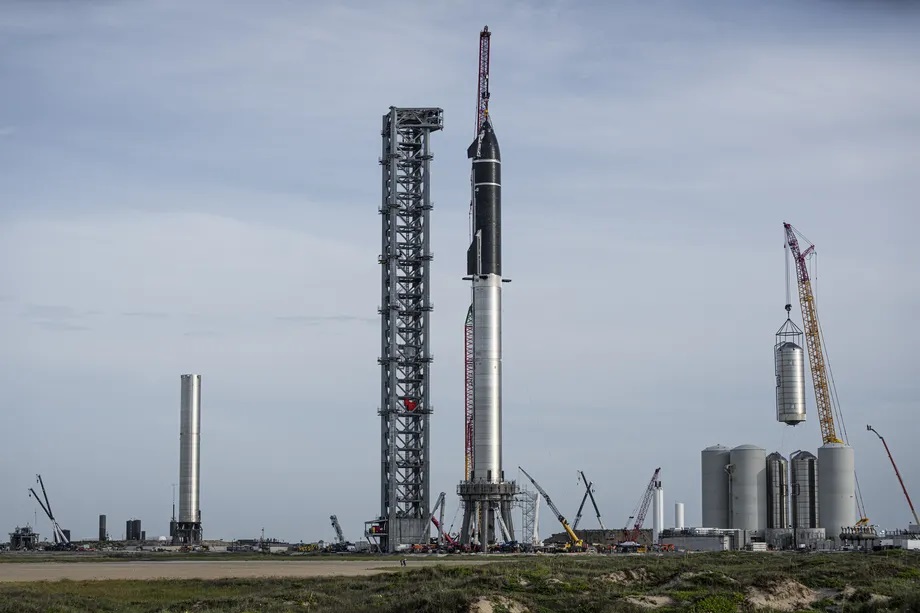
SpaceX will also be blazing a trail this year with the first orbital flight test of the Starship and Super Heavy launch vehicle. Development on this spacecraft officially began after Musk unveiled the Interplanetary Transport System (ITS) in 2016 – though concepts for a “Mars Colonial Transporter” (MCT) and “BFR” were discussed as early as 2005. In 2017, Musk shared a detailed mission architecture and a timeline for using the ITS to establish a permanent human outpost on Mars.
By 2018, the ship’s design and the mission architecture were updated, and the launch system was renamed again – the Starship orbital spacecraft and Super Heavy booster. Shortly after that, SpaceX expedited construction of its South Texas Launch Facility, located near the town of Boca Chica on the Gulf of Mexico. This is where, for the past three years, SpaceX has progressively tested and validated the Starship through test firings, pressure tests, and test flights.
The Starship and Superheavy (fully stacked) standing next to the “Mechazilla” launch and retrieval tower at Boca Chica, Texas. Credit: SpaceX
In 2021, SpaceX accomplished several milestones with the development of the Starship and the Boca Chica facility (now called the Starbase). After a series of successful flight and glide tests with Starship prototypes (two even managed to stick the landing!), SpaceX built a prototype for orbital flight (SN20) with six Raptor engines and heat shielding. They’ve also finished assembling multiple Super Heavy prototypes and built the “Mechazilla” launch and retrieval tower.
Though SpaceX had indicated that it hoped to conduct the first orbital flight test in early 2022 (January or February), the Federal Aviation Administration (FAA) indicated on December 28th that this must wait upon the completion of their Programmatic Environmental Assessment (PEA) – which they are aiming to finish by February 28th. This means that SpaceX will likely have to wait until the end of the first quarter (or early Q2) to make their orbital launch test.
Based on the flight path SpaceX’s previously filed with the Federal Aviation Administration and a recent announcement by NASA, the flight will launch either from the Starbase or the newly-commissioned Launch Complex 49 at Cape Canaveral, Florida.
Tiangong
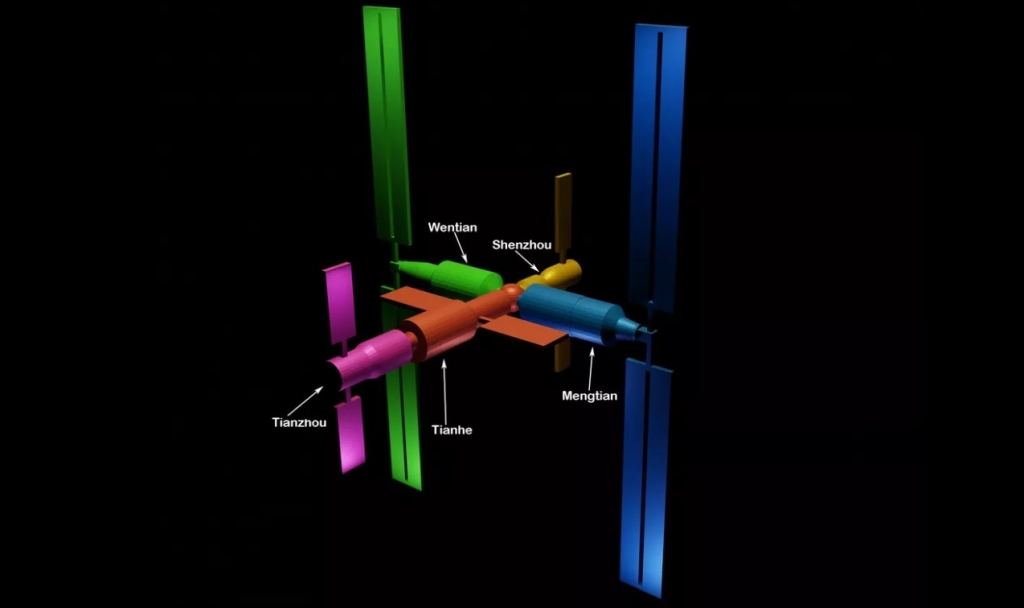
This year will also see significant developments for the China National Space Agency (CNSA). For instance, China’s plans to complete its Tiangong space station (“Heavenly Palace”) in orbit, which is intended to rival (and possibly succeed) the International Space Station (ISS). This will be the culmination of the Tiangong program and will build on the experience gained from the Tiangong-1 and Tiangong-2 space stations.
The Tianhe module will form the core of the space station, with other modules to be added later to increase the size of the station and make more experiments possible. Credit: Saggitarius A/Wikimedia Commons
Deployment of the Tiangong space station began with the launch of the Tianhe core module on April 29th, 2021. This year, the two other primary modules will be launched to orbit, where they will be integrated with the core module. This includes the Wentian Laboratory Cabin Module (“Quest for the Heavens”) and the Mengtian Laboratory Cabin Module (“Dreaming of the Heavens”) – which are scheduled to launch between May and June 2022 and August and September 2022 (respectively).
The CNSA also plans to conduct multiple launches to the Tiangong space station this year, including two Shenzhou crewed missions and two Tianzhou cargo missions.
ULA Vulcan Centaur
Since 2014, the United Launch Alliance (ULA) has been working on a new heavy launch system known as the Vulcan Centaur. This two-stage rocket will consist of a first stage that relies on a single Blue Origin BE-4 engine and up to six GEM-63XL solid rocket boosters (SRBs). The second stage consists of the ULA’s new Centaur V vehicle powered by two Aerojet Rocketdyne RL-10 engines.
Since work began on the Vulcan Centaur, the ULA has indicated that they intend to upgrade the rocket to make it at least “partially reusable.” This included early plans to make the first stage BE-4 engines reusable by making them detachable and equipping them with parachutes. A more bold concept, Sensible Modular Autonomous Return Technology (SMART), consisted of making the first-stage booster engines, avionics, and thrust structure into a single module that would be detachable and retrievable.
After the first stage completed its booster engine burn, this module would detach from the propellant tanks and undergo mid-air retrieval with the help of parachutes and an inflatable heat shield. While there’s been no development on this front, the ULA did indicate in late 2019 that they still planned on making the Vulcan’s first-stage BE-4 engines detachable and reusable.
Vulcan Centaur, United Launch Alliance’s next-generation American rocket, lifts off in this artist’s rendering. Credit: ULA
While ULA had intended to conduct the maiden flight in 2021, the date has since been pushed to 2022 due to delays with the development of the commercial payload, which were a result of the pandemic. For this flight, the Vulcan Centaur will launch Atrobotic Technology’s Peregrine Lunar Lander (Peregrine Mission-1) as part of NASA’s Commercial Lunar Payload Services (CLPS) program.
Vera Rubin Observatory
In addition to the many missions destined for space, the Moon, and Mars, many developments are expected to happen here on Earth this year as well. One of them is the Vera C. Rubin Observatory, formerly known as the Large Synoptic Survey Telescope (LSST), which is scheduled to gather its first light by October 2022. Full-survey operations are not expected until October 2023 due to COVID-related schedule delays. However, its main astronomical survey – the Legacy Survey of Space and Time (LSST) – will be worth the wait!
Using its massive 3200-Megapixel camera, the LSST will consist of four major science goals. These include probing the Universe’s large-scale structure to measure the influence of Dark Matter and Dark Energy, taking an inventory of objects in the Solar System, exploring the transient optical sky, and mapping out the Milky Way Galaxy. In addition, the Observatory will be invaluable to the study of interstellar objects (ISO) and is expected to detect between five objects a year or a few a month.
Rubin Observatory at sunset, lit by a full moon. Credit: Rubin Observatory/NSF/AURA
While many predict that 2022 will have its share of tribulations, not the least of which is because of the ongoing pandemic, it’s also clear that it will be an exciting time characterized by multiple breakthroughs and important milestones. Perhaps the milestones and discoveries that we make in space this year will remind us that there are always reasons to be hopeful. A few gentle reminders of our place in the Universe has a way of putting things into perspective!