Sunday, October 29, 2023

Environmental Concerns Could Drive Asteroid Mining

Asteroid mining is one of those topics that sounds like it’s straight out of science fiction. But, in recent years, with the growth of lower-cost launch options, mining space rocks could become downright economical. As an added plus, getting important resources from asteroids could help drive the switchover to clean environmental practices and technologies right here on Earth.

In a recent exploratory paper, a group of academic researchers at Colorado School of Mines led by Dr. Maxwell Fleming joined an International Monetary Fund member Martin Stuermer to explore the topic. Their work looks at a variety of factors, including those lower launch costs, and asks the question “What if these costs continue to decline, making mining from asteroids or the Moon feasible?”

They analyzed the most relevant factors and used a Ramsay growth model to look at cost savings and investment dynamics involved with a transition from Earth-based to space mining. That model outlines a steady economic growth rate in terms of labor, capital, and technology. For space-based mining, labor is an open question, since such activities probably would be mostly robotic. Investment capital probably isn’t a problem, but the development of such technology has challenges.

Modern coal mining in Germany. Courtesy Eickhoff Gruppe, CC BY-SA 3.0

After examining the costs of mining here on Earth—both economic and environmental—the answer is fairly simple. They write, “We find that a transition of mining from Earth to Space could potentially allow for continued growth of metal use on Earth while limiting environmental and social costs. At the same time, such a transition could require an upper limit on the environmental and social costs on Earth to incentivize investment into R&D for space mining.”

Mining on Earth and Asteroids

Earth-based mining is an old and familiar concept. In the “olden days”, it was fairly cheap to get ores out of the ground. Miners dug ore and sent it to market. In more modern times, most mining uses automation in addition to some human labor. These days, the cost of extracting minerals has increased 60 times over the past century. It’s also incredibly environmentally damaging.

Many minerals today are important to the clean energy technologies needed for more efficient transportation, communication, and other facets of modern living. A complete clean energy transition leans heavily on the availability of copper, cobalt, nickel, zinc, silver, and others. Increased mining costs and depletion of these resources have an effect on the clean energy transition. And, of course, there are always the environmental effects of such mining.

The Challenges of Space Mining

With that in mind, people are looking toward space-based resources. That means asteroids and possibly the Moon. Asteroids are a particularly tasty target. They’re just floating around out there, and appear to be rich in many ores. Of course, there are challenges to getting those ores. First, miners have to get to the asteroids. Or, we need to build robotic mining operations that work on asteroids in the harsh environment of space. Then, all that ore has to be transported back to Earth for refining and eventual incorporation into our clean technologies. That could, in the long run, stimulate economic growth back here on the home planet.

Leaving aside questions of “Who benefits?” and “Should we worry about the environmental damage to asteroids and near-Earth space?”, mining asteroids does present an interesting and profitable challenge.’ just floating around out there, and they appear to be rich in many ores. Of course, there are challenges to getting those ores. First, miners have to get to the asteroids. Or, we need to build robotic mining operations that work on asteroids in the harsh environment of space. Then, all that ore has to be transported back to Earth for refining and eventual incorporation into our clean technologies. That could, in the long run, stimulate economic growth back here on the home planet. Leaving aside questions of “Who benefits?” and “Should we worry about the environmental damage to asteroids and near-Earth space?”, mining asteroids does present an interesting and profitable challenge.

The Challenges of Space Mining

One potential sticking point is basically “How do we know which asteroids are rich in ores?” While planetary scientists know a fair amount about these leftovers of Solar System creation, a lot remains unknown. For example, based on asteroid samples, scientists know that the abundance of some minerals in asteroids is higher than here on Earth. Cobalt, Nickel, and iridium, for example, are more abundant on asteroids. But, how much are we talking about? That’s unknown because scientists don’t have good data on any “reserves” existing on these objects. Of course, as NASA and others send more probes to asteroids, that knowledge base will change. Eventually, companies interested in mining will be able to develop more concrete plans based on feasibility studies and missions (such as OSIRIS-REx) sent by space agencies.

Artist concept of NASA’s OSIRIS-REx spacecraft as it readies itself to touch the surface of asteroid Bennu. This mission is an early precursor to possible asteroid mining. Credits: NASA/Goddard/University of Arizona

Another potential barrier is the development of the actual mining technologies. There are issues of usability, safety, and cost. Any equipment will have to work consistently in a low-gravity, near-vacuum environment. It’s one thing to send a small test robot to poke at an asteroid, and that does give some initial ideas about mining equipment. But, extensive mining to solve some of the environmental challenges here on Earth will require a full-scale operation. Once those challenges are met, the authors of the paper expect that the space environment will hardly be affected. Also, they state that costs to transport ores back to Earth (or Earth orbit) will benefit from utilizing the gravity well. A number of challenges on the technology side need solutions.

What Do We Gain?

The authors of the study employed a growth model to chart a possible plausible future for space mining. They came up with the following conclusions. First, eventually, there could well be a shift from mining Earth resources to exploiting asteroid resources. This will be influenced by the amount of environmental damage done here on the home planet. Second, there will need to be a pretty substantial investment in R&D for mining asteroids. Third, costs should drop as companies deploy more technology for mining. Fourth, in the short term, as ores are depleted on Earth, costs could rise, which could slow down a clean energy transition. But, if massive amounts of ores from space become available, eventually costs drop. That could signal a speed-up of the transition.

There’s an important factor that will affect future mining in space: who owns the asteroids? While the goal of the paper was to examine an economic model for space mining, the political and social aspects also need to be examined. Property rights in space have to be clarified, particularly in light of the Outer Space Treaty. Some countries and companies are very interested in exploiting resources and the Treaty may or may not stop them from doing so. In addition, questions about the market, public-private partnerships, taxation, and other aspects of doing business also come into play.

The authors end their exploration of the topic by asking, “How can the government help “buy down” the risk to encourage private investment? What public–private partnerships provide all parties with a fair distribution of potential gains?” The answers remain for future investors to determine.

For More Information

Mining in Space Could Spur Sustainable Growth

The post Environmental Concerns Could Drive Asteroid Mining appeared first on Universe Today.


Saturday, October 28, 2023

China Showcases its Lunar Exploration Plans

The China National Space Agency (CNSA) has drawn a lot of attention to its space programs in recent years. In addition to their Tiangong space station and crewed missions to Low Earth Orbit (LEO), there’s also been a lot of buzz surrounding the China Manned Space Agency (CMSA) and its Human Lunar Space Program. The high points have included the announcement of the International Lunar Research Station (ILRS) – a joint operation with Roscosmos – and shared concept art for their next-generation spacecraft and lunar lander.

As always, what we know about China’s plans for space exploration is limited to snippets of news, public statements, and the occasional video, which are the direct result of state-controlled media and tight secrecy regarding the country’s space program. The latest is a bootleg video that recently appeared online, which shows a video presentation that provides some insight into China’s long-term plans for crewed lunar exploration. The video is captioned with the words “China’s lunar space station and development of lunar molten cave base plan,” and it certainly lives up to that description!

The video presents several familiar elements of lunar exploration, which have been hinted at in the past by the CMSA and the Manned Lunar Deep Exploration Project Office. These include a modular station in lunar orbit, robotic missions exploring the surface to scout resources and locate a base site, lunar landers, and facilities that will grow food, provide power, and facilitate crewed missions to explore the surface. In-Situ Resource Utilization (ISRU) and using robots equipped with additive manufacturing (3D printers) are also alleged from the imagery alone.

Lunar Base in Orbit

The video, uploaded by YouTube user Chen Junlong, opens with a spacecraft rendezvousing with an orbiting lunar habitat. Immediately, this tells us that China hopes to create an orbital platform that will rival NASA’s Lunar Gateway, which has been hinted at in the ILRS mission architecture. This includes the International Lunar Research Station (ILRS) Guide for Partnership released in 2021, which describes the ILRS as a complex experimental research [facility] to be constructed with [the] possible [involvement] of partners on the surface and/or in orbit of the Moon.

An orbital element is further detailed in Section 1 (“Facilities Description”), where there is the mention of a Cislunar Transportation Facility in addition to a Long-term Support Facility on the Lunar Surface. According to the guide, the former will “support cislunar round-trip transfer between the Earth and the Moon, lunar orbiting, soft landing, ascending on [the] lunar surface and re-entry to the Earth.” Whereas the Gateway will be placed in a “halo orbit” around the Moon (orbiting from pole to pole), the Chinese facility is shown orbiting the lunar equator.

Lava Tube Habitat

In the video, this habitat is also a staging area for creating a subsurface habitat – the “lunar molten cave base.” For years, NASA has researched the possibility of building bases inside these tubes since they are accessible via “skylights” (holes in the surface) and are large enough to accommodate entire bases. They can also maintain comfortable room temperature conditions inside and provide natural shielding against radiation. China has also indicated that they are exploring the possibility of building a base inside lunar lava tubes.

At the 10th CSA-IAA Conference on Advanced Space Technology in September, representative Zhang Chongfeng from the Shanghai Academy of Spaceflight Technology presented a study that detailed fieldwork where his colleagues and planetary geologists explored several lava caves in China. According to Zhang, this research could lead to bases constructed in Mare Tranquillitatis (the Sea of Tranquility), where the Apollo 11 astronauts landed, and Mare Fecunditatis (the Sea of Fertility), both of which are located in the eastern half of the visible side of the Moon. However, rather than using a natural skylight, Chinese explorers created one in the video using a penetrator launched from the station.

Once the debris is cleared and the robots explore the cave below, we then see the core module of the lunar base deploying from the orbiting habitat. It then lands in the artificial skylight and deploys infrastructure into the cave, including inflatable cabin sections that appear to be a greenhouse and a research module. Meanwhile, the core deploys another inflatable module on the surface around the artificial skylight, which a robotic 3D printer proceeds to fashion a dome over. Both modules are equipped with double-layer airlocks, providing the crew access to the surface and subsurface.

This is followed by the creation of a solar array and other platforms that accommodate radio receivers, a vehicle bay (Lunar Transportation and Operation Facility in the ILRS guide), and a landing pad for lunar landers. The remaining footage details the allocation of space inside the habitat for different operations (research, sleeping, exercise) and how a central elevator connects the surface and subsurface sections. We also get a brief glimpse at what operations taikonauts will perform, which includes growing plants, conducting EVAs on the surface, and exploring =lunar caves.

Lunar Landers

This brings up another key element of China’s lunar program, which is the lander that will transport crews to and from the surface. However, the lander featured here does not resemble the one China recently unveiled, which will be used to send the first taikonauts to the lunar surface by 2030. But from the footage, this lander is clearly not reusable either, consisting of a descent and ascent module – similar to the lunar landers used by the Apollo astronauts.


The video also hints (very briefly) at the end that these lunar facilities will enable future missions to Mars. This is similar to what NASA has stated about the Artemis Program and the “Moon to Mars” mission architecture that preceded it. In previous statements, China has indicated that it intends to send crewed missions to Mars starting in 2033, the same timeline proposed by NASA. Under the circumstances, it makes sense that they would be adopting a similar Moon-to-Mars architecture with the ILRS. This constitutes the most detailed vision of China’s proposed lunar program to date.

It will be interesting to see how this unfolds in the coming years!

Author’s note: The origin and authenticity of the video are unclear, which is exacerbated by the fact that it is a recording of a video presentation (i.e. a bootleg). Nevertheless, the content certainly looks authentic and aligns with a lot of previous statements by the CNSA. Take it with a grain of salt!

The post China Showcases its Lunar Exploration Plans appeared first on Universe Today.


The Largest Simulation of the Universe Ever Made

There’s a running joke among astronomy students that the most-dreaded question on a final in cosmology is “Define the Universe and give three examples.” Nowadays, the answer could just very well be, “See the FLAMINGO simulations.”

They’re a product of the VIRGO consortium for cosmological supercomputer simulations. FLAMINGO stands for Full-hydro Large-scale structure simulations with All-sky Mapping for the Interpretation of Next Generation Observations. Its main science goals are to carry out a suite of massive cosmological simulations. These latest and largest model universe simulations executed on a supercomputer cluster at Durhan University in the UK.

A Sizeable Simulation

The largest simulations in the suite use 300 billion resolution elements. These are particles with the mass of a small galaxy, all arrayed in a cubic volume with edges of ten billion light-years. It’s likely the largest cosmological computer simulation with ordinary matter ever completed. Matthieu Schaller (Leiden University): “To make this simulation possible, we developed a new code, SWIFT, which efficiently distributes the computational work over 30 thousand CPUs.”

The background image shows the present-day distribution of matter in a slice through the largest FLAMINGO simulation, which is a cubic volume of 2.8 Gpc (9.1 billion light years) on a side. The luminosity of the background image gives the present-day distribution of dark matter, while the colour encodes the distribution of neutrinos. The insets show three consecutive zooms centred on the most massive cluster of galaxies; in order, these show the gas temperature, the dark matter density, and a virtual X-ray observation. Josh Borrow, the FLAMINGO team and the Virgo Consortium.
The background image shows the present-day distribution of matter in a slice through the largest FLAMINGO simulation, which is a cubic volume of 2.8 Gpc (9.1 billion light years) on a side. The luminosity of the background image gives the present-day distribution of dark matter, while the color encodes the distribution of neutrinos. The insets show three consecutive zooms centered on the most massive cluster of galaxies; in order, these show the gas temperature, the dark matter density, and a virtual X-ray observation. Josh Borrow, the FLAMINGO team and the Virgo Consortium.

The VIRGO consortium focuses on the evolution of the intergalactic medium, the formation and evolution of galaxies, galaxy clusters, large-scale structures, the formation of dark matter haloes, and the large-scale distribution of dark matter. The FLAMINGO simulations go further, tracking not only dark but also ordinary matter (such as planets, stars, and galaxies). The result is a glimpse of how the Universe may have evolved.

Simulation of the Cosmos

So, how do you go about simulating the Universe? First, you need data about everything that’s out there. Observatories on the ground and in space collect huge amounts of information about everything they can detect. Next, all that information goes into a series of models that are incorporated into the larger simulations.

The simulations utilized data about all the regular (baryonic) matter there is. That includes planets, stars, galaxies, gaseous nebulae—essentially everything detectable. But, that’s not all there is in the cosmos. There’s dark matter, even though it’s only detectable through its gravitational influence on baryonic matter. And, you have to account for the mysterious dark energy.

The surface density of cold dark matter is modeled in a 20 Mpc slice of the Universe. This is part of the FLAMINGO simulation. Courtesy Joop Schaye, et al
The surface density of cold dark matter is modeled in a 20 Mpc slice of the Universe. This is part of the FLAMINGO simulation. Courtesy Joop Schaye, et al.

Okay, so that’s it, right? Well, not so fast. Stuff in the Universe interacts, usually via gravity, but also other processes. So, you have to take gravity into account. In addition, ordinary matter reacts to gas pressure. This sends matter out of galaxies by way of active black holes or supernova explosions. Then, there are more esoteric factors, such as the gravitational back-reaction of dark matter due to the redistribution of baryons. You need models of the relations between galaxy properties and various physical processes at work in galaxies and clusters. Other models take into account the star-formation activity of a central galaxy, which may correlate with the distribution of gas around it.

You’d also need hydrodynamical simulations of cosmology and galaxy cluster physics and data about the effects of gravitational lensing. Oh, and neutrinos, because they also play a role. All of this information has to be modeled and put into the simulation suite. The result is a greater large-scale understanding of our cosmos.

Simulations and Tensions

Aside from coming up with a full-scale model of the Universe, FLAMINGO’s work is also a way to take all cosmic data and connect various predictions and theories about the universe to actual observations. Theories include a set of properties about the Universe called the “cosmological parameters”. Those can be measured and compared to other observations. If they don’t match, that introduces a “tension” between measurements.

For example, there’s one called the “Hubble tension”. It refers to a parameter called H0 (pronounced “H-naught”) that really affects distance measurements in the Universe. Its value is the expansion rate of the Universe. H0 has been variously measured at 67 kilometers per second per megaparsec all the way up to 74.

There are other “tensions” in cosmological measurements, as well. One involves properties of the cosmic microwave background. That’s the light essentially left over from the earliest epochs of cosmic history. Some measurements of those properties yield different values so astronomers need to resolve that tension as well. Otherwise, they’d have to completely revise the standard model of cosmology which relies on a cold dark matter model. So, simulations are an important way to resolve tensions experimentally. They also allow researchers to play with different tweaks to their models.

Opening a Virtual Window on the Universe

The FLAMINGO project is really giving astronomers a new window into cosmic evolution. It’s based on real data to populate a virtual universe. The result is virtual data that researchers can test using new data analysis techniques and machine learning. Astronomers involved with the project have published three papers: one describing the methods, another presenting the simulations, and the third examining how well the simulations reproduce the large-scale structure of the Universe.

For More Information

The FLAMINGO Project
The VIRGO Consortium
Astronomers Carry Out Largest-ever Cosmological Computer Simulation
The FLAMINGO Project: Cosmological Hydrodynamical Simulations for Large-scale STructure and Galaxy Cluster Surveys
“FLAMINGO: Calibrating Large Cosmological Hydrodynamical Simulations with Machine Learning”.

“The FLAMINGO Project: Revisiting the S8 Tension and The Role of Baryonic Physics”

The post The Largest Simulation of the Universe Ever Made appeared first on Universe Today.


A New Map Shows Where Mars is Hiding all its Ice

Water will be one of the most important resources for human explorers on Mars. They’ll need it for drinking, propellant, breathing, and more. It makes sense to land near a spot where there’s water ice close to the surface.

NASA has released a new map of Mars’s northern hemisphere showing all the places where subsurface water ice has been detected, some of which are surprisingly close to the equator, as well as surprisingly close to the surface. This map could decide the first human landing site.

Earlier and later HiRISE images of a fresh meteorite crater 12 meters, or 40 feet, across located within Arcadia Planitia on Mars show how water ice excavated at the crater faded with time. The images, each 35 meters, or 115 feet across, were taken in November 2008 and January 2009. Credit: NASA/JPL-Caltech/University of Arizona

Early on during the Mars Reconnaissance Orbiter (MRO) mission, which arrived at Mars in 2006, scientists started finding evidence of subsurface water ice being exposed from recent impacts, showing up as bright white in the high-resolution images from the new spacecraft. While scientists were fairly certain there was ice below the surface at high latitudes of Mars, they were surprised to find that the ice was also present closer to the equator.  

But whenever you’re looking for exposed subsurface ice on the Red Planet, you have to look fast. It doesn’t take long for ice — or water – to sublimate away because of the thin atmosphere on Mars.  

Scientists have now combined data from several NASA missions, including MRO, 2001 Mars Odyssey, and the now-inactive Mars Global Surveyor. The project is called SWIM, Subsurface Water Ice Mapping. The project has just released its fourth set of maps, and NASA and JPL say these are the most detailed water ice maps since the project began in 2017.

See the interactive map here, where you can zoom in and explore the various regions where water ice could be buried.

Using a mix of data sets, scientists have identified the likeliest places to find Martian ice that could be accessed from the surface by future missions.

“These ice-revealing impacts provide a valuable form of ground truth in that they show us locations where the presence of ground ice is unequivocal,” said Gareth Morgan, SWIM’s co-lead at the Planetary Science Institute, in a JPL press release. “We can then use these locations to test that our mapping methods are sound.”

These Mars global maps show the likely distribution of water ice buried within the upper 3 feet (1 meter) of the planet’s surface and represent the latest data from the SWIM project. Buried ice will be a vital resource for astronauts on Mars, serving … Credit: NASA/JPL-Caltech/PSI

The new maps reveal what scientists believe are masses of subsurface frozen water along Mars’ mid-latitudes. The northern mid-latitudes are especially attractive because a thicker atmosphere exists there than most other regions on the planet. A thicker atmosphere would aid in slowing down an incoming spacecraft. NASA says the ideal astronaut landing sites would be a sweet spot at the southernmost edge of this region – far enough north for ice to be present but close enough to the equator to ensure the warmest possible temperatures for astronauts in an icy region.

“If you send humans to Mars, you want to get them as close to the equator as you can,” said Sydney Do, JPL’s SWIM project manager. “The less energy you have to expend on keeping astronauts and their supporting equipment warm, the more you have for other things they’ll need.”

The HiRISE camera on NASA’s Mars Reconnaissance Orbiter took this image of a new, 8-meter (26-foot)-diameter meteorite impact crater in the topographically flat, dark plains within Vastitas Borealis, Mars, on November 1, 2008. The crater was made sometime after Jan. 26, 2008. Bright water ice was excavated by, and now surrounds, the crater. This entire image is 50 meters (164 feet) across. Credit: NASA/JPL-Caltech/University of Arizona

Back in 2009, data from several instruments on MRO detected and confirmed highly pure, bright ice exposed in new craters, ranging from 1.5 feet to 8 feet deep, at five different Martian sites. Scientists said they were able to figure out, given how long it took that ice to fade from view, that the ice was about 99 percent pure ice.

Over the years, MRO’s wonderful, high-resolution camera, HiRISE (High-Resolution Imaging Science Experiment) has continued to study fresh impact craters, where meteoroids may have excavated chunks of ice. For the latest maps for the SWIM project, HiRISE data was incorporated to provide the most detailed perspective of the ice’s boundary line as close to the equator as possible. Another instrument on MRO, the Context Camera, which provides a big-picture, background view of the terrain, provides data that further refines the northern hemisphere maps.

Detailed image of large-scale crater floor polygons, caused by desiccation process, with smaller polygons caused by thermal contraction inside. The central polygon is 160 metres in diameter, smaller ones range 10 to 15 metres in width and the cracks are 5-10 metres across. Credit: NASA/JPL

In addition to ice-exposing impacts, scientists also look for “polygon terrain,” where the seasonal expansion and contraction of subsurface ice causes the ground to form polygonal cracks. Seeing these polygons extending around fresh, ice-filled impact craters is yet another indication there’s more ice hidden beneath the surface at these locations.

“The amount of water ice found in locations across the Martian mid-latitudes isn’t uniform; some regions seem to have more than others, and no one really knows why,” said Nathaniel Putzig, SWIM’s other co-lead at the Planetary Science Institute. “The newest SWIM map could lead to new hypotheses for why these variations happen.”

He added that it could also help scientists tweak models of how the ancient Martian climate evolved over time, leaving larger amounts of ice deposited in some regions and lesser amounts in others.

SWIM’s scientists hope the project will serve as a foundation for a proposed future mission, called Mars Ice Mapper. This would be an orbiter with a powerful subsurface radar that could search for near-surface ice beyond where HiRISE has confirmed its presence.

The post A New Map Shows Where Mars is Hiding all its Ice appeared first on Universe Today.


Friday, October 27, 2023

JWST Sees Four Exoplanets in a Single System

When the JWST activated its penetrating infrared eyes in July 2022, it faced a massive wish-list of targets compiled by an eager international astronomy community. Distant, early galaxies, nascent planets forming in dusty disks, and the end of the Universe’s dark ages and its first light were on the list. But exoplanets were also on the list, and there were thousands of them beckoning to be studied.

But one distant solar system stood out: HR 8799, a system about 133 light-years away.

Why this system over others? 15 years ago astronomers discovered three exoplanets orbiting the star. Not long after they announced a fourth, all detected with direct imaging. They’re all massive planets on wide orbits, which are rare. The HR 8799 system is also young, another important point.

The fact that they were discovered 15 years ago is also important; it means we have observations of these planets that span a lengthy time. This type of data is critical to understanding other solar systems because the duration of the data paints a more complete picture.

However, it also poses more questions and whets our appetite for more answers.

That’s why the JWST observed the system recently. Its MIRI instrument and its coronagraph can perform the kind of high-contrast imaging needed to understand the system better.

A new paper presents the results of these observations. It’s title is “Imaging detection of the inner dust belt and the four exoplanets in the HR 8799 system with JWST’s MIRI coronagraph.” It’ll appear in the journal Astronomy and Astrophysics, and the lead author is Anthony Boccaletti from the LESIA, Observatoire de Paris, France.

HR 8799 is 1.5 times more massive than the Sun and is almost five times more luminous. It’s also surrounded by a debris disk and is only about 30 million years old. Young solar systems are important because they can reveal the intricate details behind planet formation, one of the things the JWST was built to focus on.

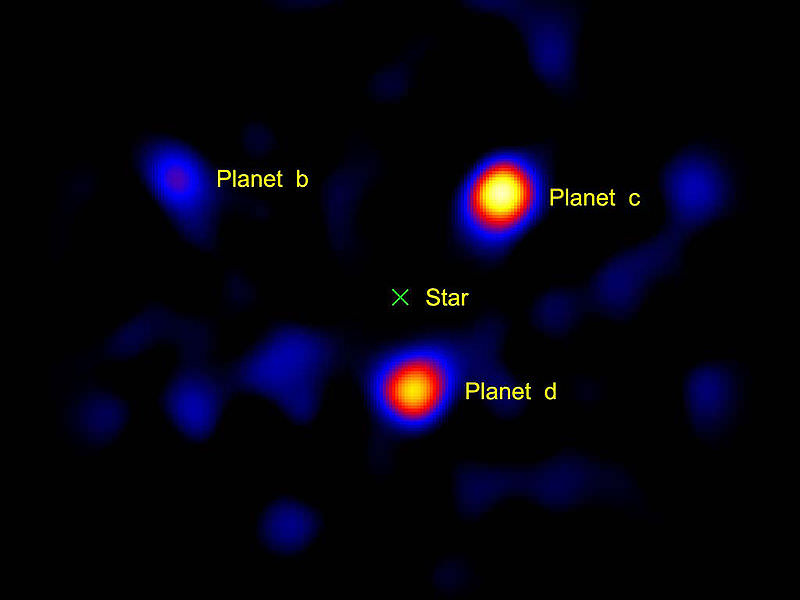
The four planets are HR 8799 b, c, d, and e. They’re all massive planets, between 5.7 and 9.1 Jupiter masses, barely below the point where deuterium fusion takes place, making them brown dwarfs. They range from 16 to 71 astronomical units away from the star, and have orbits from about 45 to about 460 years. All four of them have radii of about 1.2 Jupiter radii.

A portrait of the HR8799 planetary system as imaged by the Hale Telescope. A fourth planet was eventually discovered. Credit: NASA/JPL-Caltech/Palomar Observatory.

Massive giant planets that follow large orbits greater than 5 AU are rare. So every instance of these types of planets is important. MIRI’s high contrast imaging can open up a new window on these types of systems and allowing scientists to characterize them more fully. Mid-infrared observations of the system have been difficult up until now. Not only that, but the JWST’s angular resolution makes the observations even more powerful.

What did the JWST find?

“Overall, the MIRI images of the HR 8799 system yield a very different vision than in the near IR, with the clear detection of the four planets, together with a localized but extended central emission,” the authors write.

The JWST was able to refine what we already know about some aspects of this system. The main objective of this work was to characterize the planetary atmospheres better.

While there has been some uncertainty around the nature of the planets, and if they are brown dwarfs, the JWST observations put that idea to rest. “Their colors indicate that these four giant planets differ from field brown dwarfs,” the authors write.

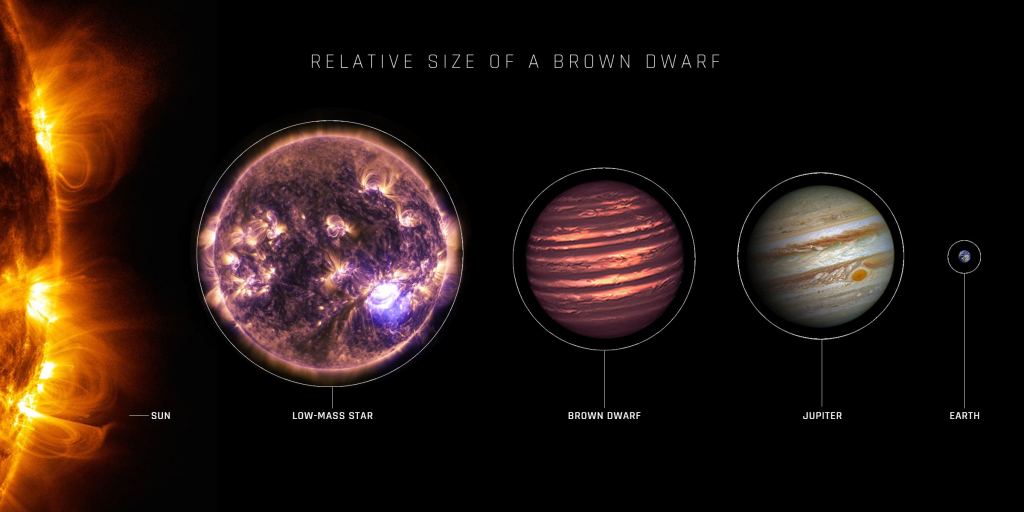
An artist’s depiction of the relative sizes of the Sun, a low-mass star, a brown dwarf, Jupiter, and the Earth. While there was some initial uncertainty over the nature of the planets around HR 8799, the JWST images confirmed them as planets rather than brown dwarfs. Image Credit: Jupiter: NASA,ESA,and A. Simon (NASA,GSFC); Sun and Low-Mass Star: NASA,SDO; Brown Dwarf: NASA,ESA,and JPL-Caltech; Earth: NASA; Infographic: NASA and E. Wheatley (STScI)

Their temperatures range from 900 K to 1300 K, with HR 8799 b being fainter and cooler. The JWST measurement’s shows that planet b’s temperature is lower than previous observations showed, an indication of the telescope’s greater power. MIRI also identified two atmospheric chemicals unequivocally: H2O and CO. The authors say there’s a debatable detection of methane, and that’s additional evidence that they’re planets not brown dwarfs. Brown dwarfs always show the signature for methane at these temperatures.

The JWST’s MIRI instrument was built with different filters. They were partly designed to investigate the presence of ammonia, which is a solid biosignature on terrestrial planets. Unfortunately, these four planets are a little too hot for ammonia to stand out. “As a result, the current data cannot conclude on the detectability of the ammonia feature in the HR 8799 planets,” the paper states. If it had detected ammonia, it would be headline news.

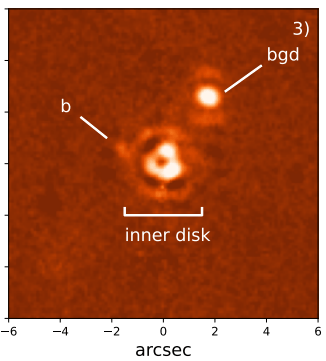
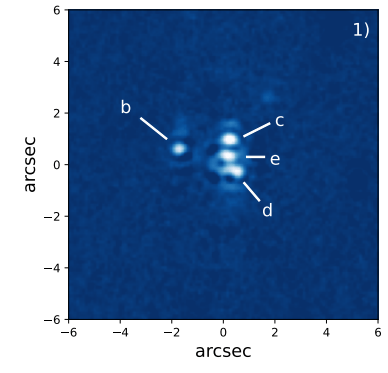
This is one of the JWST's MIRI images of HR 8799 and its four planets. It won't grace the cover of a magazine; it's a scientific image. Image Credit: Boccaletti et al. 2023.
This is one of the JWST’s MIRI images of HR 8799 and its four planets. It won’t grace the cover of a magazine; it’s a scientific image. Image Credit: Boccaletti et al. 2023.

The HR 8799 system is also noteworthy for its debris disk. It’s unusual in that it has two belts. Researchers have wondered if the inner edge of the outer belt was caused by a fifth planet with a mass between Jupiter’s and Saturn’s. Others thought it might be a dust clump.

But the JWST shows that it’s a background object, and seems to have ended the debate. “With a new data point, 4.44 years apart from the former detection, we can now safely conclude that this is a background
object,” the authors write.

The powerful filters on the JWST's MIRI instrument ended the debate about a potential fifth planet at HR 8799. This MIRI image helped determine that the object is in fact a background object. Image Credit: Boccaletti et al. 2023.
The powerful filters on the JWST’s MIRI instrument ended the debate about a potential fifth planet at HR 8799. This MIRI image helped determine that the object is in fact a background object. Image Credit: Boccaletti et al. 2023.

This was the JWST’s first look at a young exoplanetary system with its MIRI instrument, including its filters and its coronagraph. “The MIRI instrument onboard JWST is now offering high-contrast imaging capacity at mid-IR wavelengths, thereby opening a completely new field of investigation to characterize young exoplanetary systems,” the authors explain.

As such, the main thrust of the work was to test the observations and different algorithms to determine how to best use it in future work, and how to interpret the results. For example, measuring a planet’s flux successfully means accounting for how the coronagraph attenuates the images, depending on a planet’s position.

These observations contribute to using the instrument more effectively. Ironically, MIRI’s coronagraph can be so sensitive that understanding its images of young stellar systems can be challenging. The use of the instrument is only in its infancy, and the coronagraphs extreme sensitivity “can make the detection and the interpretation of young system observations very challenging, not mentioning the confusion related to background galaxies,” the authors write.

The authors point out that there’s still room for improvement, and these results will only lead to improved future results.

The post JWST Sees Four Exoplanets in a Single System appeared first on Universe Today.


Venus Might Have Had Plate Tectonics Just Like Earth

Even though Venus is very similar to Earth in many ways, it’s a hell-world with a runaway greenhouse effect. It was assumed this was because it lacked plate tectonics like Earth to sequester carbon inside the planet. A new study suggests that the high nitrogen and argon in its atmosphere are evidence from outgassing when it had plate tectonics billions of years ago. This could mean that Venus was habitable for a long time before something went horribly wrong.

Scientists have long tried to understand why Venus’ crushing carbon dioxide atmosphere is 90 times as thick as Earth’s. Additionally, there is almost no water vapor, and temperatures hover around 462 degrees Celsius (864 degrees Fahrenheit).

But it might not have always been this way. Previous work on modeling the planet’s geologic past has indicated it was quite likely Venus may have had a shallow liquid-water ocean and habitable surface temperatures for up to 2 billion years of its early history.

So, what happened?

Researchers from Brown University used current atmospheric data from Venus and plugged that into a computer model to compare the present-day Venusian atmosphere to atmospheres generated by various long-term thermal–chemical–tectonic evolution models. What the model revealed is that the planet’s current atmosphere and surface pressure would only have been possible if plate tectonics was part of Venus’ history.

“The [current] Venusian atmosphere requires volcanic outgassing in an early phase of plate-tectonic-like activity,” the team wrote in their paper, published in Nature Astronomy. “Our findings indicate that Venus’s atmosphere results from a great climatic–tectonic transition, from an early phase of active lid tectonics that lasted for at least 1?Gyr [1 billion years], followed by the current stagnant lid-like mode of reduced outgassing rates.”

“Stagnant lid” means its surface has only a single plate with minimal amounts of give, movement and gasses being released into the atmosphere.

Cloud structure in the Venusian atmosphere in 2016, revealed by observations in the two ultraviolet bands by Akatsuki. Credit: Kevin M. Gill

The researchers modeled what would have had to happen on the planet to get to where it is today. They eventually were able to match the numbers almost exactly when they accounted for limited tectonic movement early in Venus’ history followed by the stagnant lid model that exists today.

They theorize that Venus must have had plate tectonics sometime after the planet formed, about 4.5 billion to 3.5 billion years ago. The paper suggests that this early tectonic movement, like on Earth, would have been limited, in terms of the number of plates moving and in how much they shifted.

But somehow, the paper suggests, Venus eventually became too hot and its atmosphere too thick, and the necessary conditions and ingredients for tectonic movement were lost.

Comparatively, the movement of the plates in Earth’s crust increased over billions of years, forming new continents and mountains, and leading to chemical reactions that stabilized the planet’s surface temperature, resulting in an environment more conducive to the development of life.

“One of the big picture takeaways is that we very likely had two planets at the same time in the same solar system operating in a plate tectonic regime — the same mode of tectonics that allowed for the life that we see on Earth today,” said Matt Weller in a press release from Brown University. Weller is the study’s lead author who completed the work while he was a postdoctoral researcher at Brown and is now at the Lunar and Planetary Institute in Houston.

But something must have been different on Venus for the action of plate tectonics to cease.

“Venus basically ran out of juice to some extent, and that put the brakes on the process,” said Daniel Ibarra, a professor in Brown’s Department of Earth, Environmental and Planetary Sciences and co-author on the paper.

While there is more work to be done on verifying the outcomes of this model, this work might also change the current thinking on planetary evolution.

“We’ve so far thought about tectonic state in terms of a binary: it’s either true or it’s false, and it’s either true or false for the duration of the planet,” said study co-author Alexander Evans, an assistant professor of Earth, environmental and planetary sciences at Brown. “This shows that planets may transition in and out of different tectonic states and that this may actually be fairly common. Earth may be the outlier. This also means we might have planets that transition in and out of habitability rather than just being continuously habitable.”

This work also shows that there are multiple ways to take a look back at a planet’s history.

“We’re still in this paradigm where we use the surfaces of planets to understand their history,” Evans said. “We really show for the first time that the atmosphere may actually be the best way to understand some of the very ancient history of planets that is often not preserved on the surface.”

Venus Envision mission
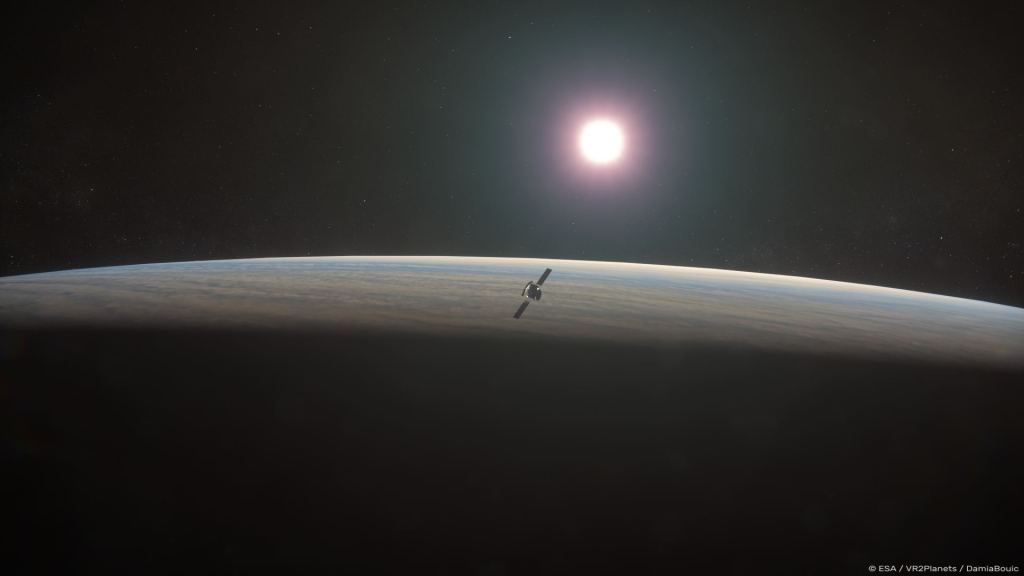
Artist rendition of EnVision orbiting Venus and studying its surface and atmosphere. The mission will launch in the mid-2030s. Courtesy ESA.

Upcoming missions to Venus should help clarify these findings. NASA’s DAVINCI (Deep Atmosphere Venus Investigation of Noble gases, Chemistry and Imaging) will measure gasses in the Venusian atmosphere. ESA’s EnVision spacecraft will peer through the planet’s thick atmosphere from orbit with a high-resolution radar.

DAVINCI is slated to launch in 2029, and EnVision will launch between 2035 to 2039.

The post Venus Might Have Had Plate Tectonics Just Like Earth appeared first on Universe Today.


What’s the Best Way to Find Planets in the Habitable Zone?

Despite the fact that we’ve discovered thousands of them, exoplanets are hard to find. And some types are harder to find than others. Naturally, some of the hardest ones to find are the ones we most want to find. What can we do?

Keep working on it, and that’s what a trio of Chinese scientists are doing.

Scientists have four methods of detecting exoplanets. The transit method is the most prolific, but there’s also the radial velocity method, astrometry, and, of course, direct imaging. Each one works differently, has different strengths and weaknesses, and is better at finding some planets around different types of stars than others.

We’re mostly interested in finding terrestrial planets in the habitable zones of nearby stars. Which of the four methods will deliver the best results as we continue our search?

The three Chinese scientists set out to determine that. Their paper “The Potential of Detecting Nearby Terrestrial Planets in the HZ with Different Methods,” sums up their results. It appeared in the Publications of the Astronomical Society of the Pacific. The lead author is Hao Qiao-Yang from the School of Astronomy and Space Science, Nanjing University, China.

“Terrestrial planets in the habitable zone around nearby stars are of great interest and provide a good sample for further characteristics of their habitability,” the authors write. The more of them we can find, the better we can understand them, and then we can use that understanding to find even more of them. But this research didn’t involve any actual planet hunting.

This artist's illustration shows Kepler-186f, a possibly Earthlike exoplanet that could be a host to life. It's about 500 light years from Earth. It's so far away that it's difficult to study. We need to find more of these types of planets in our closer stellar neighbourhood. (NASA Ames, SETI Institute, JPL-Caltech, T. Pyle)
This artist’s illustration shows Kepler-186f, a possibly Earthlike exoplanet that could be a host to life. It’s about 500 light years from Earth. It’s so far away that it’s difficult to study. We need to find more of these types of planets in our closer stellar neighbourhood. (NASA Ames, SETI Institute, JPL-Caltech, T. Pyle)

The researchers dipped into Gaia’s Catalog of Nearby Stars to obtain a sample of 2,234 main sequence stars within 20 parsecs, or about 65 light years. The sample excluded brown dwarfs and white dwarfs. Then they derived the extended habitable zones (HZ) for all those stars. Finally, they performed simulations by injecting Earth-like planets into each HZ.

That set the stage for the final piece. They determined what signals each of these 2,234 planets would send that would be recieved by each of the four exoplanet detection methods: velocity amplitude for radial velocity, transit probability and depth for the transit method, stellar displacements for astrometry, and contrast and angular separation for imaging. Then, they “… predict the highest possible detection number of Earth-like planets via different methods in the best-case hypothetical scenario.”

Why the focus on nearby stars? Well, no matter what method planet-hunters use, exoplanets are easier to find the closer they are, and also easier to confirm. They’re also easier to study with follow-up observations by telescopes like the JWST, which can characterize exoplanet atmospheres and detect potential biosignatures.

Determing the habitable zones around all these stars was tricky. Impossible, in fact. “An HZ is rarely determined precisely because it depends on not only on the stellar spectrum and stellar activity, but also on the planetary atmosphere,” the authors write. To simplify things, they used extended habitable zones, which increases the occurrence rate of planets in the HZ. The inner boundary (IHZ) is set to “Recent Venus” and the outer boundary (OHZ) is set to “Early Mars.”

“Since we adopt the extended HZ, we assume an occurrence rate of Earth-like planets in the HZ of 1, and put one Earth-like planet in the HZ around every single star,” the authors explain. This doesn’t mean they expect there to be this many of these desirable exoplanets. It just gives them a more complete sample to work with, and that produces better results.

“The average location of IHZ and OHZ is 0.22 and 0.43 au, respectively,” the paper states. That may sound awfully close, but most stars are cool M dwarfs, and their HZs are closer than our Sun’s, which is a much more luminous main sequence star.

The meat of the study concerns the signals we’d receive from all of these planets with the four detection methods.

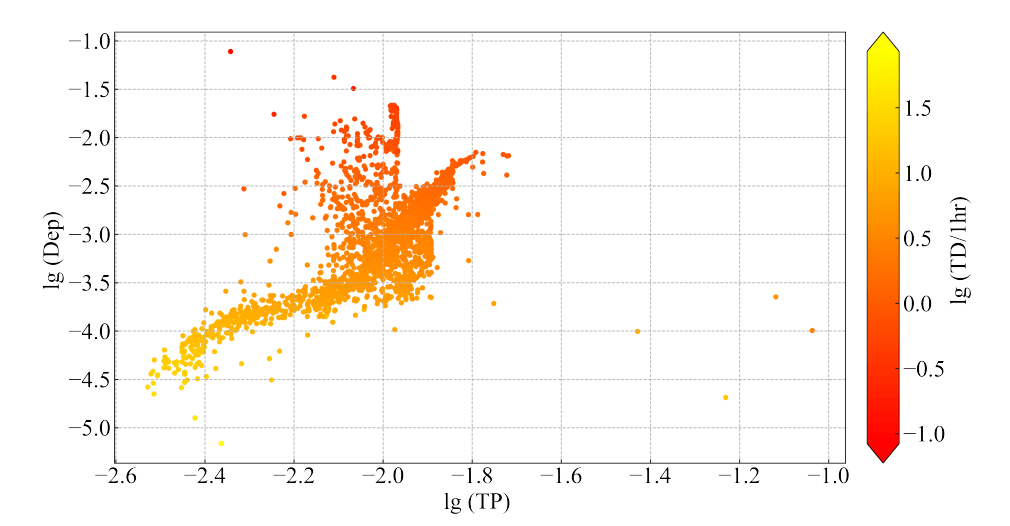
The transit method is our most prolific exoplanet detection method. This figure from the research shows the signals we would receive from the simulated terrestrial planets with the transit method. The x-axis shows the probability of detecting a signal, the y-axis shows the signal's depth, and the colour key on the right shows the duration of the signal. Image Credit: Hao Qiao-Yang et al 2023
The transit method is our most prolific exoplanet detection method, but maybe not the best. This figure from the research shows the signals we would receive from the simulated terrestrial planets in their star’s central habitable zone with the transit method. The x-axis shows the probability of detecting a signal, the y-axis shows the signal’s depth, and the colour key on the right shows the duration of the signal. Image Credit: Hao Qiao-Yang et al 2023

The transit method has been our most prolific exoplanet detection method, and the probability of detecting a signal reflects that. However, the transit method only works when the geometry is right. The transiting planet has to pass between its star and us. The other methods don’t have the same limitation, though the RV method isn’t totally immune from geometry.

Of all the planets detected in the simulations, the transit method first detected 24 of them. However, since the transit method excels at finding planets close to their stars, all 24 of them were too close to their stars and not inside the HZ.

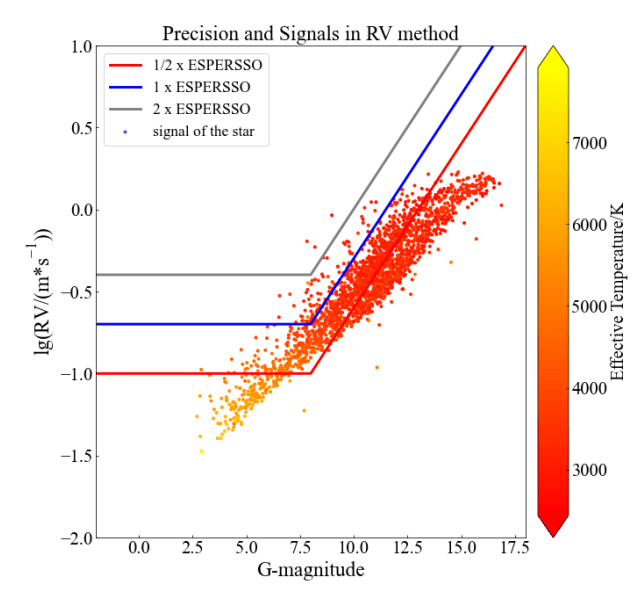
The study’s results show that the radial velocity method is most effective. Our most sensitive RV instrument is the ESO’s ESPRESSO, or Echelle SPectrograph for Rocky Exoplanets and Stable Spectroscopic Observations. Since it’s our best instrument, the researchers used its sensitivity in their simulations. How easily could ESPRESSO detect the planets in the sample?

Of the 252 planets detected within the study’s 20 parsec radius, the RV method using ESPRESSO is responsible for 221 of them. Four of them are Earth-like.

This figure from the study shows how the RV method fares. It’s based on the ESO’s ESPRESSO RV instrument. The blue line represents ESPRESSO’s results, the red line represents 1/2 ESPRESSO sensitivity, and the grey line represents 2x ESPRESSO sensitivity, reflecting the sensitivity of future instruments needed for a more effective search. Image Credit: Hao Qiao-Yang et al 2023

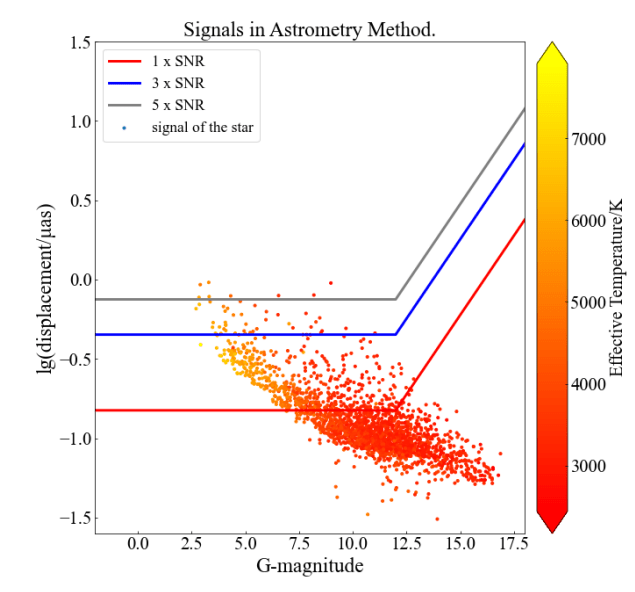
The astrometry method is one of the most sensitive ways to detect exoplanets. It relies on detecting the minute wobbles in host stars created by their orbiting planets. It’s how the ESA’s Gaia mission works, and in the near future, several more observatories will use the astrometry method. The simulations show that astrometry prefers finding planets in the HZ around massive stars, but that current astrometry is not sensitive enough to detect about 98% of planets within 20 parsecs.

There’s a critical distinction between Gaia’s astrometry method, and astrometry used to find exoplanets. Gaia measure stars using absolute astrometry, but finding exoplanets uses relative astrometry. Astrometry measures displacement, which is measured in microarcseconds. “We have found that more than 98% of the maximum stellar displacements of stars within 20 pc are under 1 ?as,” the authors write. That means we need greater precision to detect more exoplanets.

The figure below shows how more precise astrometry detects more planets.

The least precise gray line detects five habitable planets, the blue line is more precise and the expected number increases to 30, including seven planets around G stars and 10 planets around M stars. The red line represents the most precise astrometry and the expected number becomes 511, including 116 and 174 planets around G and M stars, respectively.

This figure from the study shows how astrometry fared in the simulation. The red, blue, and grey lines represent more precise astrometry needed to find more planets. The temperature diagram shows that detecting terrestrial planets in the HZ of G-type, Sun-like stars requires extreme sensitivity. Image Credit: Hao Qiao-Yang et al 2023

The astrometry method has the greatest potential to detect Earth-like planets in HZs around Sun-like stars, but only with better precision.

Lastly, the researchers simulated results from direct imaging, a method only in its infancy. It works best on young planets still emitting infrared that are far from their stars. There are sub-types of direct imaging, and together they’ve found about 30 planets.

Planet hunting scientists have found six exoplanets within 20 parsecs with direct imaging. That may not sound great, but the method has some advantages over RV and the transit method. It’s not sensitive to an exoplanet’s inclination. But compared to the other methods, direct imaging is more complex because it needs to take both contrast and angular resolution into account. Direct imaging can use both optical and infrared light.

The results show that direct imaging excels at detecting planets around G-type or Sun-like stars.

“In the optical band, the predicted number of exoplanets is 159, and 92 of them are around G stars,” the authors write. Infrared direct imaging is even more productive, finding 191 exoplanets, with 106 of them around G-type stars.

Method Reference Instrument Expected HZ Planets (known, expected, around G stars)
Radial Velocity ESPRESSO 4, 39,1
Transit TESS 4, 5, 0
D.I. Optical LUVOIR 0, 159, 92
D.I. Infrared LIFE 0, 191, 96
Astrometry 3xGaia 0, 30, 8

When it comes to finding exoplanets in HZs around nearby stars, each method has its strengths and weaknesses and is better at finding planets around different types of stars.

The paper is a preliminary effort to compare the potential of the different detection methods. Out of necessity, it’s based on some ideal assumptions and in part on the improved sensitivity of future instruments. Its purpose is to help develop a framework for “… selecting the targets and designing the precision requirements of the four different methods.”

The hunt for exoplanets shows no signs of slowing down. Why would it? Finding Earth-like planets in habitable zones is one of our most meaningful scientific pursuits.

The simulation is based on terrestrial planets existing in the HZs of every main sequence star within 20 parsecs. So the specific numbers in the results are likely not accurate. But that isn’t really the point.

Future instruments will out of necessity be more sensitive, including LUVOIR and HabEx. So this study shows what could be possible, and lays the groundwork for how we can use future instruments with the greatest success.

The post What’s the Best Way to Find Planets in the Habitable Zone? appeared first on Universe Today.