A microwave oven–sized cubesat launched to space today from New Zealand by commercial company Rocket Lab and their Electron rocket. The small satellite will conduct tests to make sure the unique lunar orbit for NASA’s future Lunar Gateway is actually stable.
The Cislunar Autonomous Positioning System Technology Operations and Navigation Experiment, or CAPSTONE, mission launched at 5:55 a.m. EDT (09:55 UTC) on Tuesday June 28 from the Rocket Lab Launch Complex 1 on the Mahia Peninsula of New Zealand. The Electron has now flown 27 times with 24 successes and 3 failures.
Illustration of the Gateway. Built with commercial and international partners, the Gateway is critical to sustainable lunar exploration and will serve as a model for future missions to Mars. Credit: NASA
The Gateway is a lunar space station that will support NASA’s Artemis program to return to the Moon and enable future missions to Mars. The unusual orbit, called a near rectilinear halo orbit (NRHO), is an elongated polar orbit that brings a spacecraft within 1600 km (1,000 miles) of one lunar pole on its near pass and 70,000 km (43,500 miles) from the other pole every seven days. Since the orbit uses a balance point in the gravities of Earth and the Moon, it is theorized that spacecraft in this type of orbit require less propulsion capability for spacecraft flying to and from the Moon’s surface than other circular orbits and requires minimal energy to maintain.
CAPSTONE’s mission is to attempt to establish that this location in space provides a stable and ideal location for a space station, as well as a staging area for missions to the Moon and beyond.
An image of the Cislunar Autonomous Positioning System Technology Operations and Navigation Experiment, or CAPSTONE, launching aboard Rocket Lab’s Electron rocket from the Rocket Lab Launch Complex 1 on the Mahia Peninsula of New Zealand Tuesday, June 28, 2022. Credit: Rocket Lab
The spacecraft is currently in low Earth orbit, and is attached to Rocket Lab’s Lunar Photon, an interplanetary third stage that will send CAPSTONE on its way to deep space. It will take about four months for it to reach the targeted lunar orbit.
Shortly after launch, Lunar Photon separated from Electron’s second stage. Over the next six days, Photon’s engine will ignite at specific times to accelerate it beyond low-Earth orbit, where Photon will release the CubeSat on a ballistic lunar transfer trajectory to the Moon. CAPSTONE will then use its own propulsion and the Sun’s gravity to navigate the rest of the way to the Moon. NASA says the gravity-driven track will dramatically reduce the amount of fuel the CubeSat needs to get to the Moon.
Animation of the CAPSTONE mission in orbit of the Moon. Credits: NASA/Daniel Rutter
CAPSTONE’s job is to validate the power and propulsion requirements for maintaining its orbit as predicted by NASA’s models. During its many orbits, the CAPSTONE will demonstrate the reliability of an innovative spacecraft-to-spacecraft navigation system, using the reliable and long-lived Lunar Reconnaissance Orbiter – which has been in orbit of the Moon since 2009 – as a touchstone and point of reference, without the use of groundstations. CAPSTONE will determine the distance between the two lunar orbiting spacecraft, and NASA says this technology could allow future spacecraft to determine their position in space without relying exclusively on tracking from Earth.
“CAPSTONE is an example of how working with commercial partners is key for NASA’s ambitious plans to explore the Moon and beyond,” said Jim Reuter, associate administrator for the Space Technology Mission Directorate, in a NASA press release. “We’re thrilled with a successful start to the mission and looking forward to what CAPSTONE will do once it arrives at the Moon.”
Congrats to the #CAPSTONE team for a successful launch this morning! The spacecraft will explore a unique lunar elliptical orbit, the same orbit planned for @NASA_Gateway – a multipurpose outpost for long-term lunar missions as part of the @NASAArtemis program. pic.twitter.com/FRFcfy38WQ
You can follow the spacecraft’s journey live using NASA’s Eyes on the Solar System interactive real-time 3D data visualization. Starting approximately July 5, 2022 NASA will also provide a virtual ‘ride along’ with the CubeSat in a visualization on NASA’s Ames Research Center’s home page as well as providing updates on Twitter and Facebook.
“CAPSTONE is a pathfinder in many ways, and it will demonstrate several technology capabilities during its mission timeframe while navigating a never-before-flown orbit around the Moon,” said Elwood Agasid, project manager for CAPSTONE at NASA’s Ames Research Center in California’s Silicon Valley. “CAPSTONE is laying a foundation for Artemis, Gateway, and commercial support for future lunar operations.”
Earth’s oceans are one huge, uniform electrolyte solution. They contain salt (sodium chloride) and other nutrients like magnesium, sulphate, and calcium. We can’t survive without electrolytes, and life on Earth might look very different without the oceans’ electrolyte content. It might even be non-existent.
On Earth, electrolytes are released into the oceans from rock by different processes like volcanism and hydrothermal activity.
Are these life-enabling nutrients available on water worlds?
Water worlds are exoplanets with enough water to form a hydrosphere. Many of the exoplanets we’ve discovered are super-Earths and/or mini-Neptunes, and scientists expect some of them to be water worlds. On those planets, electrolytes probably play a similar role in habitability that they do on Earth’s oceans.
But the problem is that super-Earths and mini-Neptunes are more massive than Earth, and their interiors are under more pressure than Earth. These planets can form deep planetary ice mantles between the rocky cores and the surface oceans. These ice barriers aren’t regular ice. Instead, they’re high-pressure ices like ice VII, and that dense ice could be a barrier that prevents essential mineral electrolytes from moving from the cores to the oceans, where they’d be available for life.
These high-pressure ice barriers could limit the habitability of ocean worlds. But a new study suggests that electrolytes can flow through these icy mantles on water worlds. If this is true, there’s one more reason to be optimistic about life in these compelling worlds.
“Electrolytes play an important role in the internal structure and dynamics of water-rich satellites and potentially water-rich exoplanets,” the paper begins. “However, in planets, the presence of a large high-pressure ice mantle is thought to hinder the exchange and transport of electrolytes between various liquid and solid deep layers.”
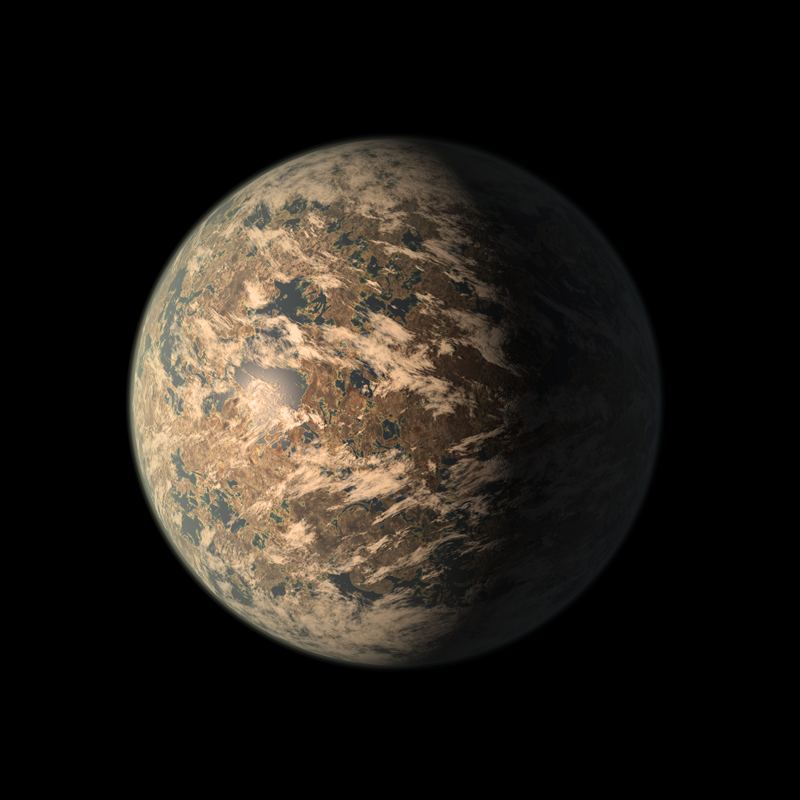
This is an artist’s impression of TRAPPIST-1e, a potential water world. Planets like this may have submerged mantles of high-pressure ice that act as a barrier to nutrient flow. Image Credit: By NASA/JPL-Caltech – Cropped from PIA22093: TRAPPIST-1 Planet Lineup – Updated Feb. 2018, Public Domain, https://ift.tt/iwqt9NE
The ice in these mantles is different than Earth’s ice. A series of ice types form under higher pressures on more massive planets. Regular, atmospheric Earth ice is called Ice I. Researchers have created other types in laboratory experiments, from Ice II to Ice VII. In one experiment, researchers subjected a drop of water to a powerful shock wave and created Ice VII, though it only lasted a moment.
In ocean worlds that are super-Earths or mini-Neptunes, the deeper layers of the ocean are likely frozen into high-pressure ices like Ice VII. Ice VII is structurally different than Ice I. In Ice VII, water molecules break apart, oxygen ions crystallize, and the hydrogen atoms move around freely in the oxygen crystal lattice. According to the study’s simulations, nutrients can make their way into the ice.
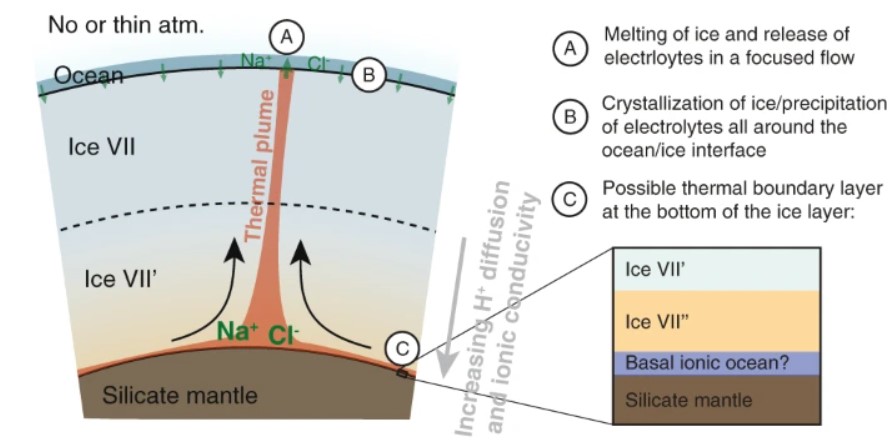
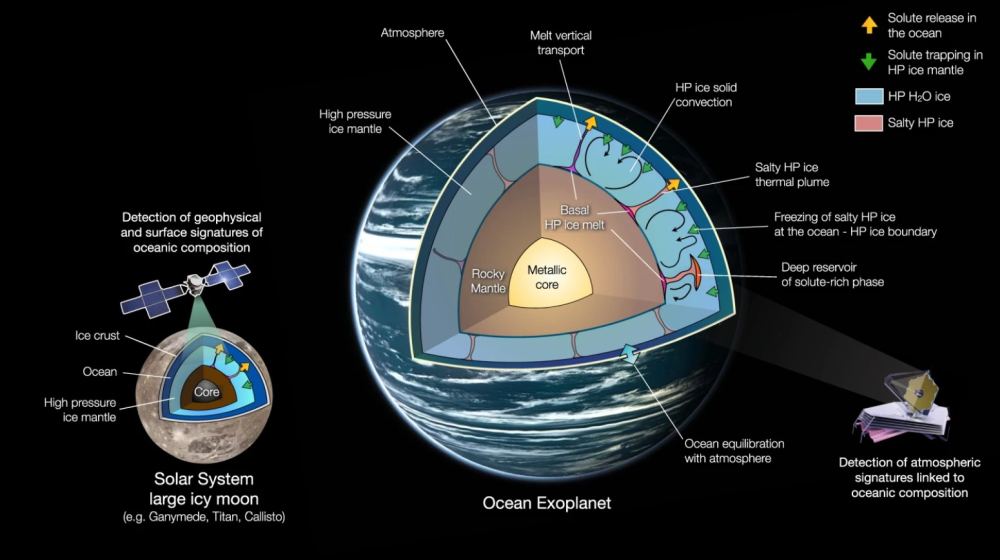
Ice VII has an important characteristic when it comes to nutrient transport. While regular Earth ice expels salt as it forms, ice VII can hold about 2.5% of NaCl in its structure by weight. The NaCl in Ice VII lowers the ice’s melting point and softens it. So convection currents from the planet’s interior can propel the NaCl upward through the ice and into the ocean. That creates a temperature differential, and the ice cools and sinks again. The result is a recycling current of salt from the planet’s rocky interior, up through the ice mantle into the ocean, and down again.
This figure from the study shows how NaCl can be released from an exoplanet’s silicate mantle and flow upward due to convection. Image Credit: Hernandez et al. 2022.
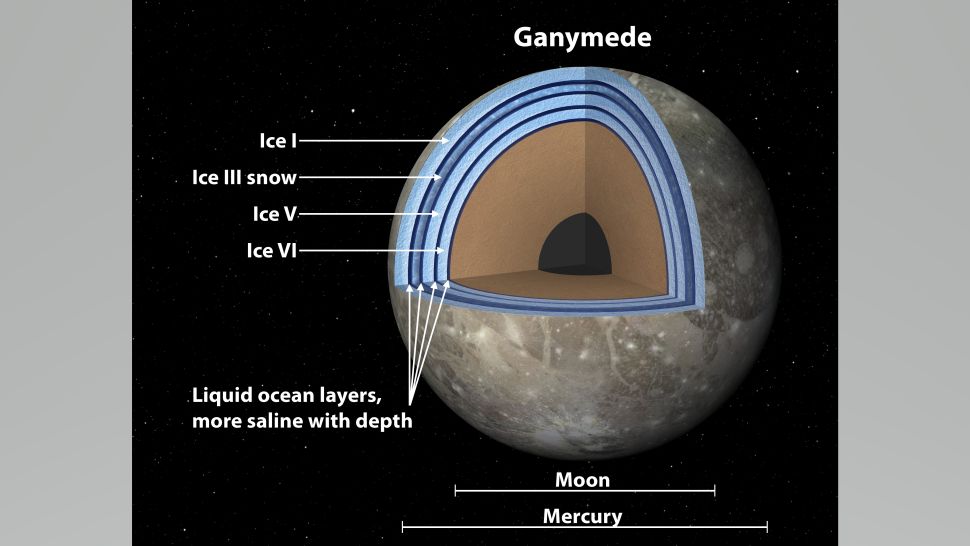
This may be happening in our Solar System. Researchers have found evidence of hydrated salt minerals staining the surface of some of the icy moons. Moons like Ganymede, Callisto, Europa, and Enceladus all have likely subsurface oceans under their frozen shells, with HP ice mantles at different depths that form barriers between their rocky cores and their oceans. So the minerals staining the surfaces were transported through at least one layer of ice, maybe more. Some of the moons aren’t massive enough to form Ice VII, but Jupiter’s Callisto, Ganymede, and Saturn’s Titan are massive enough to form mantles of high-pressure ice.
This diagram shows what the interior of Ganymede, the largest moon in the Solar System, might look like. Layers of the ocean with different salinities might be sandwiched between layers of ice with different structures. Image Credit: NASA/JPL–Caltech
If nutrients like sodium chloride can be transported from a planet’s rocky interior through a layer of Ice VII to the ocean, it could be a game-changer. Suddenly, there’s more evidence that these ocean worlds could support life.
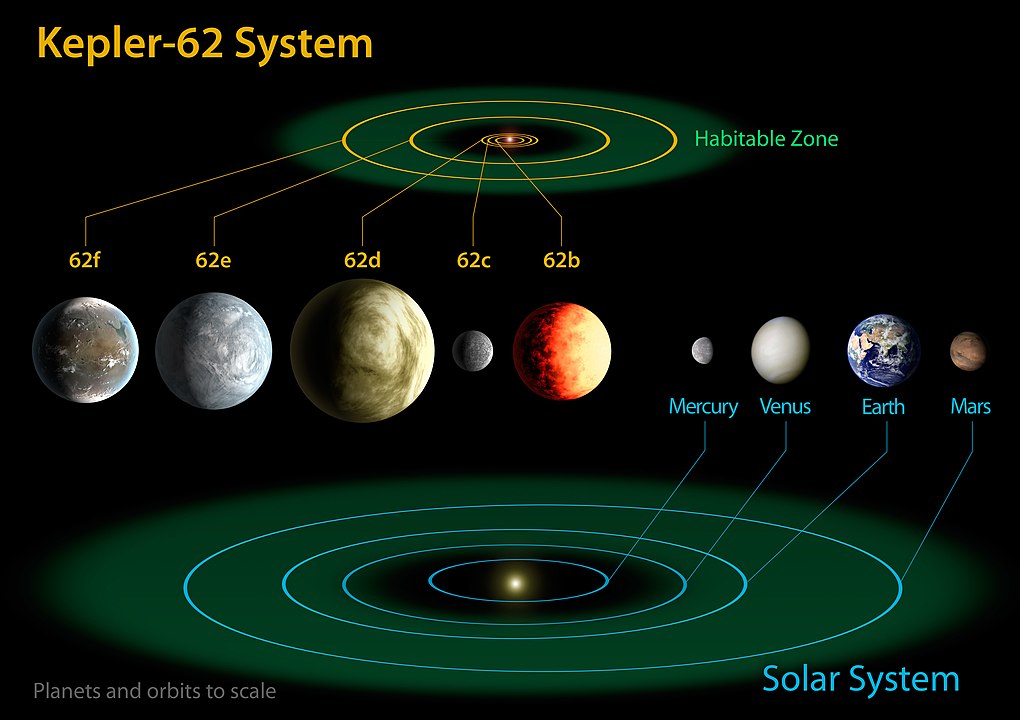
As we find more exoplanets, we see more potential water worlds. The well-known TRAPPIST-1 system may host several of them—TRAPPIST-1e and TRAPPIST-1f are strong candidates—though scientists aren’t certain. Kepler-62e and Kepler-62f are also possible water worlds.
The Kepler 62 system is about 990 light-years from Earth and hosts two potential water worlds, 62e and 62f. Image Credit: NASA Ames/JPL-Caltech – https://ift.tt/F7rLHny, Public Domain, https://ift.tt/Jj4eEaI
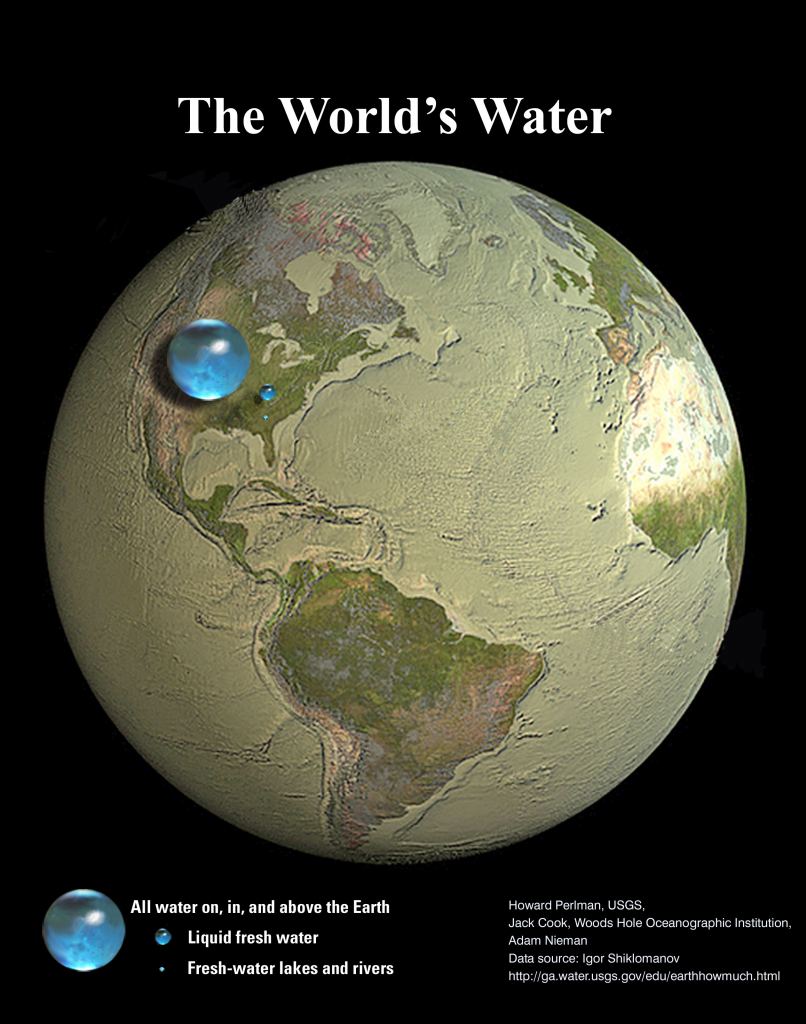
Baptiste Journaux is a researcher at the University of Washington, where he studies planetary sciences, including the conditions in deep planetary oceans. Journaux wrote a commentary on this new study in Nature Communications. In his article, he said exoplanet discoveries show that ocean worlds are likely widespread. Our Solar System has ocean moons but no ocean worlds. And while Earth’s surface is two-thirds ocean, our planet is actually remarkably dry.
Earth might be two-thirds covered in water, but it’s nowhere near being an ocean planet. Image Credit: USGS.
These new results have boosted the habitability potential of all of the ocean worlds out there, according to Journaux. “The study by Hernandez et al. offers the most convincing argument yet in resolving the dilemma of large planetary hydrosphere habitability.”
Several geologic processes can release minerals from a planet’s rocky core into an icy mantle. According to this new study, the dense ice in the mantle allows nutrients to be transported to the surface ocean on ocean planets. Image Credit: Baptiste Journaux
The study of ocean exoplanets is all about simulations; there’s no way to observe them in great detail. But the JWST could start to change that. It may be able to detect spectroscopic fingerprints from interactions between an ocean planet’s atmosphere and its ocean. And more help is on the way.
NASA and the ESA are developing missions to some of the Solar System’s icy/ocean moons. The ESA’s Jupiter Icy Moons Explorer (JUICE) will launch in about a year and reach the Jovian system in 2031. In 2034 it will enter orbit around Ganymede, the solar system’s largest moon. It’ll eventually approach within 500 km (310 mi) of Ganymede’s surface.
NASA’s Europa Clipper is scheduled to launch in 2024 and reach Jupiter by 2030. Even though it’ll orbit Jupiter, it’ll be studying Europa, another ocean moon with an icy shell.
Ganymede and Callisto are likely massive enough to form high-pressure water ice mantles. Titan is too, but it’s a long way away, and though there’s some talk of a mission to Saturn’s largest moon, it’s far from certain.
Ganymede is massive enough to form one or more layers of high-pressure ice. If this new study is correct, critical electrolytes may be able to cycle between the moon’s rocky core and its oceans, which boosts any chances of habitability. Image Credit: By National Oceanic and Atmospheric Administration
The missions to these moons will start to test some of the study’s conclusions. If electrolytes can be transported through high-pressure ice layers on Ganymede, that’ll be an essential finding in favour of habitability on water worlds. But life requires more than just Na and Cl. We still don’t know if other important molecules can pass through these icy barriers.
The upcoming missions will tell us a lot about our Solar System’s icy ocean moons and the permeability of high-pressure ice mantles. Some of the findings will also extrapolate to ocean worlds in other solar systems. “These missions will not only allow us to better understand the inner-workings of the hydrospheres of icy moons but will be key to understanding the largest oceans in our universe in water-rich exoplanets, their potential for habitability and their future characterization by modern and next-generation telescopes,” Journaux said in his article.
The authors of the new study end by talking about some of the other factors involved in ocean world habitability. They point out that electrolyte transport depends “… on the actual size, composition and surface temperature of the considered planet, which might result in different scenarios at the interface between the ocean and the ice mantle, and between the ice mantle and the rocky core.”
Many factors need to be just right for an ocean planet to transport nutrients to the surface ocean. But at least they showed with their simulations that it’s possible.
We’ll have to wait to find out if their simulations are correct and how widespread the phenomenon is.
The thing with black holes is they’re hard to see. Typically we can only detect their presence when we can detect their gravitational pull. And if there are rogue black holes simply traveling throughout the galaxy and not tied to another luminous astronomical, it would be fiendishly hard to detect them. But now we have a new potential data set to do so.
Gaia just released its massive 3rd data set that contains astrometry data for over 1.5 billion stars, about 1% of the total number of stars in the galaxy. According to a new paper by Jeff Andrews of the University of Florida and Northwestern University, it might be possible for Gaia to detect perturbances caused by a rogue black hole briefly interacting with one of the 1.5 billion stars in the catalog. Unfortunately, it’s just not very likely that any such interaction actually took place during Gaia’s observing time.
This paper is the third in a series that explores potentially using the trove of new Gaia data to find companions to some of its stars. Luminous stars are Gaia’s specialty, but many have “dark companions” that are not as detectable as their light-emitting partners. Not all of these dark companions are black holes – some might be dead stars that have already burnt through their fuel supply but weren’t massive enough to form a black hole.
Recent Fraser video discussing the discovery of the mass of the first rogue black hole.
The first paper looked at how scientists could use Gaia’s data to pick up on signatures of those dark companions. The second focused on whether the data contains hints of very long binary orbital relationships with orbital periods that outlast the observational timeline. Both of those studies point to valid analyses that someone will undoubtedly undertake now that the Gaia data is released. However, they don’t address what is potentially the most interesting of all dark companions – black holes.
Estimates put the number of black holes in the Milky Way at between 10 million and 1 billion, between .01% and 1% of the probable total number of stars in the galaxy. But most of these are only the size of a star and extremely hard to detect using conventional data. Their pull might just be noticeable in Gaia’s data set, though.
Gaia itself collects astrometry data, which detects the position, motions, and magnitudes of stars. Any interaction, however fleeting, with a black hole, could potentially affect any of these metrics. It’s just a matter of understanding what to look for.
UT interview with Dr. Martin Barstow discussing the release of Gaia’s third massive dataset.
That might not be so easy, as the complex math and “extreme assumptions” that the Andrews papers details make clear. He notes that about 300,000 stars in Gaia’s catalog are exhibiting acceleration events. However, he also notes that, with some very blanket assumptions about the dark matter content of the Milky Way, none of those 300,000 observed accelerations are likely due to interactions with a rogue black hole.
But that doesn’t mean it isn’t possible to detect any such interaction with Gaia. In fact, Andrews believes that it is possible, with some more assumptions about how the galaxy itself is structured. A rogue black hole transiently interacting with a luminous star is just a rare event that most likely Gaia didn’t capture it during its observational period. But if another scientist does find evidence of such an interaction hiding in the data or another mission further in the future manages to capture proof of it, such a discovery would be a boon for black hole science.
On February 11th, 2016, researchers at the Laser Interferometer Gravitational-Wave Observatory (LIGO) announced the detection of gravitational waves (GW) for the first time. As predicted by Einstein’s General Theory of Relativity, these waves result from massive objects merging, which causes ripples through spacetime that can be detected. Since then, astrophysicists have theorized countless ways that GWs could be used to study physics beyond the standard models of gravity and particle physics and advance our understanding of the Universe.
To date, GWs have been proposed as a means of studying Dark Matter, the interiors of neutron stars and supernovae, mergers between supermassive black holes, and more. In a recent study, a team of physicists from the University of Amsterdam and Harvard University has proposed a way where GWs could be used to search for ultralight bosons around rotating black holes. This method could not only offer a new way to discern the properties of binary black holes but could lead to the discovery of new particles beyond the Standard Model.
It’s a well-known fact that normal matter will infall toward black holes over time, which will form an accretion disk around its outer edge (aka. Event Horizon). This disk will be accelerated to incredible speeds, causing the material within to become super-heated and release tremendous amounts of radiation while slowly being accreted onto the black hole’s face. However, for the past few decades, scientists have observed that black holes will shed some of their mass through a process called “superradiance.”
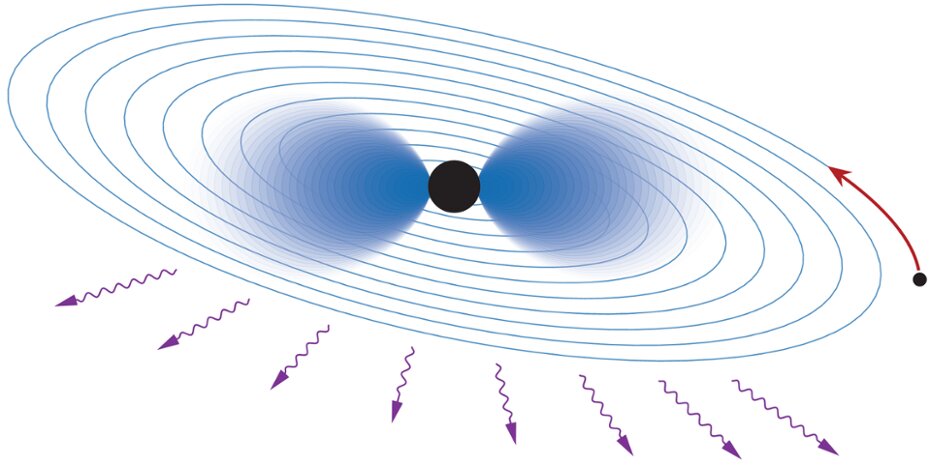
This phenomenon was studied by Stephen Hawking, who described how rotating black holes would throw off radiation that would appear “real” to a nearby observer, but “virtual” to a distant one. In the process of transferring this radiation from one reference frame to another, the acceleration of the particle itself would cause it to transform from virtual to real. This exotic form of energy, known as “Hawking Radiation,” will form clouds of low-mass particles around a black hole. This leads to a “gravitational atom,” so-named because they resemble ordinary atoms (clouds of particles surrounding a core)
While scientists know that this phenomenon occurs, they also understand that it could only be explained through the existence of a new ultralight particle that exists beyond the Standard Model. This was the focus of the new paper, where lead author Daniel Baumann (GRAPPA and the University of Taipei) and his colleagues examined how superradiance causes unstable clouds of ultralight bosons to form around black holes spontaneously. In addition, they suggest that the similarities between gravitational and regular atoms go deeper than their structure.
In short, they suggest that binary black holes could cause particles in their clouds to become ionized via the photoelectric effect. As described by Einstein, this occurs when electromagnetic energy (such as light) makes contact with a material, causing it to emit excited electrons (photoelectrons). When applied to a binary black hole, Baumann and his colleagues show how clouds of ultralight bosons could absorb the “orbital energy” of a black hole companion. This would cause some of the bosons to become ejected and accelerated, evident from the black hole’s associated GW signals.
Artist’s concept of a “gravitational atom,” where a nucleus (black hole) is surrounded by clouds of particles. Credit: UvA Institute of Physics
Lastly, they demonstrated how this process could dramatically alter the evolution of binary black holes by reducing the time it takes for the objects to merge. As they state:
“The orbital energy lost in this process can overwhelm the losses due to GW emission, so that ionization drives the inspiral rather than merely perturbing it. We show that the ionization power contains sharp features that lead to distinctive “kinks” in the evolution of the emitted GW frequency.”
These “kinks,” they argue, will be discernible to next-generation GW interferometers like the Laser Interferometer Space Antenna (LISA). This process could be used to discover an entirely new class of ultralight particles and provide direct information about the mass and state of “gravitational atom” clouds. In short, the ongoing studies of GWs using more sensitive interferometers could reveal exotic physics that advance our understanding of black holes and lead to new breakthroughs in particle physics.
This is one of many possibilities that have been ventured thanks to the revolution taking place with GW astronomy. In the coming years, astrophysicists hope to use them to probe the most extreme environments in the Universe, like black holes and neutron stars. They also hope that primordial gravitational waves will reveal things about the early Universe, help resolve the mystery of the matter/anti-matter imbalance, and lead to a quantum theory of gravity (aka. a Theory of Everything).
Dust is an everyday feature on Mars and wreaks havoc on various pieces of equipment humans decide to send to it, such as Insight’s continual loss of power or the losses of Opportunity and Spirit. But we’ve never really understood what causes the dust to get up into the air in the first place. That equipment that is so affected by it usually isn’t set up to monitor it, or if it is, it has been sent to a place where there isn’t much dust, to begin with. Now, that has changed with new readings from Perseverance in Jerezo crater, and the answer shouldn’t be much of a surprise – dust devils seem to cause some of the dust in the atmosphere on Mars. But strong winds contribute a significant amount too.
A new paper in Science Advances by a team of over 45 scientists reports on data collected by Perseverance’s instrumentation that is designed to study the Martian environment. The Radiation and Dust Sensor (RDS) instrumentation is part of a broader package of instrumentation known as the Mars Environment Dynamics Analyzer (MEDA).
This instrument can detect changes in the environmental conditions that would occur around the rover about once a second. The most likely cause of those changes would be the presence of dust devils.
UT video discussing the perils of dust storms
But it is not enough to detect those changes alone, as they could be caused by sources other than dust devils. So the RDS combines forces with another MEDA instrument, the Thermal InfraRed Sensor (TIRS), which can provide data on the tracking radiative flux around the rover. Combining these two data sets allow scientists to comprehensively say whether or not a dust devil has overtaken the rover.
They do so often. About four times a day, the rover is subjected to “convective vortices,” the technical term for updrafts that are strong enough to sense. About one of those four carries enough dust to be thought of as what we would conventionally call a “dust devil.” And their existence seems to be the source of most of the dust that reaches the air. But they aren’t the only source.
There was some evidence for strong wind gusts that don’t actually form into a dust devil and might force a significant amount of dust into the air themselves. While these weren’t necessarily as strong as the dust devils, they covered a much larger area, with the largest being ten times larger than the largest dust devil. So even if they are much weaker, they were potentially able to lift smaller grains of dust high into the atmosphere.
Another dust devil seen by HiRISE.
Credit – NASA / JPL / UArizona
The scientists think that a roughly equal amount of dust in the Martian atmosphere could be caused by both dust devils and these more concentrated wind gusts. But no matter what the dust is from, the existence of instruments on Mars that can finally collect data on the underlying cause of the dust is a breakthrough in understanding the Martian environment. It might also help us find a way to disrupt this potentially destructive process if it ever comes to that.
Sunspots are typically no real reason to worry, even if they double in size overnight and grow to twice the size of the Earth itself. That’s just what happened with Active Region 3038 (AR3038), a sunspot that happens to be facing Earth and could produce some minor solar flares. While there’s no cause for concern, that does mean a potentially exciting event could happen – spectacular auroras.
Although scientists consistently point out that people are in no danger from sunspots like AR3038, that doesn’t stop the popular media from worrying about them, especially ones that seem to grow quickly. But this is all par for the course, according to Rob Steenburgh, the head of the US’s National Oceanic and Atmospheric Administration Space Weather Forecast Office.
He points out that this type of rapid growth is exactly what we expect to see at this point in the solar cycle, the 11-year repeating pattern that started again in 2019. He also points out that sunspots of this kind don’t typically produce the types of dangerous solar flares that could knock out satellites or disrupt power grids. It simply lacks the complexity.
UT video describing when we should be worried about solar flares.
Solar flares occur when the magnetic fields surrounding a sunspot break and rejoin in complex patterns, some of which cause flairs to be ejected out into the solar system. If these hit the Earth, they could potentially cause damage to some infrastructure, especially those reliant on electricity. However, they are much more likely to create spectacular auroras when their ions hit Earth’s own magnetic field.
They are rated in severity, scaling from B (the weakest) to C, M, and X (the strongest). X flares have their own grading system, and the most powerful solar flares, X20, happen less than once per 11-year solar cycle and typically do not face Earth.
The likelihood of an X20 forming due to AR3038 is minuscule, though there was a 10% chance of it creating a less powerful X flare. More likely are M flares, which AR3038 has a 25% chance of developing before it dies down in size and scale, as sunspots typically do.
UT video on the most violent solar storm in history – The Carrington Event.
However, it doesn’t look like any of those flares will be directed at Earth, as AR3038 has rotated back out of view and is no longer facing us. There is another active region, AR3040, which had 6 C-class flares in the last 24 hours. So there might still be a chance of some spectacular auroras if the planet happens to be in the path of one of those C-class flares.
If not, the whole episode with the rapid growth of AR3038 will prove another example of the public being generally concerned about what appears to be a threatening turn of events, but which is quite common and even innocuous. With all the equipment currently set up to monitor the Sun, the general public can rest assured that we’ll have at least some warning before any potentially damaging flare affects our Earth-bound systems. But it might be a while before that happens, so don’t hold your breath.
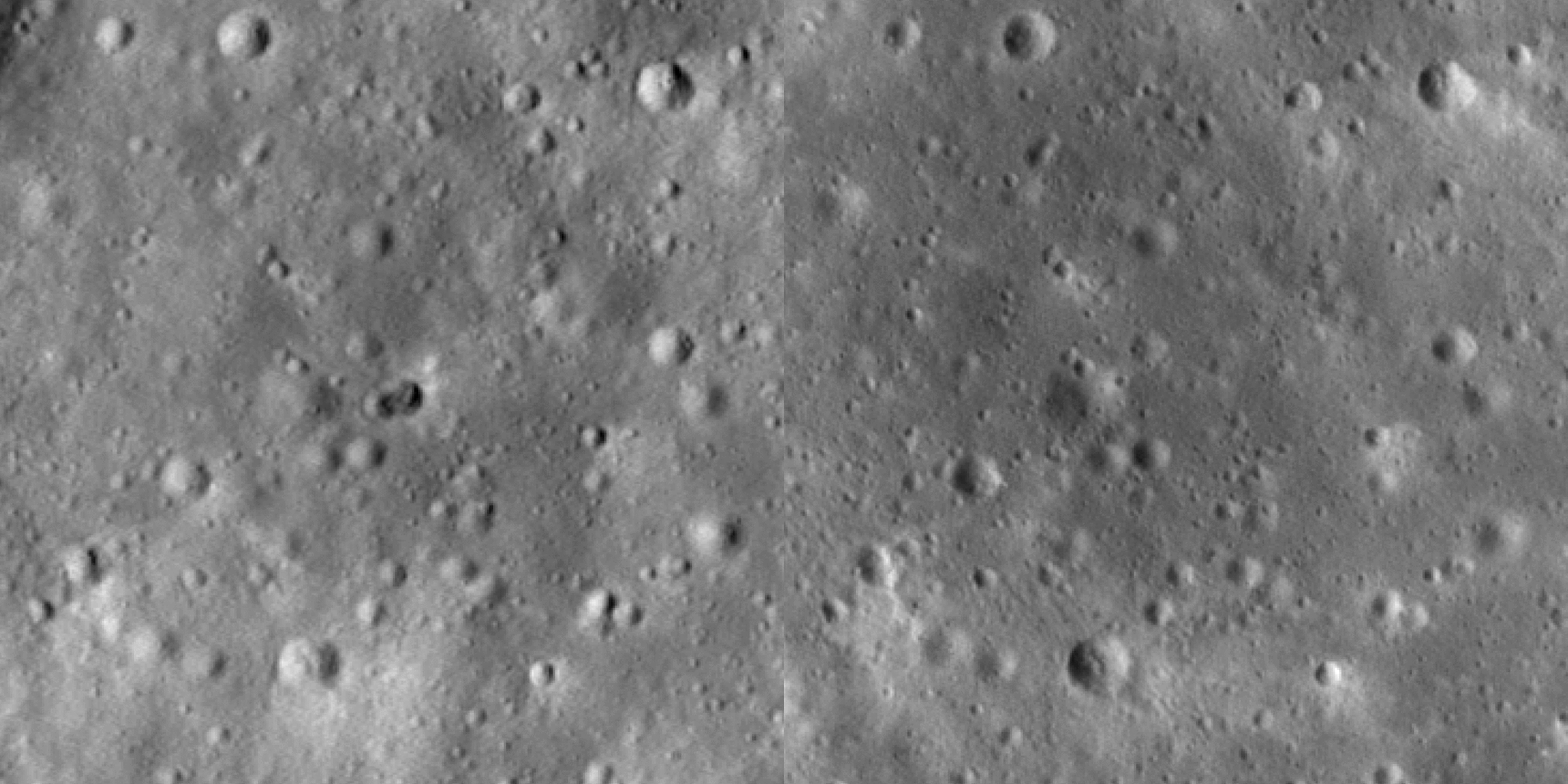
The Lunar Reconnaissance Orbiter (LRO) – NASA’s eye-in-the-sky in orbit around the Moon – has found the crash site of the mystery rocket booster that slammed into the far side of the Moon back on March 4th, 2022. The LRO images, taken May 25th, revealed not just a single crater, but a double crater formed by the rocket’s impact, posing a new mystery for astronomers to unravel.
Why a double crater? While somewhat unusual – none of the Apollo S-IVBs that hit the Moon created double craters – they’re not impossible to create, especially if an object hits at a low angle. But that doesn’t seem to be the case here. Astronomer Bill Gray, who first discovered the object and predicted its lunar demise back in January, explains that the booster “came in at about 15 degrees from vertical. So that’s not the explanation for this one.”
Before and after photos at the location of the newly formed craters. Before image acquired 2022-02-28; after image acquired 2022-05-21. Credit: NASA/GSFC/Arizona State University.
The impact site consists of an 18-meter-wide eastern crater superimposed on a 16-meter-wide western crater. Mark Robinson, Principal Investigator of the LRO Camera team, proposes that this double crater formation might result from an object with distinct, large masses at each end.
“Typically a spent rocket has mass concentrated at the motor end; the rest of the rocket stage mainly consists of an empty fuel tank. Since the origin of the rocket body remains uncertain, the double nature of the crater may help to indicate its identity,” he said.
So what is it?
It’s a long story. The unidentified rocket first came to astronomers’ attention earlier this year when it was identified as a SpaceX upper stage, which had launched NASA’s Deep Space Climate Observatory (DSCOVR) to the Sun-Earth L1 Lagrange Point in 2015. Gray, who designs software that tracks space debris, was alerted to the object when his software pinged an error. He told the Washington Post on January 26th that “my software complained because it couldn’t project the orbit past March 4, and it couldn’t do it because the rocket had hit the Moon.”
Gray spread the word, and the story made the rounds in late January – but a few weeks later, he received an email from Jon Giorgini at the Jet Propulsion Lab (JPL). Giorgini pointed out that DSCOVR’s trajectory shouldn’t have taken the booster anywhere near the Moon. In an effort to reconcile the conflicting trajectories, Gray began to dig back into his data, where he discovered that he had misidentified the DSCOVR booster way back in 2015.
Wide view of the double crater and its surroundings. Image width: 1100 meters. Credit: NASA/GSFC/Arizona State University.
A bit of detective work led Gray to determine it was actually the upper stage of China’s Chang’e 5-T1 mission, a 2014 technology demonstration mission that lay the groundwork for Chang’e 5, which successfully returned a lunar sample to Earth in 2020 (incidentally, China recently announced it would follow up this sample return mission with a more ambitious Mars sample return project later this decade). Jonathan McDowell offered some corroborating evidence that seemed to bolster this new theory for the object’s identity.
The mystery was solved.
Except, days later, China’s Foreign Minister claimed it was not their booster: it had deorbited and crashed into the ocean shortly after launch.
As it stands now, Gray remains convinced it was the Change 5-T1 booster that hit the Moon, proposing that the Foreign Minister made an honest mistake, confusing Chang’e 5-T1 with the similarly named Chang’e 5 (whose booster did indeed sink into the ocean).
As for the new double crater on the Moon, the fact that the LRO team was able to find the impact site so quickly is an impressive feat in itself. It was discovered mere months after impact, with a little help from Gray and JPL, who each independently narrowed the search area down to a few dozen kilometers. For comparison, The Apollo 16 S-IVB impact site took more than six years of careful searching to find.
LRO images of Apollo-era S-IVB impact sites, none of which feature the double crater features seen at the March 4 2022 impact site. Credit: NASA/GSFC/Arizona State University.
Bill Gray’s account of the booster identification saga is here, as well as his take on the double crater impact. The LRO images can be found here.
Feature Image Credit: NASA/GSFC/Arizona State University.