Thursday, November 2, 2023

ESA’s Hera Mission is Bringing Two Cubesats Along. They’ll Be Landing on Dimorphos

In about one year from now, the European Space Agency will launch its Hera mission. Its destination is the asteroid Didymos, and it’ll be the second human spacecraft to visit the 390-meter chunk of rock. NASA’s DART mission crashed a kinetic impactor into Didymos’ tiny moonlet Dimorphos as a test of planetary defence.

Hera will perform a follow-up investigation of the binary asteroid to measure the size and morphology of the impact crater on Dimorphos. To help it along, it’s taking two tiny CubeSats that will land on Dimorphos.

It might seem strange that two tiny satellites will perform landings on an asteroid. But Hera is designed to fulfill different goals. First of all, it’s part of the ESA’s Planetary Defence program. So, its main mission is to study the effect NASA’s DART mission had on Dimorphos and Didymos so we can learn more about deflecting dangerous asteroids that might threaten Earth. But it’s also a technology demonstration mission.

The pair of CubeSats could test a new method of landing on an asteroid called Robust Ballistic Landings.

Landing something on a spinning asteroid with almost no gravity is tricky. If you want to spend a lot of money on a complex spacecraft, you can get good results. But can it be done with less expense and with less complexity and still be successful? That’s what the CubeSats Milani and Juventus will try to do.

The pair of CubeSats are identical except for their instruments. They’re approximately 12 kgs (26.5 lbs), are three-axis stabilized, and have cold gas propulsion systems. They’ll use their instruments to complement Hera’s study of the binary asteroid. Their instruments include a spectrometer, a thermogravimeter for detecting volatiles and organics, a radar to probe Dimorphos’ inner structure, and a gravimeter. There are also cameras and radio equipment. Hera, Milani and Juventus will examine Dimorphos and Didymos for about six months.

Then, at the end of their mission, the plan is for Milani and Juventus to land on Dimorphos.

A new paper presents a novel method the CubeSats can use to land on Dimorphos. Its title is “Design and Analysis of Robust Ballistic Landings on the Secondary of a Binary Asteroid.” The lead author is Iosto Fodde from the University of Glasgow in the UK.
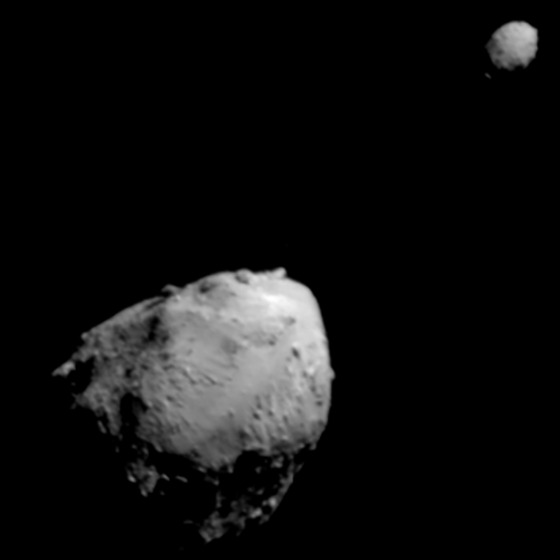
Asteroid Didymos (bottom left) and its moonlet, Dimorphos, about 2.5 minutes before the impact of NASA’s DART spacecraft. Credit: NASA/Johns Hopkins APL.

“Two CubeSats on board Hera plan to perform a ballistic landing on the secondary of the system, called Dimorphos,” the authors write. “For these types of landings, the translational state during descent is not controlled, reducing the spacecraft’s complexity but also increasing its sensitivity to deployment maneuver errors and dynamical uncertainties.”

What’s a Robust Ballistic Landing? Basically, it means it’s not a powered descent.

There’s a lot of math involved, but it boils down to what’s called the non-intrusive Chebyshev interpolation (NCI) technique. Basically, a computer calculates the rate of growth of the number of possible states of the CubeSat over time. That lets the spacecraft constrain the number of impact velocities and angles that will allow a successful landing. The result is that the spacecraft can optimize its landing. So, the tiny CubeSat can increase the robustness of its trajectory compared to other methods.

“The resulting trajectory increases the robustness of the trajectory compared to a conventional method, improving the landing success by 20 percent and significantly reducing the landing footprint,” the authors of a new paper say.
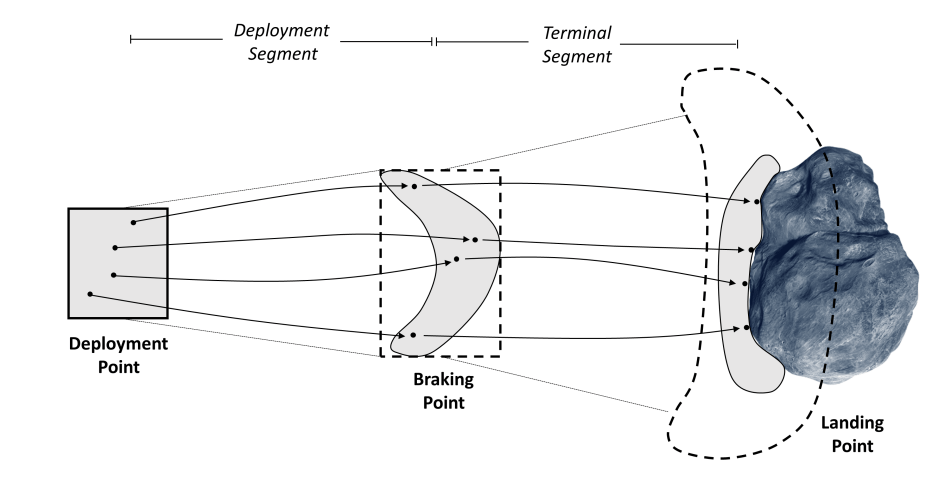
This schematic from the paper illustrates how the NCI technique works. The grey areas represent the actual area which the trajectories occupy, whereas the squares represent the total propagated area using NCI. Image Credit: Fodde et al. 2023.

NASA’s successful asteroid sample-return mission, OSIRIS-REx, amplified how important bringing samples back to Earth is. It was fantastically successful. But it was also a complicated and relatively expensive mission. All that complexity isn’t necessary for every mission. The authors of this paper point out how simply landing a basic spacecraft on an asteroid can reveal a lot. “Landings on the surface of asteroids are incredibly valuable in terms of scientific return as the spacecraft-surface interaction provides direct information on the internal structure and material properties of the asteroid while their instruments can do some in-situ measurements to characterize the asteroid in more depth,” they write.

So, developing a reliable way to land on asteroids is part of studying them.

Artist’s impression of the DART mission impacting the moonlet Dimorphos. Credit: ESA

Milani and Juventus will attempt to land on Dimorphos at the end of the Hera mission. By that time, they’ll have detailed information on the surface, including rocks and craters. But Dimorphos is a binary system, and that, along with other things, introduces additional complexity that previous asteroid missions didn’t have to contend with. “The complex dynamics due to the large influence of the primary, the non-spherical shape of both bodies and the low gravitational forces make the landing trajectory design difficult,” the authors explain.

The researchers looked specifically at landing the CubeSats in the same hemisphere as DART’s impact crater. That would require an additional braking maneuver to reduce the landing velocity. The NCI robust ballistic landing method “increased the landing success percentage from 74.3% to 94.7% compared to a trajectory designed without considering the uncertainties.” That’s a significant improvement, the type that gets engineers excited, especially when it doesn’t require more complex spacecraft design.

The last complete image of asteroid moonlet Dimorphos, taken by the DRACO imager on NASA’s DART mission from ~7 miles (12 kilometres) from the asteroid and 2 seconds before impact. The image shows a patch of the asteroid that is 100 feet (31 meters) across. Dimorphos’ north is toward the top of the image. Credits: NASA/Johns Hopkins APL

“This comes at the cost of increasing the mean impact angle and moving the mean landing longitude away from the desired location,” the authors explain. “However, even with these changes, the robust trajectory was found to be much more desirable.”

“These results show the potential of this methodology for the design of a ballistic landing on Dimorphos,” say the authors.

The post ESA’s Hera Mission is Bringing Two Cubesats Along. They’ll Be Landing on Dimorphos appeared first on Universe Today.


Jupiter Looks Bizarre in Hubble's New Ultraviolet Image

Jupiter has gone pastel!

Check out this ultra-cool image of Jupiter taken by the Hubble Space Telescope. This is a color composite picture of Jupiter seen in ultraviolet, which reveals different features in Jupiter’s atmosphere. One feature that stands out is Jupiter’s Great Red Spot — it is blue in this image!

This giant storm looks unusually dark in ultraviolet because high-altitude hazes over the huge storm absorb UV photons before they are reflected back to Earth. NASA said the data used to create this ultraviolet image is part of a Hubble proposal that looked at Jupiter’s superstorm systems. The researchers plan to map deep water clouds using the Hubble data to define 3D cloud structures in Jupiter’s atmosphere.

Ultraviolet light are short, high-energy wavelengths of light beyond what the human eye can see. Ultraviolet light reveals phenomena such as light from the hottest and youngest stars which are usually hidden in the dust of local galaxies; it can also reveal the composition, densities, and temperatures of the material between stars.

Here’s another Hubble view of Jupiter in multiple wavelentths, including ultraviolet from 2020:

A multiwavelength observation in ultraviolet/visible/near-infrared light of Jupiter obtained by the NASA/ESA Hubble Space Telescope on 25 August 2020 is giving researchers an entirely new view of the giant planet. Hubble’s near-infrared imaging, combined with ultraviolet views, provides a unique panchromatic look that offers insights into the altitude and distribution of the planet’s haze and particles. This complements Hubble’s visible-light pictures that show the ever-changing cloud patterns. Credit: NASA/ESA/STScI

Since the human eye cannot detect ultraviolet light, colors in the visible light spectrum are assigned to the images, each taken with a different ultraviolet filter.

This image was released in honor of Jupiter reaching both perigee and opposition. Perigee means when Jupiter reached its closest point to Earth this year, which occurred on November 1-2, 2023 (depending on what time zone you are in — 21 UTC or 4 p.m. EDT.) The distance between the Earth and Jupiter at that time was 595 million km (370 million miles)

Opposition is when another object — Jupiter in this case – is opposite the Sun in our sky. That means Earth comes between the Sun and Jupiter. This happens on of November 2-3, 2023 at 5 UTC (12 a.m. CDT).

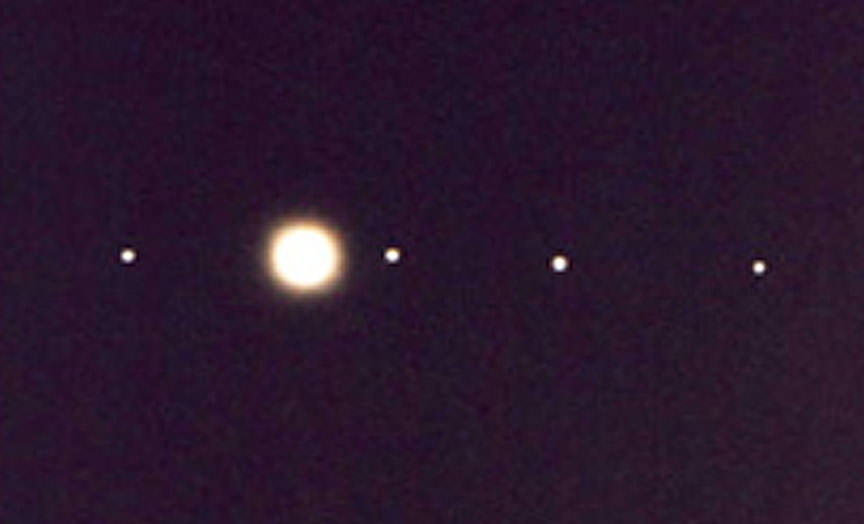
An object’s opposition also usually means it’s a great time to observe it from Earth. If you look to the east in the evenings, you’ll see a very bright object – that’s Jupiter. A look even through a small telescope or binoculars will reveal the four largest moons of Jupiter. Three of those moons are bigger than Earth’s Moon, and one of them, named Ganymede, is the largest moon in the Solar System.

Jupiter and its four brightest moons seen in a small telescope. Credit: Bob King

The post Jupiter Looks Bizarre in Hubble's New Ultraviolet Image appeared first on Universe Today.


Old Data from Kepler Turns Up A System with Seven Planets

NASA’s Kepler mission ended in 2018 after more than nine years of fruitful planet-hunting. The space telescope discovered thousands of planets, many of which bear its name. But it also generated an enormous amount of data that exoplanet scientists are still analyzing.

Now, a team of researchers has shed new light on a seven-planet system in Kepler’s ocean of data.

The star is called Kepler 385, and it’s about 4,670 light-years away. Some of its planets were confirmed back in 2014, while some remained as candidates. But in a new updated catalogue, exoplanet scientists have confirmed the rest of the planets and revealed new details on this rare system.

The paper announcing the new catalogue is called “Updated Catalog of Kepler Planet Candidates: Focus on Accuracy and Orbital Periods.” The lead author is Jack Lissauer, a research scientist at NASA’s Ames Research Center. The paper will appear in the Journal of Planetary Science.

“We’ve assembled the most accurate list of Kepler planet candidates and their properties to date,” Lissauer said. “NASA’s Kepler mission has discovered the majority of known exoplanets, and this new catalogue will enable astronomers to learn more about their characteristics.”

Scientists have known about the Kepler 385 planetary system for years. Some of its planets were confirmed back in 2014, while others remained candidates. But updated methods and refined data have led to new understandings and discoveries.

The team of researchers behind the catalogue says it lists all known Kepler planet candidates that orbit and transit only one star. One of the most intriguing systems is Kepler 385, which boasts seven planets so close to their star that they’re bathed in its heat. All seven are larger than Earth but smaller than Neptune.

Kepler 385 is similar to the Sun but a little larger and hotter. It’s 10% larger and about 5% hotter. It’s one of a very small number of stars with more than six planets or planet candidates orbiting it.

The two innermost planets are both slightly larger than Earth. According to the new catalogue, they’re both probably rocky. They may even have atmospheres, though if they do, they’re very thin. The remaining five planets have radii about twice as large as Earth’s and likely have thick atmospheres.

This artist's illustration shows Kepler 385 and two of its planets. Image Credit: Bishop’s University/D. Rutter.
This artist’s illustration shows Kepler 385 and two of its planets. Image Credit: Bishop’s University/D. Rutter.

“Our revision to the Kepler Exoplanet catalogue provides the first true uniform analysis of exoplanet properties,” said co-author Jason Rowe, Canada Research Chair in Exoplanet Astrophysics and Professor at Bishop’s University in Quebec, Canada. “Improvements to all planetary and stellar properties have allowed us to conduct an in-depth study of the fundamental properties of exoplanetary systems to better understand exoplanets and directly compare these distant worlds to our own Solar System and to focus in on the details of individual systems such as Kepler-385.”

This image from the paper is a visual representation of the planets in their abbreviated catalogue, showing planets by size and stellar temperature. Image Credit: Lissauer et al. 2023.

But the new catalogue is about a lot more than just this rare and interesting system. Kepler 385 is just one of the highlights among the almost 4400 planet candidates and 700 multi-planet systems in the work.

With improved measurements of the stars that host all these planets —especially from the ESA’s Gaia star-measuring spacecraft—the researchers were better able to analyze the distribution of transit durations. Transit durations are an important tool for probing exoplanet distributions. It concerns orbital eccentricities, which range from circular orbits with an eccentricity of zero to highly elongated orbits.

There isn’t enough data for most exoplanets to measure their eccentricity individually. But the researchers developed methods that can characterize the distribution of eccentricities for a population of transiting exoplanets. This is an important component of the new Kepler catalogue, and it led the researchers to some new conclusions.

The main one concerns the nature of planetary orbits in multi-planet systems.

“While previous studies had inferred that small planets and systems with more transiting planets tend to have smaller orbital eccentricities, those results relied on complex models,” said co-author Eric Ford from the Department of Astronomy and Astrophysics at Penn State University. “Our new result is a more direct and model-independent demonstration that systems with more transiting planets have more circular orbits.”

This artist's rendering compares the relative sizes of the Kepler-385 (KOI 2433) planets. Credit: NASA/Daniel Rutter.
This artist’s rendering compares the relative sizes of the Kepler-385 (KOI 2433) planets. Credit: NASA/Daniel Rutter.

In terms of potential habitability, the Kepler 385 system is a dud.

All seven planets are well inside the habitable zone and bathed in intense radiation. In fact, all seven of them receive more heat from their star per area than any planet in our Solar System. But this new work isn’t about habitability.

It’s about a new Kepler catalogue that’s more detailed and accurate than its predecessors.

“It has been more than a decade since Kepler ceased its collection of data from its prime field of view,” the authors write. “Nevertheless, the list of Kepler planet candidates remains the largest and most homogeneous collection of exoplanets known.”

Now, we have even better data on all those planets. Who knows what other insights it’ll generate?

The post Old Data from Kepler Turns Up A System with Seven Planets appeared first on Universe Today.


Devastating Clouds of Dust Helped End the Reign of the Dinosaurs

When a giant meteor crashed into Earth 66 million years ago, the impact pulverized cubic kilometers of rock and blasted the dust and debris into the Earth’s atmosphere. It was previously believed that sulfur from the impact and soot from the global fires that followed drove a global “impact winter” that killed off 75% of species on Earth, including the dinosaurs.

A new geology paper says that the die-off was additionally fueled by ultrafine dust created by the impact which filled the atmosphere and blocked sunlight for as long as 15 years. Plants were unable to photosynthesize and global temperatures were lowered by 15 degrees C (59 F).

Most scientists agree the disaster started with an asteroid impact, where an asteroid at least 10 kilometers wide struck the Chicxulub region in the present-day Yucatán Peninsula in Mexico. The impact released 2 million times more energy than the most powerful nuclear bomb ever detonated.

The devastation created layer of ash sandwiched between layers of rock, known as the Cretaceous-Paleogene (K–Pg) boundary, formerly known as the Cretaceous–Tertiary (K-T) boundary, which is found across the world in the geologic record. It includes a layer of iridium, an element common in asteroids but rare on Earth. It was this ‘iridium anomaly’ that first revealed the extinction event as an asteroid strike to geologists more than three decades ago.

What has been debated is what created conditions for the post-impact winter. The leading candidates were sulphur from the asteroid’s impact, or soot from global wildfires that ensued after the impact. Both would have blocked out sunlight and plunged the world into a long, dark winter, collapsing the food chain and creating a chain reaction of extinctions.  

Overview of the Cretaceous-Paleogene boundary in North Dakota (USA). The sediments indicate a river and swamp-like environment at the end of the age of the dinosaurs. The pink-brown layer yields ejecta debris derived from the Chicxulub impact event and the grain-size data from this interval were used as input parameters for the paleoclimate modeling study (photo: Pim Kaskes).

But in this new research, scientists from the Royal Observatory of Belgium (ROB) studied new sediment samples taken from the Tanis fossil site in North Dakota in the US, which captures a 20-year period during the aftermath of the asteroid impact. Analysis of the samples revealed evidence of silicate dust particles, particles that were ejected into the atmosphere and eventually settled back down on the planet.

Related:  Previous research at the Tanis site suggests the Chicxulub impact happened in the springtime.

“We specifically sampled the uppermost millimeter-thin interval of the Cretaceous-Paleogene boundary layer,” said Pim Kaskes  from the Archaeology, Environmental Changes & Geo-chemistry (AMGC) at the Vrije Universiteit Brussel (VUB) and the Vrije Universiteit Amsterdam (VUA), who was also involved in the study. “This interval revealed a very fine and uniform grain-size distribution, which we interpret to represent the final atmospheric fall-out of ultrafine dust related to the Chicxulub impact event. The new results show much finer grain-size values than previously used in climate models and this aspect had important consequences for our climate reconstructions.”

Based on their findings, the scientists also created a new paleoclimate computer model that evaluated the roles of sulfur, soot, and silicate dust on the post-impact climate.

Conceptual model of the Chicxulub impact plume showing different stages of (a) production, and (b) transport and deposition of the impact-generated ejecta (not to scale). (c) Paleoclimate model simulations showcasing the time evolution of the dust-induced photosynthetic active radiation flux across the planet following the Chicxulub impact 66 million years ago (modified from Senel et al., 2023; Nature Geoscience).

“The new paleoclimate simulations show that such a plume of micrometric silicate dust could have remained in the atmosphere for up to 15 years after the event, contributing to global cooling of the Earth’s surface by as much as 15 °C in the initial aftermath of the impact,” said Cem Berk Senel from ROB, the lead author of the study.

But while the dust was a contributor to the catastrophic conditions, the sulfur and soot were also a factor.

“We suggest that, together with additional cooling contributions from soot and sulfur, this is consistent with the catastrophic collapse of primary productivity in the aftermath of the Chicxulub impact,” the researchers wrote in their paper.

The prolonged disruption in photosynthesis would pose severe challenges for both terrestrial and marine habitats and mass extinctions would occur in groups not adapted to survive the dark, cold, and food-deprived conditions for at least two years. The researchers said this matches the paleontological records, which show that any plants or animals that could enter a dormant phase (for example, through seeds, cysts, or hibernation in burrows) and were able to adapt to an omnivorous diet, or weren’t dependent on one particular food source generally better survived the K-Pg event.

The post Devastating Clouds of Dust Helped End the Reign of the Dinosaurs appeared first on Universe Today.


Wednesday, November 1, 2023

A Collapsed Martian Lava Chamber, Seen From Space

Lava tubes and chambers attract a lot of attention as potential sites for bases on the Moon and Mars. They provide protection from radiation, from temperature swings, and even from meteorites. They beg to be explored.

Volcanoes are just the most obvious and the largest manifestations of a planet’s volcanic activity. In reality, most of what creates a volcano happens deep underground. That’s true of Earth and Mars.

A volcano occurs when magma, ash, and gases erupt from a magma chamber beneath the surface of a planet. (Or moon, in Io’s case.) You can’t miss the volcano itself, which rise well above the surface and spew ash high into the atmosphere. But what’s hidden is what goes on underground.

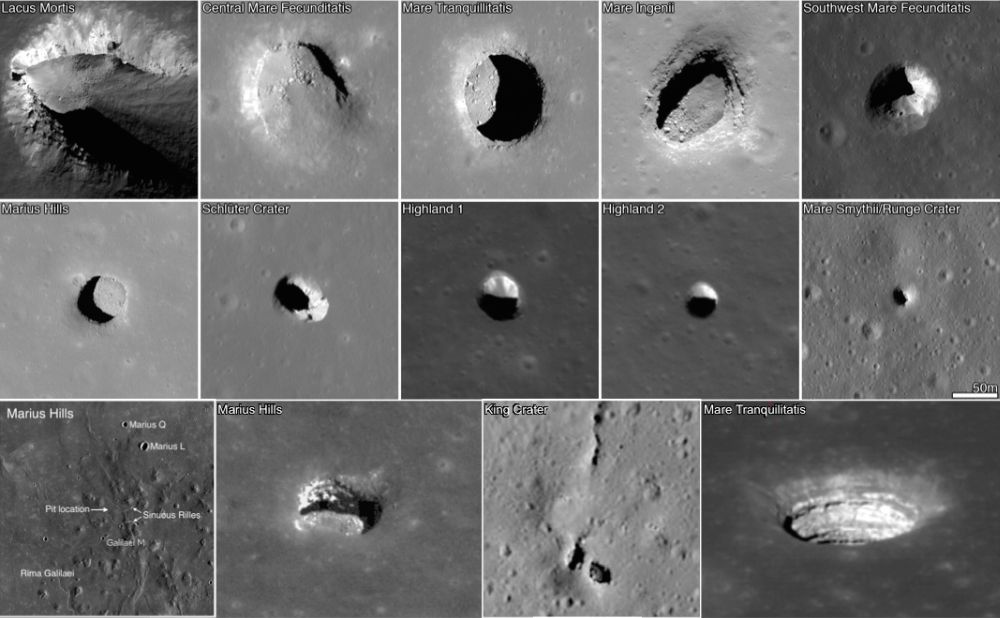
Volcanic activity can move an enormous amount of liquid rock, pushing it around and forming an interconnected network of lava tubes and chambers. The lava can drain away, leaving an empty cave or tube. Sometimes the roof collapses, forming what’s known as a skylight. There are many of them on the Moon, where they’ve attracted everyone’s attention. The skylight can provide easy access to what could be underground refuges in some cases.

Lava tubes are natural shelters and could serve as Moon bases. These images from the Lunar Reconaissance Orbiter show pits on the lunar surface. The images are each 222 meters (728 feet) wide. Credit: NASA/GSFC/Arizona State University

Mars has them too, and NASA Mars Reconnaissance Orbiter (MRO) captured an image of one with its HiRISE camera.

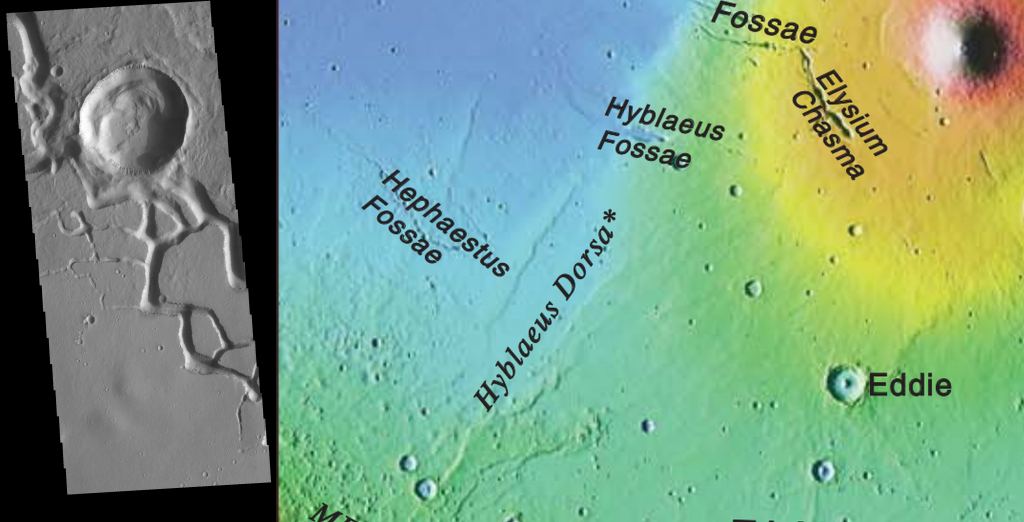
It’s in the Hephaestus Fossae Region in Utopia Planitia on Mars. Hephaestus Fossae is a system of channels and troughs. It’s connected to the nearby Elysium volcanic center, and melt water from a nearby impact may have helped create it, too. There’s some uncertainty.

This HiRISE image on the left shows more of the Hephaestus Fossae's system of troughs and channels, as well as the nearby impact crater. The image on the right shows the region in relation to its surroundings, including the Elysium Mons volcano on the upper right of the image. Image Credit: NASA/JPL- Caltech/ASU
This image on the left is from the MRO’s THEMIS camera and shows more of the Hephaestus Fossae’s system of troughs and channels, as well as the nearby impact crater. The image on the right shows the region in relation to its surroundings, including the Elysium Mons volcano on the upper right of the image. Image Credit: NASA/JPL- Caltech/ASU

Lava tubes could provide a solution to one of the obstacles confronting human exploration of Mars. The average surface radiation on Mars is 40 to 50 times stronger than on Earth, but thick overhead rock could provide protection. Mars also experiences wild temperature swings from 20 Celsius down to -152 Celsius. A temperature-controlled habitat buffered by all the overhead rock could protect astronauts and equipment from those swings.

There are all kinds of ideas how to explore these types of features. China is developing plans to explore lunar lava tubes, and even build a base in one. So by the time we make it to Mars, we’ll already have our feet wet and will be better equipped to use lava tubes to our advantage.

Currently, Mars exploration focuses on one big question: Did Mars ever support life? So our missions head to places where we might find the evidence. That usually means sediments that could preserve the evidence we desire. MSL Curiosity is at Gale Crater, Perserverance is at Jezero Crater, and the ESA’s upcoming Rosalind Franklin rover will land at Oxia Planum.

None of our missions are aimed at exploring lava tubes. But one day we will explore them, and this one in Hephaestus Fossae could be a good place to start.

It could end up being a stable home away from home.

The post A Collapsed Martian Lava Chamber, Seen From Space appeared first on Universe Today.


Next Generation Gravitational Wave Observatories Could Detect 100-600 Solar Mass Black Hole Mergers

Humans are born wonderers. We’re always wondering about the next valley over, the next horizon, what we’ll understand next about this vast Universe that we’re all wrapped up in.

In 2015, we finally detected our first long-awaited and long-theorized gravitational wave from the distant merger of two stellar mass black holes. But now we want to know more, and only better detectors can feed our appetite.

Whenever we discover something new, like a long-awaited answer to a fundamental question, our knowledge horizon shifts. That’s what happened with the first gravitational wave (GW.) We stopped for a moment, acknowledged Albert Einstein’s visionary scientific mind that predicted the phenomenon over a century ago, then moved on to wondering what comes next.

When it comes to gravitational waves, we’ve detected dozens of them, both confirmed and candidates awaiting confirmation. But they all have one thing in common: they’re all from stellar mass black hole mergers. That’s because Virgo/LIGO can’t detect mergers of more massive black holes. They occur too slowly.

So now the GW horizon has shifted. Now we want to detect intermediate mass black hole mergers. And to do that, we await the next generation of GW observatories: The Einstein Telescope and the Cosmic Explorer.

What’s so important about intermediate black hole mergers?

Intermediate black holes are difficult to detect. They have masses between 100 and one million solar masses. Astrophysicists have only found several candidates, based on indirect evidence. But they’re important because they’re likely the seeds for the supermassive black holes (SMBHs) at the heart of galaxies like the Milky Way.

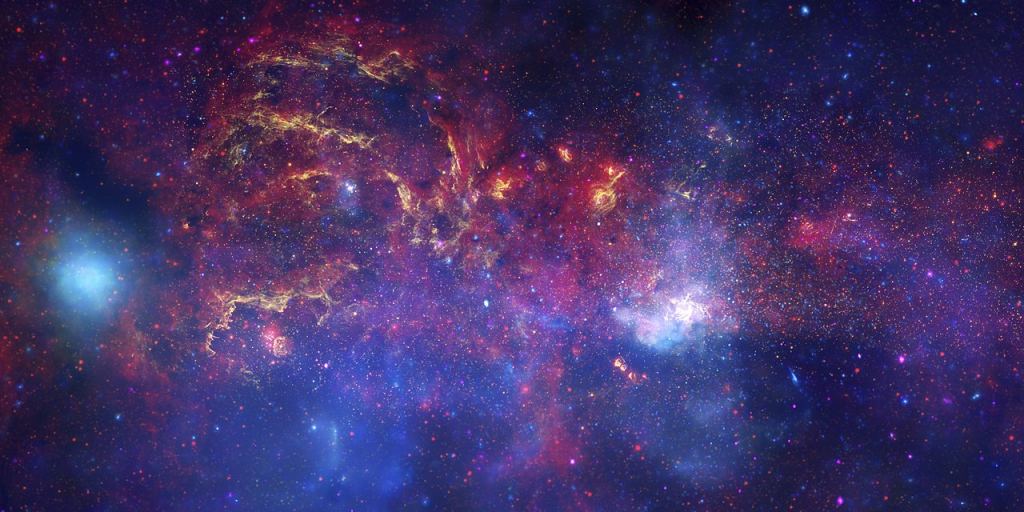
This is an image of the center of the Milky Way. The bright white area right of center is home of the supermassive black hole Sagittarius A star. Somehow, stellar mass black holes, intermediate mass black holes, and Supermassive black holes are related. But how exactly? New GW observatories will help astrophysicists sort it out. Image Credit: By NASA/JPL-Caltech/ESA/CXC/STScI - Public Domain.
This is an image of the center of the Milky Way. The bright white area right of center is home of the supermassive black hole Sagittarius A star. Somehow, stellar mass black holes, intermediate mass black holes, and Supermassive black holes are related. But how exactly? New GW observatories will help astrophysicists sort it out. Image Credit: By NASA/JPL-Caltech/ESA/CXC/STScI – Public Domain.

A new paper looks at how to investigate intermediate black holes by detecting their mergers and resulting gravitational waves. It looks at two new observatories, the Einstein Telescope and the Cosmic Explorer.

The paper is “Identifying heavy stellar black holes at cosmological distances with next generation gravitational-wave observatories.” The lead author is Stephen Fairhurst, Head of the Gravity Exploration Institute at Cardiff University.

The paper focuses on detecting binary black holes with total combined masses between 100 million and 600 million solar masses. Current detectors struggle to locate these events, but the new observatories can change that.

“The next-generation of ground-based GW observatories, specifically the Einstein Telescope (ET) and Cosmic Explorer (CE, will open the prospect of detecting the GW signatures of merging BBHs over a wider
mass range and deeper redshifts, extending the realm of observations to BBHs out to z ~ 30, when the first stars began to shine, and into the intermediate-mass range of 100?1000 <solar masses>,” the paper states.

Stellar mass black holes form when massive stars collapse under their own weight. It’s also possible that in the very early Universe, when things were much more dense, gas clouds could’ve collapsed directly into black holes. That’s an example of the many things astrophysicists don’t yet know about black holes.

An important part of the study of black hole mergers is the pair-instability mass-gap.

The pair-instability mass-gap describes a gap in mass observed in pair-instability supernovae. They only happen in stars with a mass range from around 130 to 250 solar masses. We know stellar mass black holes form well below that mass range, but there’s a gap between about 65 and 135 solar masses where no black holes form.

“Some of the BBH masses we investigate reside within the so called pair-instability mass-gap (often referred to as upper-mass gap or Pair Instability Supernova (PISN) gap.) This gap is between about 65 solar masses and 135 solar masses where no BH is expected to form in evolution models of isolated stars.”

The nature and exact range of the mass gap is uncertain. Different estimates, models, and theories arrive at slightly different numbers. But it’s there, and somehow it’s related to our overarching questions about black holes, and how the SMBHs in galaxies got to be so massive.

“We discuss the impact that these observations will have in narrowing uncertainties on the existence of the pair-instability mass-gap, and their implications on the formation of the first stellar black holes that could be seeds for the growth of supermassive black holes powering high-z quasars,” the researchers write.

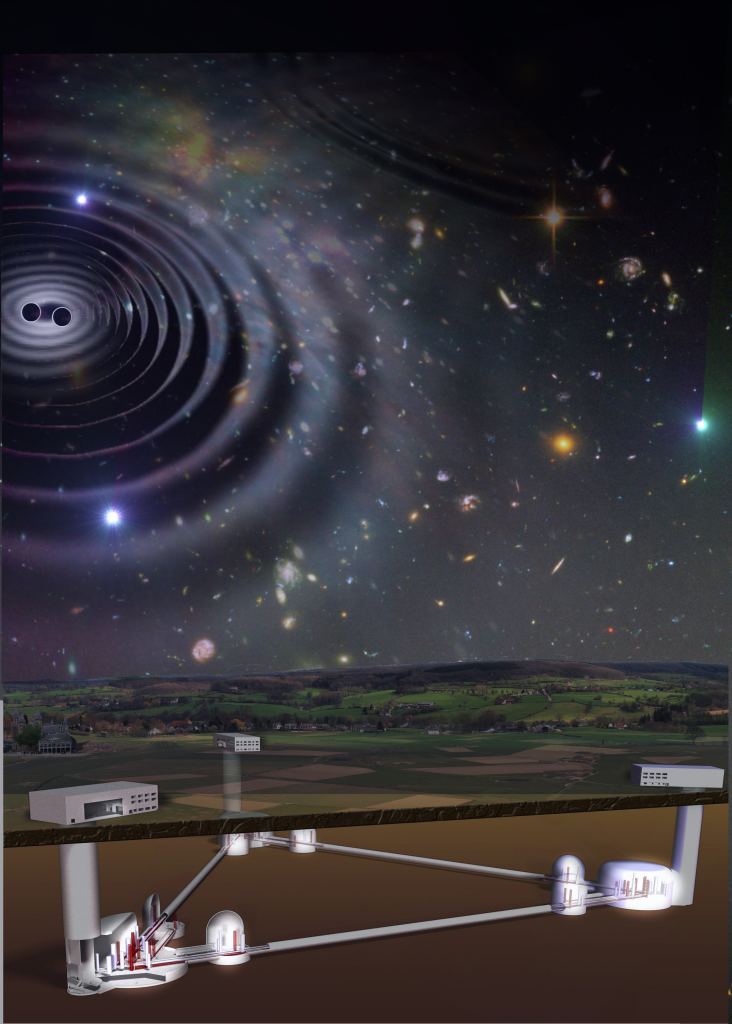
The Einstein Telescope is a proposed GW observatory under consideration by several nations in the European Union. It promises more precise GW astronomy.

This illustration shows the Einstein Telescope under the night sky. Image Credit: Einstein Telescope, R. Williams (STScI), the Hubble Deep Field Team and NASA

It’s design calls for 10km long arms, compared to 4 km for LIGO. It’ll be built underground to reduce seismic noise and background noise from nearby moving objects. The Einstein Telescope will also be cryogenically-cooled. It all adds up to increased performance, and it should be able to detect GWs from intermediate mass black hole mergers.

“Exploiting the ET sensitivity and frequency band, the entire population of stellar and intermediate mass black holes will be accessible over the entire history of the Universe, enabling to understand their origin (stellar versus primordial), evolution, and demography,” the ET website claims.

The Cosmic Explorer is another proposed third-generation GW observatory under consideration by the USA. It’s conceptual design calls for two separate facilities. One will house two 40 km arms, and the other will have two 20 km arms. While other technology advancements contribute to its sensitivity, its long arms are the key driver.

This illustration shows the Cosmic Explorer. Some of its arms will be 40 km long. Image Credit: Angela Nguyen, Virginia Kitchen, Eddie Anaya, California State University Fullerton; and courtesy of Cosmicexplorer.org

“Sources that are barely detectable by Advanced LIGO, Advanced Virgo, and Kagra will be resolved with incredible precision. The resulting explosion in the number of detected sources — up to millions per year — and the fidelity of observations will have wide-ranging impacts in physics and astronomy,” the CE website says.

How will these two observatories change our understanding of the GW sky?

Both these detectors will allow us to find BH mergers in the ancient Universe. “In all cases, it is shown that next generation GW network provides a unique capability to probe high-redshift black hole formation,” the authors explain. “The most critical feature of detector sensitivity for observing these systems is the low-frequency sensitivity of the detectors.”

It’s critical because massive mergers emit GWs with lower frequencies than our current GW observatories can detect.

This artist's concept illustrates a hierarchical scheme for merging black holes. Credit: LIGO/Caltech/MIT/R. Hurt (IPAC)
This artist’s concept illustrates a hierarchical scheme for merging black holes. Credit: LIGO/Caltech/MIT/R. Hurt (IPAC)

Nailing down the mass gap is a next critical step in understanding black holes. Will these new detectors do that? It all starts with understanding the Universe’s earliest black holes.

“The next-generation of GW detectors provide a unique way to probe the existence of heavy stellar black holes in the high-redshift Universe,” the paper states. Astrophysicicsts need to find black holes with masses above about 50 solar masses at redshift z ~ 10?15. Those BHs could be the bridge between stellar mass black holes and supermassive black holes. They’re hiding somewhere in the mass gap.

“By combining and confronting statistically all observations of both merging and accreting BHs, we will be able to shed light into the origin and evolution of the BH populations, from the stellar to the supermassive through the intermediatemass ones, across the cosmic epochs,” the authors conclude.

Gravitational wave astronomy has shifted the horizon of our knowledge. We finally detected one a few years ago, and more detections followed. A whole new window on the Universe opened. But now, as always, we want to know more.

These upcoming, more powerful and sensitive GW observatories should satisfy our hunger. For a while.

The post Next Generation Gravitational Wave Observatories Could Detect 100-600 Solar Mass Black Hole Mergers appeared first on Universe Today.


White Dwarfs Could Support Life. So Where are All Their Planets?

Astronomers have found plenty of white dwarf stars surrounded by debris disks. Those disks are the remains of planets destroyed by the star as it evolved. But they’ve found one intact Jupiter-mass planet orbiting a white dwarf.

Are there more white dwarf planets? Can terrestrial, Earth-like planets exist around white dwarfs?

A white dwarf (WD) is the stellar remnant of a once much-larger main sequence star like our Sun. When a star in the same mass range as our Sun leaves the main sequence, it swells up and becomes a red giant. As the red giant ages and runs out of nuclear fuel, it sheds its outer layers as a planetary nebula, a shimmering veil of expanding ionized gas that everybody’s seen in Hubble images. After about 10,000 years, the planetary nebula dissipates, and all that’s left is a white dwarf, alone in the center of all that disappearing glory.

White dwarfs are extremely dense and massive, but only about as large as Earth. They’ve left their life of fusion behind, and emit only residual heat. But still, heat is heat, and white dwarfs can have habitable zones, though they’re very close.

Astronomers are pretty certain that most stars have planets. But those planets are in peril when they orbit a star that leaves the main sequence behind and becomes a red giant. That can wreak havoc on planets, consuming some of them and tearing others apart by tidal disruption. Some white dwarfs are surrounded by debris disks, and they can only be the remains of the star’s planets, ripped to pieces by the star during its red dwarf stage.

But in 2020 researchers announced the discovery of an intact planet among the debris disk in the habitable zone around the white dwarf WD1054-226. If there’s one, there are almost certainly others out there somewhere. Why haven’t we found them? And does the fact that the first one we’ve found is a Jupiter-mass planet mean the WD exoplanet population is dominated by them?

An artist’s impression of the white dwarf star WD1054–226 orbited by clouds of planetary debris and a major planet in the habitable zone. Credit Mark A. Garlick / markgarlick.com Licence type Attribution (CC BY 4.0)

A new paper examines the issue of exoplanets around white dwarfs and asks why rocky white dwarf planets seem to be rare. The paper is “The giant nature of WD 1856 b implies that transiting rocky planets are rare around white dwarfs.” The paper’s been accepted into the Monthly Notices of the Royal Astronomical Society and the author is David Kipping, Assistant Professor in the Department of Astronomy at Columbia University in New York.

White dwarfs are long-lived and stable. So even though their habitable zones are far smaller than the zone around a star like our Sun, they still exist. In theory, planets in those habitable zones could support life.

The only intact planet around a white dwarf we know of for certain was detected by NASA’s TESS spacecraft, and it’s a whopper: 13.8 Jupiter masses.

“Given the relative paucity of giant planets compared to terrestrials indicated by both exoplanet demographics and theoretical simulations (a “bottom-heavy” radius distribution,) this is perhaps somewhat surprising,” Kipping explains.

That statement may sound surprising to readers. A quick look at NASA’s Exoplanet Catalogue shows 5,535 confirmed exoplanets. 1898 of them are Neptune-like, and 1756 of them are gas giants. Only 1675 of them are Super-Earths, and a mere 199 are terrestrial. Kipping’s statement that the exoplanet distribution is ‘bottom-heavy,’ meaning that small radius planets are more plentiful than large radius planets seems puzzling from this angle.

But our measured numbers don’t reflect what’s actually out there. Each detection method we use to find exoplanets has its own selection bias. In short: we only know what we’ve found. We don’t know what’s actually out there.

“… there is an emerging view that Jupiter-sized planets represent the minority of the planet population. Thus, the fact that the first transiting planet detected around a WD was found to be a giant planet is somewhat surprising,” Kipping writes. WD 1856 b may be the only confirmed white dwarf planet, but there are other candidates, and most of them are Jupiter-mass or higher planets as well.

To Kipping, the implications of finding a massive gas giant around a white dwarf is concerning. “The implied hypothesis is that transiting WD rocky planets are rare,” Kipping writes.

There’s ample evidence for small terrestrial planets around white dwarfs. But the evidence is in the rocky debris disks from destroyed terrestrial planets. This indicates that these planets are out there, but the question then becomes, are there any intact ones in the habitable zones? Does WD 1856 b’s detection tell us anything about the existence of terrestrial WD planets?

This illustration shows a white dwarf surrounded by debris from shattered objects in a planetary system. Image Credit: NASA, ESA, Joseph Olmsted (STScI)

There are two ways to reconcile the evidence for small planets with the detection of WD 1856 b.

Firstly, there’s no absolute reason why either small rocky planets or massive Jupiter+ mass planets need to dominate the WD exoplanet population. “Perhaps the distribution turns over at some radius, representing the most unlikely planetary radius, and then peaks back up,” Kipping writes. There could be an infinite number of distributions; we just don’t know yet.

The other way to reconcile it is simple. “A second possibility is that WD 1856 b is simply a fluke. Perhaps there truly is a bottom-heavy distribution and it was indeed highly improbable that a WD 1856 b-sized exoplanet would be the first to be revealed in transit.” This is the challenge of working with only one data point.

Kipping calculated the odds of the first WD planet being a massive planet at 0.37%. That’s extremely rare, but that doesn’t necessarily lead to any reliable conclusions. “That’s certainly interesting,” Kipping writes, “but hardly overwhelming – in the history of astronomy, improbable events can and will occur given enough time.”

So where does that leave us? We have a single WD planet detection and it’s a massive gas giant, but we have multiple rocky debris disks around WDs that must have come from terrestrial planets. Where does that leave the hypothesis that small rocky planets around WDs are rare?

“For these reasons, we don’t consider our hypothesis in any way established with conviction,” Kipping writes.

An artist’s impression of the white dwarf star WD1054–226. It captured interest when astronomers identified a potential major planet in the star's habitable zone in 2022. If confirmed, it would be the first. Credit Mark A. Garlick / markgarlick.com Licence type Attribution (CC BY 4.0)
An artist’s impression of the white dwarf star WD1054–226. It captured interest when astronomers identified a potential major planet in the star’s habitable zone in 2022. If confirmed, it would be the first. Credit Mark A. Garlick / markgarlick.com Licence type Attribution (CC BY 4.0)

Maybe it’s just one of those things that, while interesting, can only lead to inaccurate conclusions. As is often the case, we need more data. “It would certainly be premature to abort on-going and future efforts to look for terrestrial planets around WDs.”

White dwarf exoplanet science is only in its infancy. But it holds hope because WDs are so stable and long-lived. So are their habitable zones.

White dwarfs are unique among stars because their radius is the same as Earth’s. They’re smaller than other stars, and that could facilitate the detection of Earth-size planets. It could also facilitate atmospheric study, including the potential detection of biosignatures that can be more difficult around much larger stars.

Kipping’s hypothesis that terrestrial planets are rare around WDs is easily testable. A focused search will no doubt start to reveal the true population of planets around white dwarfs.

If we find more Earth-similar worlds around white dwarfs, that opens up another pathway for habitability, and more potential for life to persist in the Universe.

The post White Dwarfs Could Support Life. So Where are All Their Planets? appeared first on Universe Today.