NASA and NOAA now have a sophisticated new weather satellite in space. The GOES-T satellite launched on the powerful United Launch Alliance (ULA) Atlas V rocket on March 1, and it will provide forecasters with high resolution weather imagery. It will also provide real-time monitoring of events on the ground like wildfires, floods and landslides, while monitoring atmospheric and climate dynamics over the Western US and Pacific Ocean.
The liftoff from Cape Canaveral Space Force Station of GOES-T (Geostationary Operational Environmental Satellite-T) provided stunning views, and incredibly, other satellites looked down and captured the launch of the new satellite from space, such as this shot from its older sibling, GOES-16:
Really like this #GOES16 30-s meso view of Geocolor + WV Ch8 of the #GOEST launch, giving you both the contrail (white) & hot fuel burn (black) as the rocket accelerates away from Cape Canaveral, Florida.
More satellite views of the launch below, but first, photographer Mike Killian took part in a stunning photo shoot from the air, capturing a the launch in the background while a restored F-86 Sabre jet flew over the Space Coast:
Couple shots from yesterday chasing jets & rockets, Doug Matthews’ newly restored F-86 Sabre over the Space Coast as a @ulalaunch Atlas V blasts off with the GOES-T #weather satellite for NOAA. Both the jet & rocket were major workhorses of their time in serving the nation https://t.co/mdhdGfazkBpic.twitter.com/tU6goQpA4B
View of the #GOEST launch as seen in the 6.9 µm band from the ABI aboard GOES-E – strong water vapor signal from the Atlas V rocket carrying the future GOES-W to orbit. pic.twitter.com/e7hZy69dQB
Here is a quick satellite loop showing NASA's launch of NOAA's new GOES-T satellite from Cape Canaveral, Florida earlier today. (Blink and you'll miss it!) #ctpwxpic.twitter.com/UuRPdaxl3I
— NWS State College (@NWSStateCollege) March 1, 2022
Una versión aún más ajustada de la foto del “engine shot”, con detalles del escape de los motores del cohete #AtlasV 541, que hoy despegó para poner en órbita al satélite #GOEST. pic.twitter.com/yboaWegNAj
And of course, there are always amazing views from the ground. Above, Manuel Mazzati focused his high-resolution camera on the flames from the rocket just after liftoff.
Alan Walters attended the launch on behalf of Universe Today and caught these gems:
An Atlas V rocket launches the GOES-T satellite on March 1, 2022 from Cape Canaveral. Credit: Alan Walters.An Atlas V rocket launches the GOES-T satellite on March 1, 2022 from Cape Canaveral. Credit: Alan Walters.
And you can always count on Ben Cooper for a unique launch perspective:
An Atlas V rocket lifts off carrying the GOES-T weather satellite into space for NASA & NOAA at 4:38pm EST March 1 (ULA pic) pic.twitter.com/lYyQ6XX9n4
A weather monitor and environmental observer, this spacecraft will help provide accurate, timely forecasts, and add to the data record of our changing climate: pic.twitter.com/Oio4BghsUx
The launch placed GOES-T in a high perigee orbit of over 8,000 km (~ 5,000 miles). Its final orbital position in geosynchronous orbit will be just over 35,000 km (22,000 miles) above Earth’s equator.
“The Atlas V delivered GOES-T directly to a geosynchronous transfer orbit,” said Gary Wentz, ULA vice president of Government and Commercial Programs, in a press release. “The orbital delivery accurately placed the spacecraft closer to its final destination which conserves the satellite’s fuel supply and enables a longer mission life.”
Once it reaches its final orbit, the satellite will undergo commissioning and checkouts over the next few months and be fully operational by early 2023. It joins four other GOES satellites currently in service, GOES-14, -15, -16 and -17. Once in service, the new satellite will be renamed GOES-18 and it will take over for GOES-17, which launched on another Atlas 5 exactly four years ago. GOES-17 has had problems with its main weather instrument, but it will remain in orbit as a backup in case any other of the GOES weather satellites encounters any problems in the future.
This was the 92nd launch of an Atlas V rocket, and ULA says they have launched 149 times with 100 percent mission success.
Lead image caption:A United Launch Alliance (ULA) Atlas V rocket carrying NOAA’s GOES-T satellite, launching for NASA’s Launch Services Program, lifts off from from Space Launch Complex-41 at 4:38 p.m. EST on March 1, 2022. Photo Credit: United Launch Alliance
One of the best motivators to solve a problem is to experience it yourself. Dr. Bonnie Dunbar happened to have just such an experience. She is a former NASA astronaut and is now a professor of Aerospace Engineering at Texas A&M. While she was in the astronaut corps, she realized that some of her fellow astronauts couldn’t fit in an Extra Vehicular Activity suit – more commonly known as a spacesuit. So she decided not only to create one for the individuals with the original problem but to create a process by which any other astronaut launched on any future mission can have a spacesuit tailored to their own specific body. And now, her former employer (NASA) is funding her and her lab to complete a feasibility study of this customization process as part of the recently announced NASA Institute for Advanced Concepts (NIAC) program.
Dr. Dunbar’s submission, known as “The Spacesuit Digital Thread,” received $175,000 to fund the research over the next nine months. It doesn’t actually utilize high-tech digitized thread to create spacesuits. Instead, it utilizes the “Digital Thread” framework commonly used in the industrial internet of things settings. The best way to describe the “Digital Thread” is to think of it as a piece of data that connects an individual part through all the design, manufacturing, and delivery processes.
Motion capture of a subject in an old Russian spacesuit.
Credit – Hall et al. & Art Dula
Get enough of these pieces of data to describe an individual object, and you end up with what is called a “digital twin” – a representation of the object in a digital space. Digital twins can then reproduce the object ad infinitium if necessary. But they can also be used to tweak and individualize the item based on the inputs on specific characteristics.
That seems to be the path that Dr. Dunbar and her team are going down. While she was an astronaut, Dr. Dunbar noticed a significant shortfall of spacesuits for the astronaut core during the shuttle period – only 18 suits were manufactured for 200 astronauts. Not all of the astronauts could fit in those suits, and many suffered from problems using them, including lost fingernails and a significant loss of strength. What’s more – many are still in use today, over 40 years after they were initially designed.
Screenshot of the range of motion image captures completed as part of the digital twin modeling.
Credit – Hall et al.
But there is an alternative – during the Apollo era, each space suit was explicitly tailored to the individual for whom it was intended. They had no such problems, with Apollo 17 astronauts saying they were happy with how their suits functioned. The problem is – there weren’t too many Apollo astronauts, now hundreds of people, including civilian tourists, are planning to go to space. It would be prohibitively expensive to fit them all with customer suits, even with the exorbitant price tags some space tourists are willing to pay for their flight to orbit.
Enter Dr. Dunbar’s “digital thread” idea. Creating a digital twin of a generic space suit would allow designers to take measurements specific to a user and alter that digital twin to create a custom-fitted suit without the massive expense of creating one from scratch. To that end, Dr. Dunbar’s previous research focused on finding the metrics that would be necessary to customize a spacesuit. Her research lab utilized a full 3D body scanner to create a complete digital twin of an individual, including their range of motion. That information could then be input to the digital twin of the spacesuit, allowing quick customization.
There’s more than one way to design a spacesuit – as discussed in this TED talk.
Credit – TED Archive YouTube Channel
Having a specially designed digital twin is excellent, but spacesuits aren’t useful unless they are physical objects. So what would be the process of actually making one of these tailored suits? That seems beyond the scope of this Phase I grant, though the proposal hints that in situ repairs and fabrication of parts could be in the offing. Most likely, that would require a type of 3D printer, particularly one that could recycle previously made spacesuit parts. No such technology exists – yet. Maybe, if Dr. Dunbar’s research is successful, it could crop up in the next round of NIAC funding.
Researchers at Australia’s Curtin University have discovered evidence of a massive impact on the Martian surface after 4.45 billion years ago. This may not seem like a surprising revelation – after all, we know that there were several large impacts on Mars, like Hellas and Argyre, and we know that large impacts happened frequently in the early solar system – so why is this a big deal?
The short version is that it challenges our understanding of when Mars could have sustained an environment capable of supporting life – that is, a habitable environment – effectively shortening the window for possible life on Mars. Let’s dig into the science here to see if we can’t uncover a bit more that’s interesting about this story.
First, let’s get a bit of context. The story focuses on the study of the mineral zircon, a zirconium silicate mineral (ZrSiO4). Zircons can form in most kinds of igneous rocks, and larger zircons typically form in metamorphic rocks. The mineral is chemically, physically, and thermally robust – meaning that once it’s formed it tends to stick around and there’s not a lot that changes it. To a geologist, this is exciting because it means that zircons tend to preserve records of the environments they formed in, even when they’re part of a rock that has been extensively altered. Particularly for the early records of planets, where rocks have generally been metamorphosed, melted, weathered, recycled, or otherwise destroyed by nature and the ravages of time, zircons can still preserve records of the environments they formed in.
Zircon crystals from the Jack Hills in Western Australia are the oldest rock fragments ever found. Image: Stuart Hay, ANU
On the Earth, the oldest materials from Earth are zircons that have been incorporated into a much younger sandstone. Specifically, I’m talking about zircons in the Jack Hills sedimentary rocks of Australia. The rocks that contain the zircons are only ~3.0 billion years old, but some of the zircons are as old as 4.4 billion years. We know that these zircons formed in a different rock that was weathered and recycled, and the zircons were incorporated into the younger sandstones and conglomerates, which were then buried and metamorphosed. By studying the chemistry of the ancient zircon grains geologists have been able to find clues about the earliest history of the Earth, including the presence of liquid water on the surface by the time that these zircons had formed. To date, this is the best evidence we have for the earliest stable, habitable surface on the Earth, and we only know about it from studying this incredible mineral.
Cut face of the Black Beauty meteorite. Credit: NASA
Now, let’s talk about the zircon grain from the Curtin study. The grain in question was a single fragment included in a martian meteorite breccia. The meteorite, Northwest Africa (NWA) 7034 which has been nicknamed “Black Beauty,” is the only sedimentary rock in our collection of meteorites from Mars. Black Beauty is classified as a martian basaltic breccia (polymict), which means that it is a rock made up of pieces of other rocks just like the formations in the Jack Hills on Earth. By studying the rock we can learn a lot about ancient environments on the surface of Mars. Many of the fragments are pieces of the ancient martian crust, the basaltic surface that the planet first formed. Zircon fragments like the one reported are a minor part of Black Beauty, and the one in question is one of the oldest so far identified, with a formation age of 4.45 billion years ago. It also happens to be twinned – a change in the mineral structure where the mineral framework is mirrored across a flat plane in the crystal. The specific kind of twinning in this mineral is known to be related to shock deformation – the kind of change that happens during a large impact event. We know that forming this kind of twinning in zircon requires pressures than 20 or 30 gigapascals (that is, more than 20-30 x 10,000 times the Earth’s atmospheric pressure); this kind of impact pressure is related to a very large meteorite impact.
A small impact crater on Mars that was created within the past 5 years, seen by the HiRISE camera on the Mars Reconnaissance Orbiter. Credit: NASA/JPL/UArizona.
Big deal, right? As we stated at the top, we know that there were numerous large impacts on Mars early in the planet’s history. Here’s the rub though – researchers studying the surface and atmosphere of Mars have argued for a habitable surface environment to have formed by 4.2 billion years ago. Critical to this interpretation is an assumption that large-scale meteorite impacts had ceased on Mars by 4.48 billion years ago – 30 million years before the zircon grain formed. Although the date of the impact that deformed the zircon grain is unknown, it had to be after the mineral’s formation. This directly contradicts the assumption of the early surface and atmosphere models, pushing the formation of a stable, habitable, surface environment later in the history of the Red Planet.
What does all of this mean? Well, the research is ongoing, so there is a lot that we don’t fully understand about Mars’ early climate and the origins of life. However, the researchers at Curtin argue that the evidence for when life could have originated on Mars is younger than when life could have originated on the Earth. Combined with the end of habitability on the surface of Mars when the planet dried out, this narrows the window for when life could have evolved on the Red Planet. So, did life evolve there? The jury is still out, so we don’t really know, but the evidence now suggests that if it did come about then life on Mars likely originated after life on the Earth, and probably didn’t stick around for very long.
Top image: An artist’s impression of what Mars might have looked like during its early, wet period circa 4 billion years ago. Credit: ESO/M. Kornmesser
Since 2009, the Lunar Reconnaissance Orbiter (LRO) has been taking high-resolution pictures of the lunar surface. This data, along with the information from a laser altimeter mapping instrument has allowed scientists to create an incredibly detailed map of the Moon. NASA says they can now confidently pinpoint any feature on the Moon, including the exact location of its South Pole.
Whenever humans return to the Moon, a detailed “roadmap” will be extremely helpful for astronauts to accurately find their way. The LRO team has put together an interactive “QuickMap” where you can view and search for various areas on the Moon.
Even before LRO launched, the science team adopted a coordinate system for all the data called the Mean Earth/Polar Axis (Moon ME) coordinate system. This has now become the standard for mapping all lunar data.
The video above is a data visualization showing the location of the Moon’s South Pole. In the Moon ME system, the Moon’s South Pole is located on the rim of Shackleton crater at a point marked by a red pin. The visualization team at Goddard Space Flight Center says that if you imagine Shackleton as a very big face of a clock with noon pointing toward Earth, the South Pole is about halfway between 10 and 11 o’clock.
The topographical maps from LRO includes information from the laser altimeter which zaps the Moon an incredible 140 times every second, measuring the ups and downs, nooks and crannies on the lunar surface to an accuracy within four inches.
Map showing the optimal traverse around persistently illuminated points on the rim of Shackleton crater (SR-1, SR-2, and SR-3) and the connecting ridge between Shackleton and de Gerlache crater (CR-1, CR-2, and CR-3) as well as a permanently shaded crater where water ice is predicted to be stable at the surface (from Speyerer et al., 2016).
In my book “Incredible Stories From Space: A Behind the Scenes Look at the Missions Changing Our View of the Cosmos,” LRO’s Project Scientist Dr. Richard Vondrak told me that LRO’s legacy will be the basic ‘guidebook’ to the Moon, a handbook of maps to guide future explorers.
“We can provide topographic maps of the Moon that have finer grid spacing than the hiking maps at the US National Parks,” Vondrak said. “We know what the Moon looks like in tremendous detail, and we actually have better knowledge of the shape, contours and topography of the Moon than any other object in the Solar System. That includes the Earth, because most of the Earth’s surface lies beneath the ocean, and the seafloor is not mapped as well as the Moon.”
Lead image caption: As the Moon heads into southern summer the region around the south pole is better seen by LROC. One of the many goals of the LRO mission is to improve our cartographic knowledge of the Moon. [NASA/GSFC/Arizona State University]
Gazing at the night sky can evoke a sense of wonder regarding humanity’s place in the Universe. But that’s not all it can evoke. If you’re knowledgeable about asteroid strikes like the one that wiped out the dinosaurs, then even a fleeting meteorite can nudge aside your enjoyable sense of wonder. What if?
Luckily, planetary defence is at the top of mind for some scientists and engineers. One of those scientists is Professor Philip Lubin from the University of California Santa Barbara. Lubin is developing his idea called PI-Terminal Defense for Humanity. The PI stands for Pulverize It, and Lubin thinks pulverizing an incoming impactor into tiny pieces is our best bet to protect ourselves from an asteroid on short notice.
Lubin presented his PI Planetary Defence idea at the 2021 Planetary Defence Conference. His idea is now a Phase One awardee in the NASA Innovative Advanced Concepts (NIAC) program. NIAC aims to promote and support visionary ideas that can transform future NASA missions. NASA operates the Planetary Defence Coordination Office (PDCO), and Lubin’s PI Planetary Defense idea fits that office’s mandate.
The threat of an asteroid strike is genuine. A massive asteroid like the one that wiped out the dinosaurs would kill our civilization. We’ve faced more minor threats, like the Tunguska Event and the Chelyabinsk meteor, but can we count on luck to avoid devastating impacts? That wouldn’t be wise.
“So far, humanity has been spared large-scale catastrophe as was visited upon our previous tenants, but counting upon being “lucky” is a poor strategy in the longer term,” Philip Lubin said in 2021.
NASA is busy finding and cataloguing asteroids that pose a threat to Earth. But that’s only an initial step. We must develop ways to protect Earth from a catastrophic impact.
Much of the thinking around asteroid impact mitigation is focused on long lead times. If we know months or years ahead of time when an asteroid will impact Earth, we can send out a kinetic impactor to redirect the asteroid. With enough lead time, even a small kinetic impactor can redirect a large asteroid away from us.
But what if time is short? What if we find out too late? What if we’ve launched a kinetic impactor, but it missed or failed somehow? That’s where Lubin’s PI idea could come into play.
The main idea of PI is to pulverize an asteroid into smaller debris which would then burn up in Earth’s atmosphere. In an article for NIAC from February 18th, 2022, Lubin wrote, “In short intercept scenarios, the asteroid fragments of maximum ~10-meter diameter allow the Earth’s atmosphere to act as a “beam dump” where the fragments either burn up in the atmosphere or air burst, with the primary channel of energy going into spatially and temporally de-correlated shock waves.”
In the Pulverize It scenario, an asteroid heading for Earth would be struck with an impactor that had an array of rods, some with explosives. The asteroid, or comet, would be broken into smaller pieces that pose a minor threat. Image Credit: Lubin/Experimental Cosmology Group, UCSB.
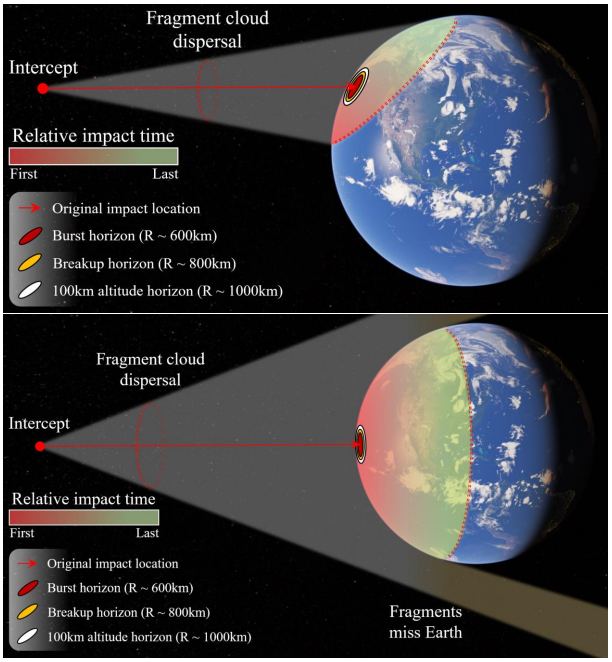
PI’s idea is to design an impactor that’s not only kinetic but explosive. The impacting device would be fitted with penetrating rods to pierce the asteroid. Explosives would fill some rods, and the resulting explosion would pulverize the bolide into smaller chunks, hopefully 15 m or less in diameter. The pieces would form a cloud of debris. Depending on the size of the bolide, the size of the device, and the distance from Earth when detonated, some of the debris might strike Earth. But much of it would be destroyed through friction with the Earth’s atmosphere.
“The effectiveness of the approach depends on the time to intercept and size of the asteroid, but allows for effective defence against asteroids in the multi-hundred-meter diameter class and could virtually eliminate the threat of mass destruction caused by these threats,” Lubin explains.
This figure shows two fragment clouds resulting from successful interceptions. The top is a smaller asteroid, and the bottom is larger. Note how some of the fragments would miss Earth entirely with a larger asteroid. Image Credit: Lubin 2021.
ACCORDING TO LUBIN, the PI System could be in orbit around Earth or even housed on a lunar base. “Compared to other threat reduction scenarios, this approach represents an extremely cost-effective, testable, and deployable approach with a logical roadmap of development and testing. Pre-deployment of the system into orbit or a lunar base allows for rapid response on the order of less than a day if needed,” Lubin said.
“The great advantage of this approach is that it allows for terminal defence in the event of short warning times and target distance mitigation where orbital deflection is not feasible,” said Lubin. “Even intercepts as close as the Moon with intercept times of a few hours prior to impact are viable.”
The Moon has a couple of inherent advantages. For one thing, it has no atmosphere, so as a base for observing the asteroid environment near Earth, it would allow “long-range optical/NIR LIDAR detection” of incoming asteroids. The Moon also has a lower escape velocity than Earth, making launches easier and less expensive.
Launching a large explosive impactor from Earth is becoming more feasible over time, too. Heavy launch vehicles like SpaceX’s Falcon Heavy, NASA’s Space Launch System, and others are heralding a new age of powerful rocket technology.
Lubin says that the PI system only needs a five-hour prior to impact window to destroy an asteroid the size of the object in the Tunguska Event. That object was likely about 50 meters in diameter and exploded with a force of about 10 Megatons. It knocked over millions of trees in a remote part of Siberia. If an object that size were to explode over one of our cities, it would be devastating.
Fallen trees from the Tunguska Event in 1908.
The Chelyabinsk meteor blew the windows out of buildings and caused injuries, and it was only about 20 meters in diameter.
A meteorite flashes across the sky over Chelyabinsk, Russia, in this image. This image is from a dashboard camera.
The system could also work when it comes to massive asteroids like Apophis. Apophis will pass near Earth in 2029, but it won’t impact Earth. However, if it passes through what’s called a “gravitational keyhole” during its 2029 flyby, it could be nudged enough that it could strike Earth on the subsequent flyby. Apophis is about 370 meters in diameter, and its yield is about four gigatons. Lubin said that his PI system could successfully destroy Apophis-sized asteroids with a 10-day prior to impact intercept.
An artist’s illustration of the asteroid 99942 Apophis. Image Credit: NASA/Caltech/JPL
It’ll be interesting to see how much further Lubin develops his Pulverize It asteroid defence idea. NASA launched its Double Asteroid Redirection Test mission in November 2021. DART is headed for the double asteroid system of Didymos and its smaller companion, Dimorphos, which orbits Didymos.
Dimorphos isn’t on a trajectory toward Earth. DART is purely a test mission, and impacting Dimorphos will lead to a slight change in the trajectory of the double asteroid system. NASA will monitor the system after the impact to see if the mission was successful.
But there’s no reason we can’t develop multiple asteroid mitigation systems in parallel. That might be the most prudent way forward. As we get better and better at finding all of the asteroids that threaten Earth, we’ll be more prepared for intercepting asteroids with advanced lead times. But no system is foolproof.
It’d be wise for humanity to develop another system that could launch rapidly and be employed on short notice. Then we can look up at the sky and relax.
As countries around the world respond to Russia’s invasion of Ukraine with sanctions aimed at crippling Moscow and Vladimir Putin, the global cooperation in space exploration that has been forged over the past 30-plus years will certainly be impacted.
One example: the European Space Agency said the launch of the ExoMars 2022 mission, scheduled for September of this year, is “very unlikely,” due to sanctions on Russia. ExoMars is supposed to launch on a Russian Proton rocket from the Baikonur Cosmodrome. Russia is also supposed to supply the landing and science platform for the Rosalind Franklin rover, and if the conflict continues, the oft-delayed mission will likely have to wait for the next launch window to Mars in 2024.
In a statement issued by ESA, officials said, “We deplore the human casualties and tragic consequences of the war in Ukraine. We are giving absolute priority to taking proper decisions, not only for the sake of our workforce involved in the programmes, but in full respect of our European values, which have always fundamentally shaped our approach to international cooperation.”
“We are fully implementing sanctions imposed on Russia by our Member States,” the statement continued. “We are assessing the consequences on each of our ongoing programmes conducted in cooperation with the Russian state space agency Roscosmos and align our decisions to the decisions of our Member States in close coordination with industrial and international partners (in particular with NASA on the International Space Station).”
Meanwhile, the head of the Russian agency appears to be burning every bridge that’s been built with various space entities around the world. In a series of bizarre rants on Twitter over the past several days, Dmitry Rogozin, head of Roscosmos, suggested future Atlas 5 launched by ULA (United Launch Alliance) will fail because they won’t have technical support for the Russian components on the rockets. Rogozin even said that the sanctions could result in the International Space Station crashing into the U.S., Europe, India, or China. He erroneously said the ISS doesn’t fly over Russia, “so all the risks are yours.”
First Soyuz lifts off from Europe’s Spaceport in French Guiana on 21 October 2011. Credits:Thilo Kranz/DLR
Officially, Roscosmos announced it was suspending cooperation with Europe on Soyuz launches from the European spaceport in French Guiana (CSG), and they have removed Russian personnel from the site. That will likely delay several upcoming launches scheduled to launch on a Soyuz rocket from CSG, including two pairs of Galileo navigational satellites, Euclid, a visible to near-infrared space telescope scheduled to launch in early 2023, the EarthCARE (Earth Clouds, Aerosols and Radiation Explorer) satellite, a cooperative effort between ESA and Japan’s space agency JAXA to improve understanding of the cloud and aerosol processes that affect the Earth’s climate. Other governmental satellites are in the queue as well.
The indication of threats to the ISS are most concerning since humans are on board. During a press briefing on February 28, Kathy Lueders, NASA associate administrator for space operations, said ISS operations have not been affected by the sanctions so far.
The International Space Station stretches out in an image captured by astronauts aboard the SpaceX Crew Dragon Endeavour during a fly-around in November 2021. Credit: NASA/SpaceX
“We are not getting any indications, at a working level, that our counterparts are not committed to ongoing operation of the International Space Station,” she said. “We’re operating just like we were operating three weeks ago. Our teams are still talking together, we’re still doing training together, we’re still working together.”
Lueders added that, “It would be a sad day for international operations that we can’t continue to peacefully operate in space,” and that it would be very difficult to operate the ISS without the international cooperation that the project was founded on.
“I actually feel like this is a good message for us – that we are operating peacefully in space now and moving forward,” she said, but added, “That said, we always look for how do we get more operational flexibility.”
In an signal of that, NASA said they are discussing cargo and crew transportation options with Northrop Grumman and SpaceX, and in an announcement late yesterday, NASA announced they have awarded SpaceX additional crew flights to the space station.
Lead image caption: Artist’s impression of ESA’s ExoMars rover (foreground) and Russia’s science platform (background) on Mars.
In perfect viewing conditions, with good eyesight and clear, dark skies, the average person can see between 2,500 and 5,000 stars in the night sky. Add a telescope to the mix, and the number of visible objects in the sky explodes exponentially. For example, in 1995, the Hubble Space Telescope famously pointed its mirrors at a tiny piece of empty space – about 1/12th the size of the Moon – and revealed three thousand new objects crammed into that little area, most of them distant galaxies, offering a glimpse of the past stretching back to the early Universe. The astounding implication of the Hubble Deep Field image was that there are still billions of objects out there yet unseen by human eyes (or telescopes). Since then, the process of surveying deep space has been a massive ongoing undertaking, using all the tools available to us, from visible light telescopes like Hubble to infrared and radio telescopes. In a new data dump last week, a major radio sky survey, LOFAR, has revealed over a million new, never before seen objects in the night sky.
The LOFAR Two-Meter Sky Survey (LOFAR stands for ‘International Low-Frequency Array’), is a network of interconnected radio telescopes across Europe. LOFAR began as a national project in the Netherlands in 2010, but has since expanded to include multiple countries. There are currently 48 sensor stations connected to the network, with more expected to come online in the near future. LOFAR’s unique capabilities allow it to survey an impressively wide portion of the night sky, capturing low-frequency radio signals from distant objects. At these frequencies, the objects that LOFAR finds tend to be highly energetic distant objects like black holes, galaxies bursting with star formation, and explosive galactic mergers, though it does occasionally catch bright objects closer to home, like nearby flaring stars.
The 1995 Hubble Deep Field, which revealed thousands of distant galaxies in a seemingly empty patch of sly. Image Credit: Robert Williams (NASA, ESA, STScI)
Perhaps the most impressive part of the LOFAR survey is its width. This release covers a whopping 27 percent of the northern sky, offering researchers a wealth of information on high-energy objects across a vast swath of space.
According to Durham University, “the research team found about a million objects that have never been seen before with any telescope and almost four million objects that are new discoveries at radio wavelengths.”
In total, the catalog shows 4,396,228 radio sources coming from the region. It’s an impressive resource for astronomers to dig into, and it’s just the beginning. As Timothy Shimwell (ASTRON and Leiden University) explains, “this release is only 27% of the entire survey and we anticipate it will lead to many more scientific breakthroughs in the future, including examining how the largest structures in the Universe grow, how black holes form and evolve, the physics governing the formation of stars in distant galaxies and even detailing the most spectacular phases in the life of stars in our own Galaxy.”
The LOFAR ‘superterp’. Part of the core of the extended telescope, near Exloo, Netherlands. Image Credit: LOFAR / ASTRON.
The survey will continue to expand its catalog across the northern skies in the coming months. According to the team, “our aim is now to secure the observing time required to complete [the survey] whilst ensuring we are able to process the data in a way that maximises the scientific opportunities. To this end we have secured observations that will extend our coverage…to 85% of the northern hemisphere by May 2023.”
In the meantime, the data for this 27% is publicly available for researchers to peruse, and is bound to offer some exciting new discoveries. A previous LOFAR release revealed many previously unknown phenomena, including signals that might represent orbiting exoplanets; a slow-spinning pulsar “that challenges the current theories describing such objects,” “jellyfish galaxies” that shed material while traveling through space, and black holes eruptions.