Wednesday, April 29, 2026

Is the Earliest Supermassive Black Hole Mystery Solved?

This galaxy, UHZ1, is 13.2 billion light-years away, seen when the universe was only 3% of its current age. NASA’s Chandra X-ray Observatory and James Webb Space Telescope joined forces to make this discovery.This is considered the best evidence to date that some early black holes formed from massive clouds of gas. Courtesy NASA/Chandra

One of the most intriguing puzzles in cosmology is the existence of supermassive black holes that seem to appear very early in the history of the Universe. Astronomers keep finding them at times when, by all that they understand about the infant Universe, they shouldn't be there. The standard theory of black hole formation suggests that they shouldn't have had enough time to grow as massive as they appear to be. Yet, there they are, monster black holes with the mass of at least a billion suns. The James Webb Space Telescope (JWST) has found a large population of them in early epochs, and they've been observed in very early quasars as well.


ESA’s Proba 3 is Unlocking Secrets of the Solar Wind

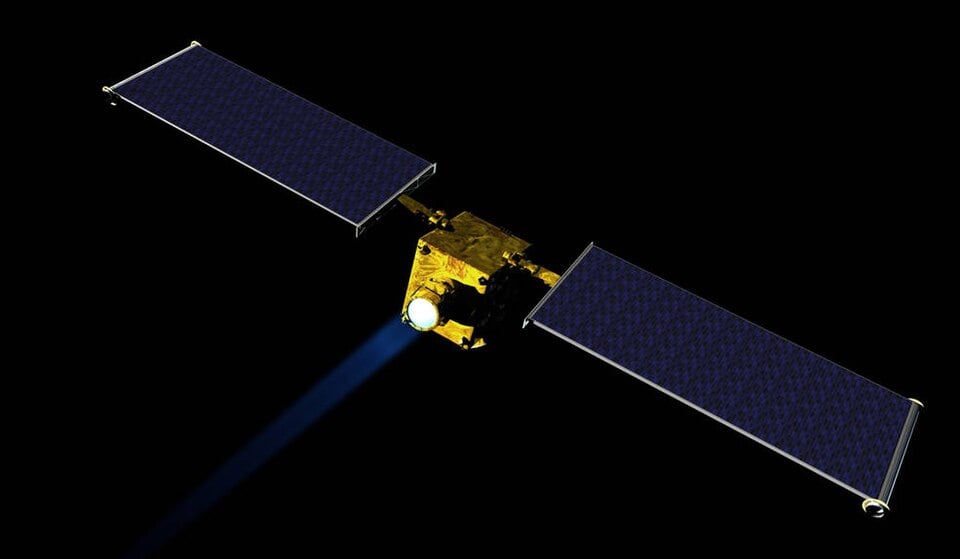
An artist's conception of Proba-3 in space. Credit: ESA/MediaLab.

It has been a dream of astronomers and solar scientists for ages. A new mission gives solar researchers a powerful new tool in their arsenal: on-demand, total solar eclipses. Launched in 2024, The European Space Agency’s Proba-3 mission has proven the feasibility of a free-flying, space-based coronagraph. Now, first science results from the mission are giving us a view of the origin of space weather. The results were recently published in the Astrophysical Journal Letters.


Canada Proposes POET Mission to Hunt Earth-Sized Planets

Artist's illustration of an ultracool dwarf star and an orbiting exoplanet. (Credit: NASA/JPL-Caltech)

Exoplanet science and the search for life beyond Earth continue to advance at break-neck speeds, with the number of confirmed exoplanets by NASA rapidly approaching 6,300, with 223 of those exoplanets being designated as terrestrial (rocky) exoplanets. With the promise of discovering an increasing number of Earth-sized exoplanets increasing every day, new telescopes from across the world have the opportunity to contribute to this incredible field.


Tuesday, April 28, 2026

Designing In Situ Power Stations for Future Mars Missions

Diagram depicting how the Martian atmosphere could be used for power generation on future human missions to Mars. (Credit: Yang et al. (2026))

You’re in the lab analyzing Martian regolith samples within your cozy Mars habitat serving on fifth human mission to Mars. The power within the habitat has been flowing flawlessly thanks to the MARS-MES (Mars Atmospheric Resource & Multimodal Energy System), including the general habitat lighting, science lab, sleeping quarters, exercise equipment, the virtual reality headsets the crew use for rest & relaxation, oxygen and fuel generation, and water. All this from converting the Martian atmosphere into workable electricity.


The Sun's Impossible Floating Mountains

Solar prominence seen in true colour during totality of a solar eclipse (Credit : ESA/CESAR)

Scientists at the Max Planck Institute for Solar System Research have produced the most detailed simulations ever of solar prominences. These vast clouds of cooler plasma suspended in the Sun's scorching outer atmosphere have often perplexed solar astronomers. Their research reveals that two separate processes work together to keep these structures alive, and could one day help us predict the violent eruptions that drive dangerous space weather here on Earth.


Our Galaxy Has a Hot Side and Now We Know Why

Image of the Milky Way above Paranal, Chile on 21 July 2007. (Credit : ESO/Y.Beletsky)

Our Galaxy's halo of hot gas is measurably warmer on one side than the other and a team of scientists have found the culprit. The gravitational pull of the Large Magellanic Cloud is drawing the Milky Way slowly southward, compressing the gas in its path and heating it up, much like a piston in an engine. The discovery solves a puzzle that has intrigued astronomers since the temperature difference was first detected in 2024.


Could Light Alone Get Us to Another Star?

A sequence shows a metasurface “metajet” moving under laser illumination, demonstrating light driven manoeuvre (Credit: Dr. Shoufeng Lan).

Using nothing but a laser beam, scientists at Texas A&M University have demonstrated that tiny engineered devices can be lifted and steered in three dimensions without any physical contact. This breakthrough could one day form the basis of a propulsion system capable of reaching our nearest neighbouring stars in decades rather than centuries.


The Ancient Art That Could Transform Space Communication

Artist impression of the Voyager spacecraft with its 3.7m antenna. A new study reveals the techniques of origami may be able to build antennae of the future. (Credit : NASA)

Researchers at the Institute of Science Tokyo have developed an origami inspired foldable antenna for CubeSat satellites that weighs just 64 grams yet in orbit, it deploys to two and a half times its stowed size. The antenna folds away neatly for launch and deploys automatically in space, achieving high gain communications performance from a package small enough to fit in your pocket and could one day support missions as far away as the Moon.


Monday, April 27, 2026

Space Travel May Impact Human Fertility and Fertilization

Space Travel May Impact Human Fertility and Fertilization

Space travel has taught us valuable lessons for living and working in outer space, specifically regarding how microgravity (often mistakenly called zero-gravity) impacts the human body during short- and long-term spaceflight. This includes decreased muscle and bone mass, fluid shifts, reduced heart rate, psychological health, compromised immune system, and radiation exposure. But with agencies like NASA aspiring to build a lunar base and establish a long-term presence on the Moon, and eventually Mars, how could space travel impact potentially having babies in space?


Tiny Ultra-Faint Dwarf Galaxies Reflect The Conditions In The Early Universe

These screenshots are from simulations aimed at understanding ultra-faint dwarf galaxies in the early Universe. (A) Dark matter distribution in our neighborhood in the Universe, the so called Local Group of galaxies. The two large dark matter halos correspond to those of the Milky Way and Andromeda galaxy; (B) zoom-in on the dark matter in and around a small halo ~700 million years after the Big Bang; (C) stars and gas in the centre of the small dark matter halo in one of our simulations. Credit: J Sureda/A Fattahi/S Brown

The Milky Way has a sizable retinue of dwarf galaxies, and they may hold important clues about conditions in the early Universe. However, they're difficult to observe because many of them are so faint. The tiniest ones are called Ultra-faint dwarf galaxies, and a new simulation aimed at how they form is showing how these faint collections of stars and gas mirror the conditions of the early Universe.


Sunday, April 26, 2026

The Planet Haul That Changes Everything.

The fully integrated Transiting Exoplanet Survey Satellite (TESS), which launched in 2018 to find thousands of new planets orbiting other stars (Credit : Orbital ATK / NASA)

NASA's planet hunting telescope has been busy. A new study has just sifted through the light of over 83 million stars and emerged with more than 11,000 potential worlds, including a confirmed giant planet orbiting a distant star. The results don't just add to our catalogue of planets. They fundamentally change where we look for them.


Another Instrument Shut Down on Voyager 1 to Extend its Interstellar Mission

Mission engineers at NASA’s Jet Propulsion Laboratory in Southern California turned off the Low-energy Charged Particles experiment aboard Voyager 1 on April 17, 2026. Credit: NASA/JPL-Caltech

On April 17th, engineers at NASA's Jet Propulsion Laboratory (JPL) sent commands to shut down an instrument aboard Voyager 1 called the Low-energy Charged Particles experiment, or LECP. The nuclear-powered spacecraft is running low on power, and turning off the LECP is considered the best way to keep humanity's first interstellar explorer going.


Small Antarctic Telescope Makes An Outsized Impact On Exoplanetary Science

The ethereal green glow of Aurora Australis high over Concordia located in the Antarctic at –75°S latitude. Credit: ESA/IPEV/ENEAA/A. Kumar & E. Bondoux

ASTEP, the Antarctic Search for Transiting ExoPlanets, a small visible telescope operating at Concordia station, continues making a real impact in characterizing odd new exoplanetary systems.


Saturday, April 25, 2026

Webb Finds Water-Ice Clouds on Nearby Super-Jupiter

Artist's rendition of Eps Ind Ab. (Credit: E. C. Matthews, MPIA / T. Müller, HdA)

The giant planets in our solar system—Jupiter, Saturn, Uranus, and Neptune—have challenged our understanding of planetary formation and evolution. Specifically, their atmospheric formations and compositions have provided awe-inspiring images from spacecraft and given scientists key insights into the interior mechanisms of these massive worlds. But what about exoplanets? What can their atmospheres teach scientists about their formation, evolution, composition, and interior mechanisms? And how do longstanding exoplanet models stack up against the real thing?


Friday, April 24, 2026

TOI-201 Planets Are Wobbling Out of Our Line of Sight

Artist's illustration of the TOI-201 system. (Credit: University of New Mexico/Tedi Vick)

It turns out that even after studying our solar system in depth and discovering more than 6,100 exoplanets across more than 4,500 exoplanetary systems, not all solar systems are created equal. The longstanding notion is that planets orbit almost entirely in the same orbital path, also called an orbital plane. But what if an exoplanetary system was found to have exoplanets that not only orbit in different planes, but also exhibits changing behavior regarding when they pass in front of their star?


JWST Hunts for an 'Earth-Moon' Twin in a Habitable Zone, But the Star Has Other Plans

Image of the TOI-700 system, including graphs of their habitable zones. Credit - NASA/JPL-Caltech/Robert Hurt/NASA’s Goddard Space Flight Center

The Moon has played a huge role in the development of Earth. It stabilizes the planet, tempered dramatic climate swings, and possibly even provided the tidal heating that might have led to the first life forms. So it’s natural we would want to find a similar Earth/Luna system somewhere else in the cosmos. But astronomers have been searching for one for years at this point to no avail. And a new paper from Emily Pass and her colleagues at MIT, Harvard, and the University of Chicago describes using the James Webb Space Telescope to track some of the most promising exomoon candidates - only to be foiled by the star they were orbiting.


Colibre: A New Cosmic Simulation With Cinematic Flair

These panels are screenshots from the new COLIBRE simulations. The panel on the left shows the so-called cosmic web, where the colour encodes the projected density of gas and stars. The panels on the right zoom into two simulated galaxies. Image Credit: Schaye et al. (2026) MNRAS

The new Colibre cosmological simulation includes more critical detail than previous simulations. It also includes updated models of things like AGN feedback and star formation. The simulations also include a sonic component, giving the results a cinematic and information-rich flair.


Thursday, April 23, 2026

New Research Reveals That Interstellar Comet 3I/ATLAS Formed in a System Far Colder Than Our Own

This artist’s impression compares the semi-heavy water content of the interstellar comet 3I/ATLAS (left) and Earth (right). Credit: NSF/AUI/NSF NRAO/M.Weiss

The interplanetary comet 3I/ATLAS is remarkably rich in a specific type of water that contains deuterium, meaning it came from somewhere colder and with lower levels of radiation than our early Solar System.


This Bathtub Ring of Minerals is More Evidence for an Ancient Warm, Wet Mars

MSL Curiosity is exploring a region in Gale Crater called the Amapari Marker Band. It's like a bathtub ring where metals have accumulated unexpectedly. The region is evidence that Gale Crater was once a paleolake. Image Credit: NASA/JPL-Caltech

NASA's MSL Curiosity rover found a bathtub ring-like deposit of zinc, manganese, and iron in Gale Crater. These metals precipitate out of water in the right conditions, and there's not really any other way they could've become concentrated here. Adding to the excitement, these deposits also form in lakes on Earth, where the concentrated metals are food for some types of bacteria.


The Most Energetic Neutrino Ever Detected Could Be Primordial

This illustration shows a neutrion interacting with ordinary matter and releasing a muon. The muon moves very rapidly, leaving the telltale blue glow of Cherenkov radiation. The most energetic neutrino ever observed was detected by the muon it created. It's energy was so great that researchers think it may have been an elusive cosmogenic neutron. Image Credit: Nicolle R. Fuller/NSF/IceCube

Neutrinos are very difficult to detect. And when they are detected, pinpointing their sources is likewise difficult. New research shows that the most energetic neutrino ever detected must have had an extraordinarly energetic source. It could even be primordial.