Thursday, February 19, 2026

Ancient Massive Stars Enriched Early Clusters and Birthed First Black Holes

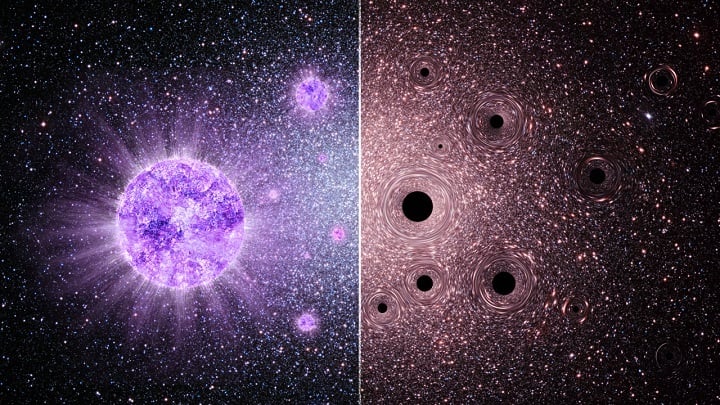
An artist’s impression of a globular cluster near its birth (left), hosting extremely massive stars with powerful stellar winds that enrich the cluster with elements processed at extremely high temperatures. (Right), an ancient globular cluster as we observe it today: surviving low-mass stars retain traces of the winds from those extremely massive stars, which have since collapsed into intermediate-mass black holes. Credits: Fabian Bodensteiner; background: image of the Milky Way globular cluster Omega Centauri, captured with the WFI camera at ESO’s La Silla Observatory.

The early Universe was a busy place. As the infant cosmos exanded, that epoch saw the massive first stars forming, along with protogalaxies. It turns out those extremely massive early stars were stirring up chemical changes in the first globular clusters, as well. Not only that, many of those monster stars ultimately collapsed as black holes.


No comments:

Post a Comment