Thursday, December 18, 2025

Luminous Fast Blue Optical Transients Are Likely Large Black Holes Shredding Their Massive Companions

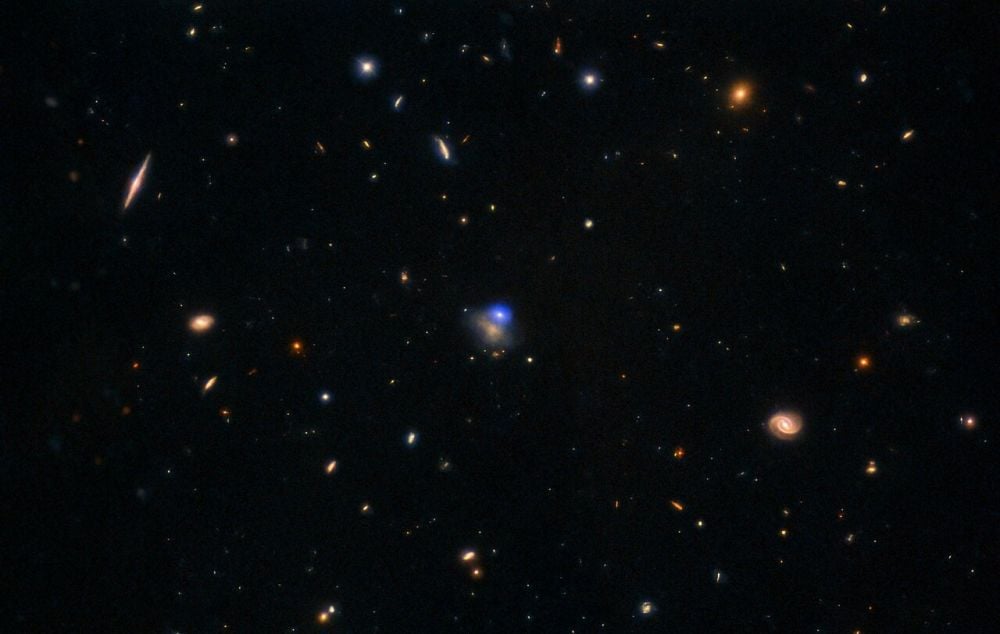
This composite image features X-ray, ultraviolet, optical, and near-infrared data of the luminous fast blue optical transient (LFBOT) named AT 2024wpp. The transient is the bright spot at the upper right edge of its host galaxy, which is 1.1 billion light-years from Earth. Astrophysicists have puzzled over these objects for more than a decade, but may have finally figured out what causes them. Image Credit: International Gemini Observatory/NOIRLab/NSF/AURA Image Processing: J. Miller (International Gemini Observatory/NSF NOIRLab), T.A. Rector (University of Alaska Anchorage/NSF NOIRLab), M. Zamani & D. de Martin (NSF NOIRLab)

In 2024, astronomers discovered the brightest Luminous Fast Blue Optical Transient (LFBOT) ever observed. LFBOTs are extremely bright flashes of blue light that shine for brief periods before fading away. New analysis of this record-breaking burst, which includes observations from the International Gemini Observatory, funded in part by the U.S. National Science Foundation, challenges all prior understanding of these rare explosive events.


No comments:

Post a Comment