Saturday, December 6, 2025

Russia Loses Launch Capability After Accident at Baikonur Cosmodrome

Aerial drone footage of Launch Site 31/6

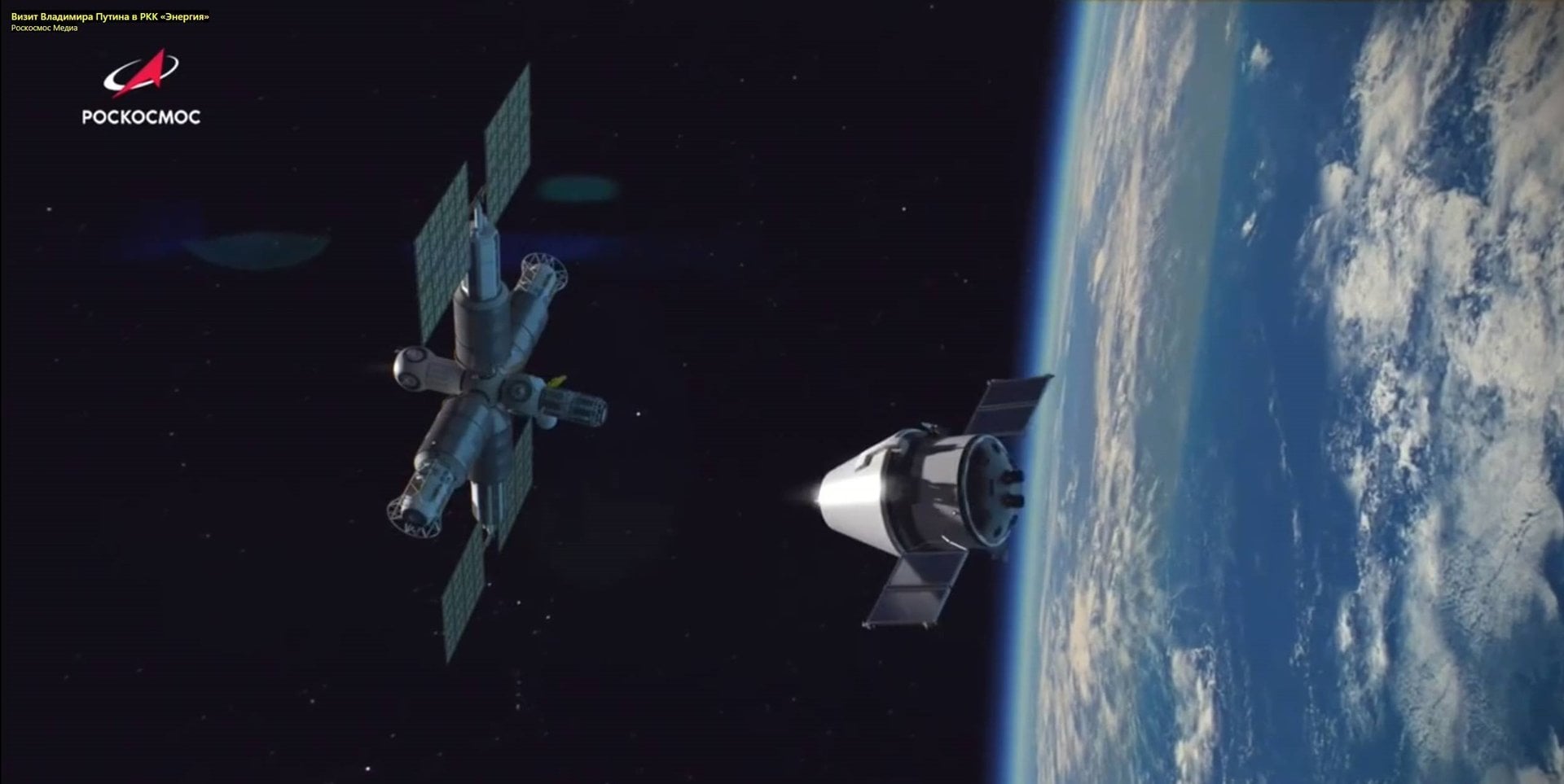
A severe accident at the Baikonur Cosmodrome involving a wrecked maintenance cabin has indefinitely delayed Russia's ability to launch crewed missions and payloads to the International Space Station (ISS).


Friday, December 5, 2025

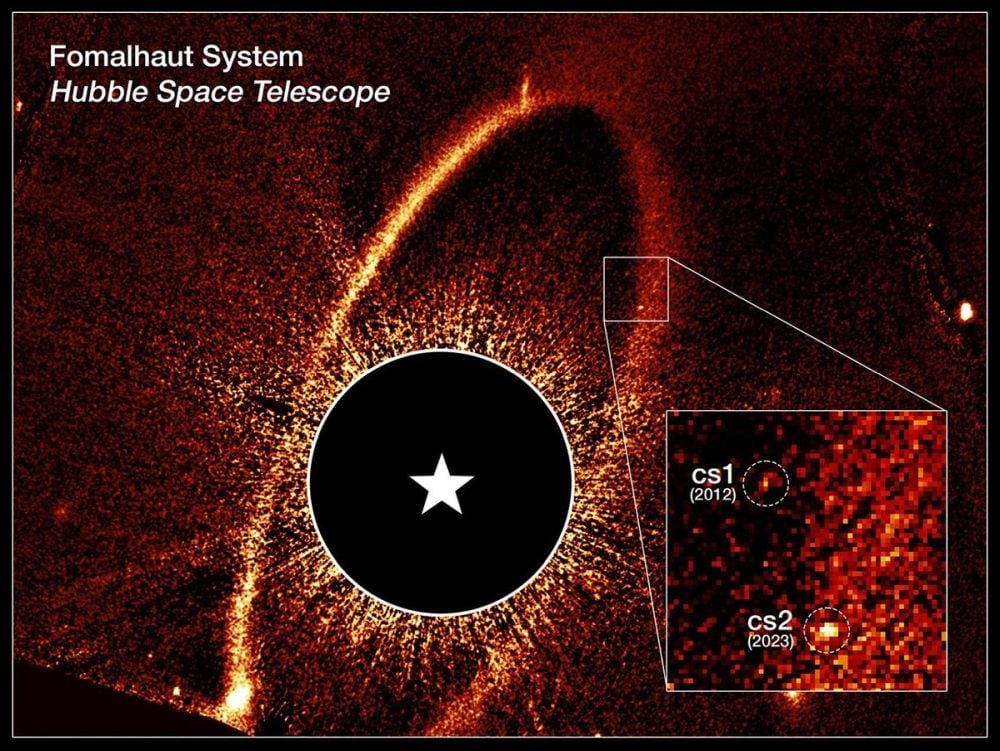
Dust In A Telescope's Eye Could Blind It To Earth 2.0

This artist's illustration shows exozodiacal light, a glowing, hazy white light above the horizon of an imagined exoplanet. It comes from dust, and there's so much of this dust around one star system that astronomers are puzzled. Image Credit: ESO/L. Calçada

Hot exozodiacal dust can thwart our efforts to detect exoplanets. It causes what's called coronagraphic leakage, which confuses the light signals from distant stars. The Habitable Worlds Observatory will face this obstacle, and new research sheds light on the problem.


China Outlines Future Plans in New Video, Including Finding Earth 2.0

An artist's impression of the Earth 2.0/ET observatory searching for exo-Earths. Credit: CAS

A video that appeared on CGTN's Hot Take details four missions that China will be sending to space in the coming years, including a survey telescope that will search for Earth 2.0.


Historic May 2024 Gannon Solar Storm Compressed Earth’s Plasmasphere

An artist's impression of the Arase satellite versus the Gannon Solar Storm. Credit: ISEE/Nagoya University.

A powerful geomagnetic superstorm is a once a generation event, happening once every 20-25 years. Such an event transpired on the night of May 10/11, 2024, when an intense solar storm slammed into the Earth’s protective magnetic sheath. Now, a recent study shows just how intrusive that storm was, and how long it took for the Earth’s plasma layer took to recover.


SPHERE Shows Us How Our Solar System Isn't Much Different Than Others

This is a gallery of debris disks captured by the SPHERE instrument on the ESO's Very Large Telescope. They're visible by the starlight they reflect, with the central star blocked out by the telescope's coronagraph. Image Credit: © N. Engler et al./SPHERE Consortium/ESO

Observations with the SPHERE instrument on the European Southern Observatory's VLT revealed the presence of debris rings similar to structures in our Solar System. SPHERE found rings similar to the Kuiper Belt and the Main Asteroid Belt. Though individual asteroids and comets can't be imaged, these debris rings infer that other solar systems have architectures similar to ours.


When Ancient Scribes Accidentally Became Scientists

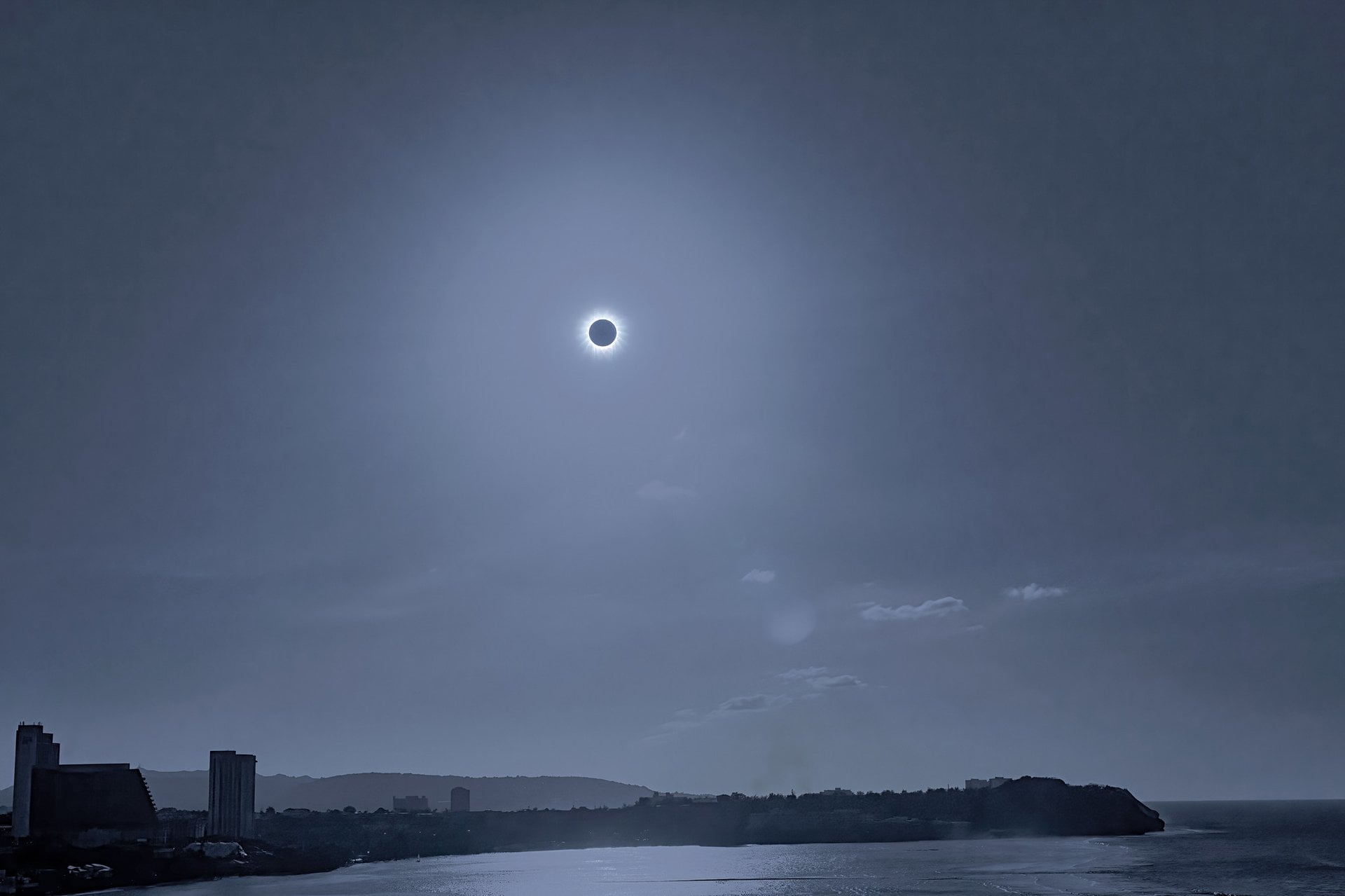
Total solar eclipses, like this one captured from France in 1999, have been recorded in ancient Chinese records (Credit : Luc Viatour)

On a summer day in 709 BCE, scribes at the Lu Duchy Court in ancient China looked up to witness something extraordinary. The Sun vanished completely from the sky, and in its place hung a ghostly halo. They recorded the event carefully, noting that during totality the eclipsed Sun appeared "completely yellow above and below." Nearly three millennia later, that ancient observation has helped modern scientists measure how fast Earth was spinning and understand what our Sun was doing at a time when Homer was composing poetry.


Thursday, December 4, 2025

New Research Could Explain Why Earth has Active Tectonics and Venus Does Not

The Quetzalpetlatl Corona, located in Venus’ southern hemisphere, depicts active volcanism and a subduction zone, where the foreground crust plunges into the planet’s interior. Credit: NASA/JPL-Caltech/Peter Rubin

An international team has made a significant breakthrough in understanding the tectonic evolution of terrestrial planets. Using advanced numerical models, the team systematically classified for the first time six distinct planetary tectonic regimes and identified a novel regime: the "episodic-squishy lid."


Lessons from the Past: Responsible Science and Astrobiology

The famous "Face of Mars" imaged by NASA's Mars Reconnaissance Orbiter (MRO) and the Viking 1 orbiter (inset). Credit: NASA/JPL-Caltech/University of Arizona

In a recent paper, a team of SETI and astrobiology specialists examines four controversial claims about the existence of extraterrestrial life. From these, they present recommendations for scientists and science communicators when addressing future claims of discovery.


Ten Versions of Earth's Future Can Help Us Hunt for ET

Image of northern Italy at night, representing the type of light pattern we could potentially see on an exoplanet. Credit - NASA / ESA

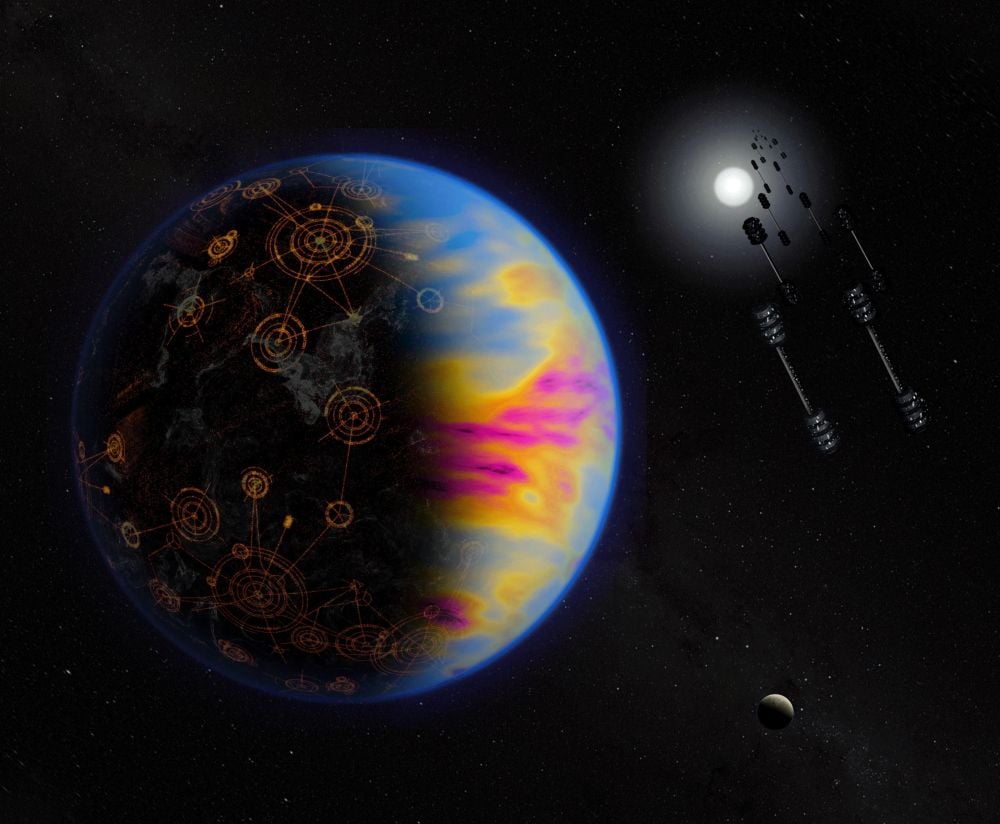
Searching for technosignatures - signs of technology on a planet that we can see from afr - remains a difficult task. There are so many different factors to consider, and we only have the technological capabilities to detect a relatively small collection of them. A new paper, available in pre-print on arXiv but also accepted for publication into The Astrophysical Journal Letters, from Jacob Haqq-Misra of the Blue Marble Space Institute of Science and his co-authors explores some of those capabilities by using a framework they developed known as Project Janus that estimates what technology will look like on Earth 1,000 years from now in the hopes that we can test whether or not we can detect it on another planet.


Wednesday, December 3, 2025

Helium Streams Observed on Super-Puff Exoplanet

Artist's illustration of WASP-107 b. (Credit: University of Geneva/NCCR PlanetS/Thibaut Roger)

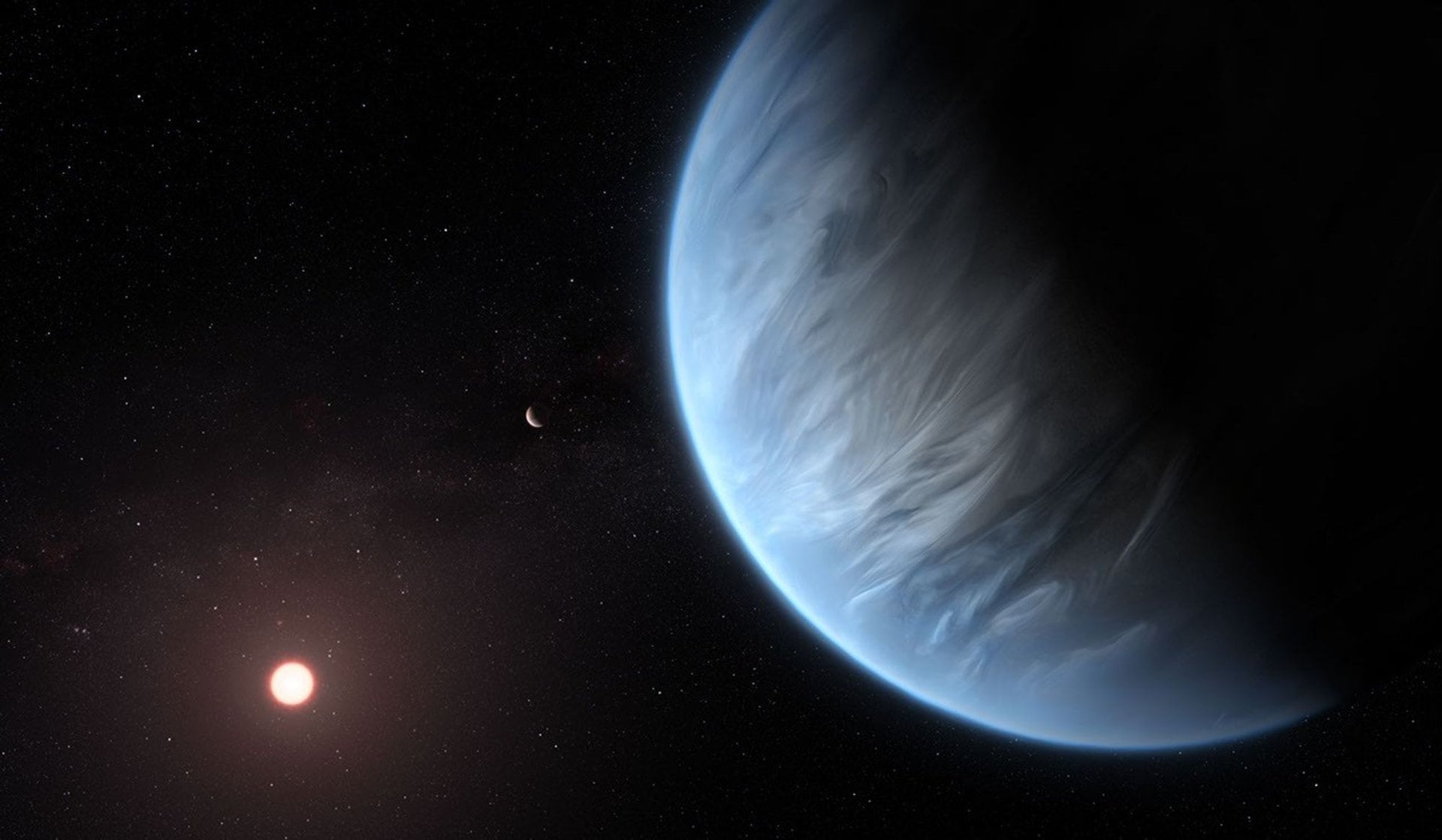
What can an exoplanet leaking helium teach astronomers about the formation and evolution of exoplanet atmospheres? This is what a recent study published in Nature Astronomy hopes to address as an international team of scientists investigated atmospheric escape on a puffy exoplanet. This study has the potential to help scientists better understand the formation and evolution of gas giant planets, specifically with many gas giant planets observed orbiting extremely close to their stars.


A Blueprint For Visiting An Interstellar Comet

This illustration shows the ESA's Comet Interceptor mission during a flyby to a long period comet. It's two smaller probes have been launched and are approaching the comet. A new white paper explains how the Comet Interceptor mission could be a blueprint for a mission to visit and interstellar comet that visits our inner Solar System in the future. Image Credit: By ESA, CC BY-SA IGO 3.0, CC BY-SA 3.0 igo, https://commons.wikimedia.org/w/index.php?curid=146114448

arXiv:2512.00492v1 Announce Type: new Abstract: We describe how the ESA Comet Interceptor mission, which is due to launch in 2028/29 to a yet-to-be-discovered target, can provide a conceptual basis for a future mission to visit an Interstellar Object. Comet Interceptor will wait in space until a suitable long period comet is discovered, allowing rapid response to perform a fast flyby of an object that will be in the inner Solar System for only a few years; an enhanced version of this concept ...


The JWST Discovered Another Perplexing Early Galaxy

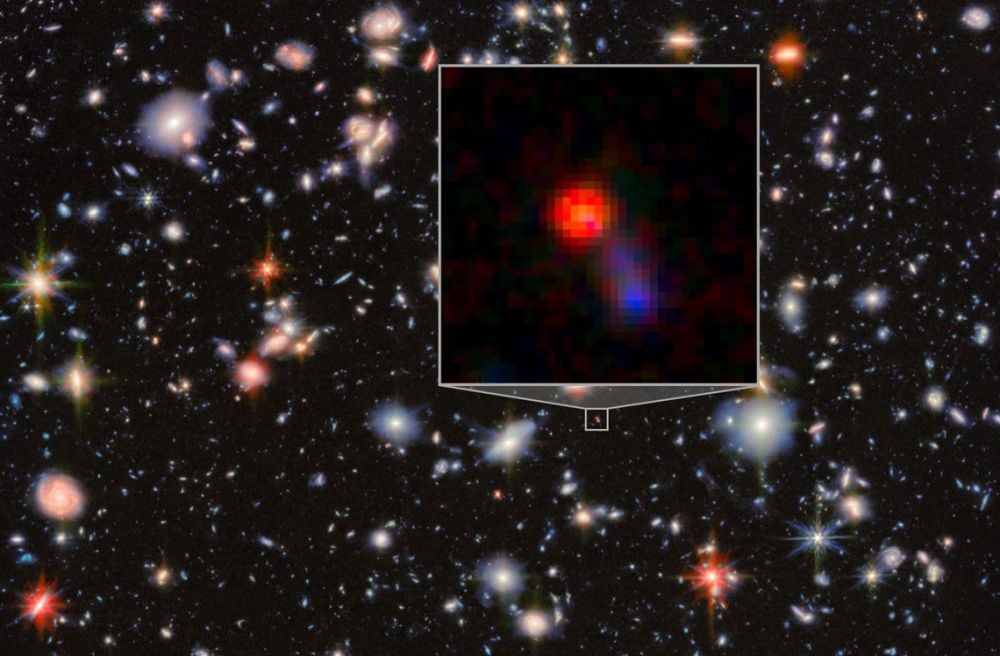
This image shows the newly discovered galaxy, now named Alknanda, in the inset image. It also shows a number of bright galaxies from the Abell 2733 cluster, which is in the foreground. Image Credit: NASA/ESA/CSA, I. Labbe/R. Bezanson/Alyssa Pagan (STScI), Rashi Jain/Yogesh Wadadekar (NCRA-TIFR)

The JWST has made a name for itself by discovering mature galaxies in the Universe's early times. This time, a pair of Indian astronomers working with the JWST found a fully-formed spiral galaxy much like the Milky Way only 1.5 billion years after the Big Bang. The discovery, and others like it, are forcing scientists to reconsider their understanding of the cosmic timeline.


We Are Moving Through The Universe Faster Than We Thought

The Lovell Radio Telescope at Jodrell Bank Observatory, near Goostrey, Cheshire, England. Credit: Mike Peel; Jodrell Bank Centre for Astrophysics, University of Manchester

We've long known that we move through the Universe relative to the cosmic microwave background, but a new study of radio galaxies finds an even faster result, which could contradict the standard model of cosmology.


These Two Galaxies Are Tying The Knot And Producing Stars

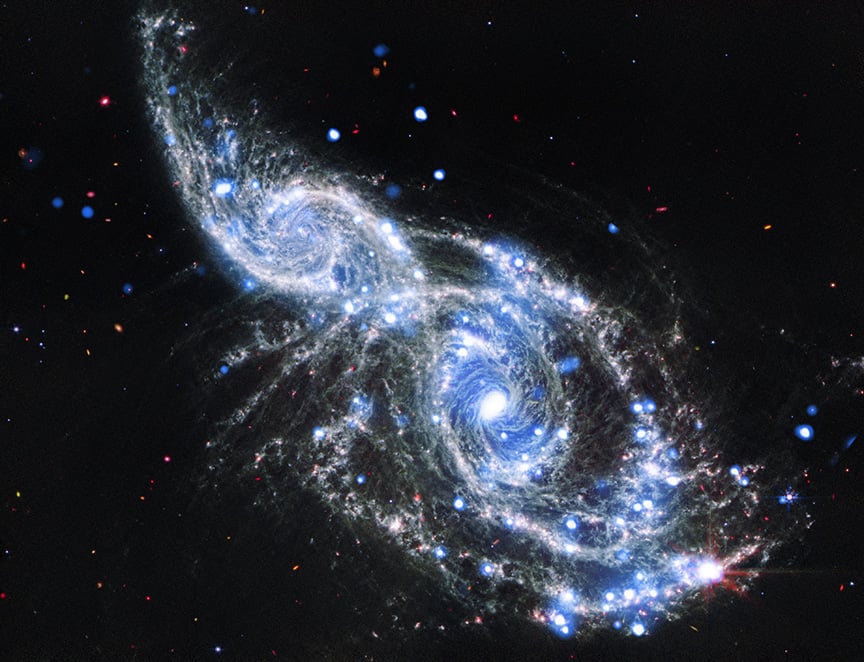
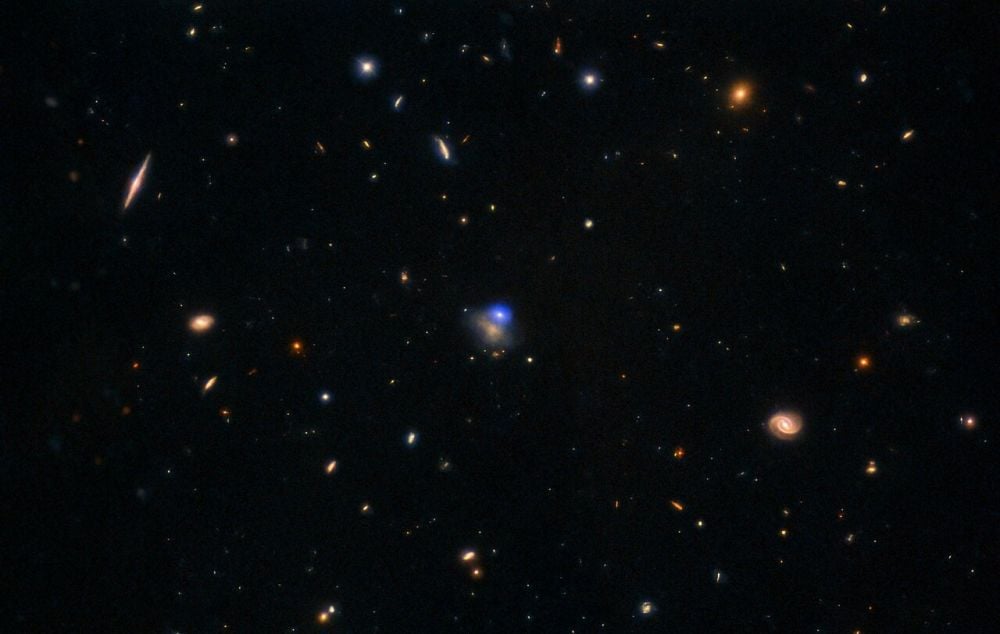
The dwarf galaxies NGC 4490 and NGC 4485 are caught interacting with one another in this ESA/JWST Picture of the Month. The pair are about 24 million light-years away, but that didn't stop the powerful James Webb Space Telescope from resolving their stellar populations or the gas bridge spanning between the two galaxies. Image Credit: ESA/Webb, NASA & CSA, A. Adamo (Stockholm University), G. Bortolini, and the FEAST JWST team. LICENCE: CC BY 4.0 INT or ESA Standard Licence

The European Space Agency has release its ESA/Webb Picture of the Month and it features a pair of dwarf galaxies engaged in a tentative dance, like nervous partners at a social. The pair are a staggering 24 million light-years away. But even at that great distance, the pair of galaxies is the closest-known interacting pair of dwarfs, other than the Milky Way's Magellanic Clouds, where both the stellar populations and the gas bridge linking the galaxies have been observed.


How to Catch a Comet That Hasn't Been Discovered Yet

ESA graphic depiction the Comet Interceptor Mission. Credit - ESA

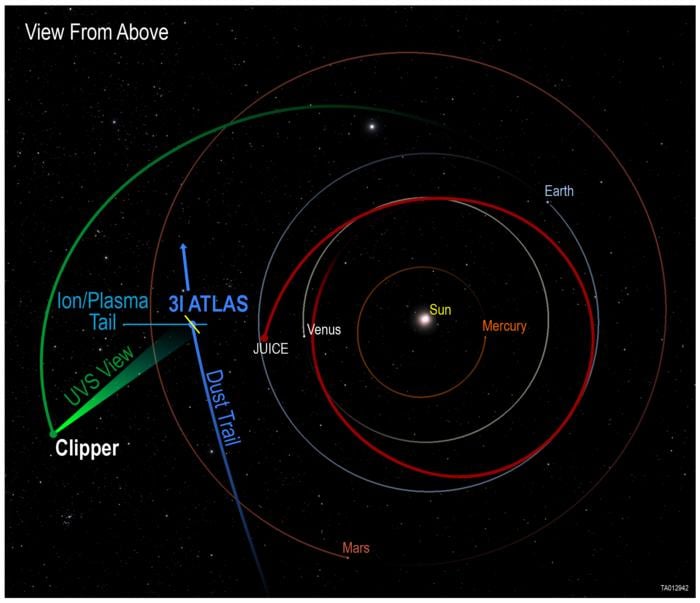
There’s been a lot of speculation recently about interstellar visitor 3I/ATLAS - much of which is probably caused by low quality data given that we have to observe it from either Earth, or in some case Mars. In either case it’s much further away that what would be the ideal. But that might not be the case for a future interstellar object. The European Space Agency (ESA) is planning a mission that could potentially visit a new interstellar visitor, or a comet that is making its first pass into the inner solar system. But, given the constraints of the mission, any such potential target object would have to meet a string of conditions. A new paper by lead Professor Colin Snodgrass of the University of Edinburgh of his colleagues, discusses what those conditions are, and assesses the likelihood that we’ll find a good candidate within a reasonable time of the mission's launch.


Tuesday, December 2, 2025

To Celebrate 25 Years In Service, The Gemini Observatory Imaged The Butterfly Nebula

The Butterfly Nebula dazzles the eye with its intricate interplay of form and colour. The Gemini South Observatory captured this image of the nebula from its perch on Cerro Pachón in the Chilean Andes. Students in Chile selected the nebula for Gemini to image as a celebration of its 25 years in service. Image Credit: International Gemini Observatory/NOIRLab/NSF/AURA. Image Processing: J. Miller & M. Rodriguez (International Gemini Observatory/NSF NOIRLab), T.A. Rector (University of Alaska Anchorage/NSF NOIRLab), M. Zamani (NSF NOIRLab)

To celebrate 25 years since the completion of the International Gemini Observatory, students in Chile voted for the Gemini South telescope to image NGC 6302 — a billowing planetary nebula that resembles a cosmic butterfly. The International Gemini Observatory is partly funded by the U.S. National Science Foundation (NSF) and operated by NSF NOIRLab.


The Knotty Problem of Matter Asymmetry Might Be Solved By Extending Physics

Simulation showing the web of galaxies and voids in the cosmos. Credit: Volker Springel/Max Planck Institute For Astrophysics/SPL

Why is the Universe filled with matter? Why isn't it an equal amount of matter and antimatter? We still don't know the answer, but a new approach looks at the symmetries of extended models of particle physics and finds a possible path forward. It's a knotty problem that may just have a knotty solution.


New Radar Data Dries Up Hope For Subsurface Liquid Water On Mars

Location of the "lake" (in blue), along with MRO's path over it and an adjacent region for comparison (in red). Credit - Planetary Science Institute

Remember back in 2018 when there was a discovery of a briny “lake” underground near the Martian south pole? Pepperidge Farm probably does, and anyone that works there that’s interested in space exploration will be disappointed to hear that, whatever might be causing the radar signal that finding was based on, it’s most likely not a lake. At least according to new data collected by the Mars Reconnaissance Orbiter (MRO) and published recently in Geophysical Research Letters by lead author Gareth Morgan of the Planetary Science Institute and his colleagues.


Monday, December 1, 2025

The life-giving secret of protoplanetary disks? Dust.

ESO/L. Calçada

The complex molecules required for life on Earth might never have formed if it wasn’t for cosmic dust.


The Universe Was Warm Before It Was Bright

The early Universe as seen by the MUSE spectrograph on ESO’s Very Large Telescope. Credit: ESA/Hubble & NASA, ESO/ Lutz Wisotzki et al
There is a period in the Universe known as the cosmic dark ages. It lies between the recombination of the first atoms and the ignition of the first stars, when the Universe was thought to be cold and dark. Now astronomers have looked at the faint glow of atomic hydrogen to find that while the Universe was dark, it wasn't quite as cold as we thought.